55+ Rustic Small Bathroom Ideas That Make Tiny Spaces Feel Warm and Intentional
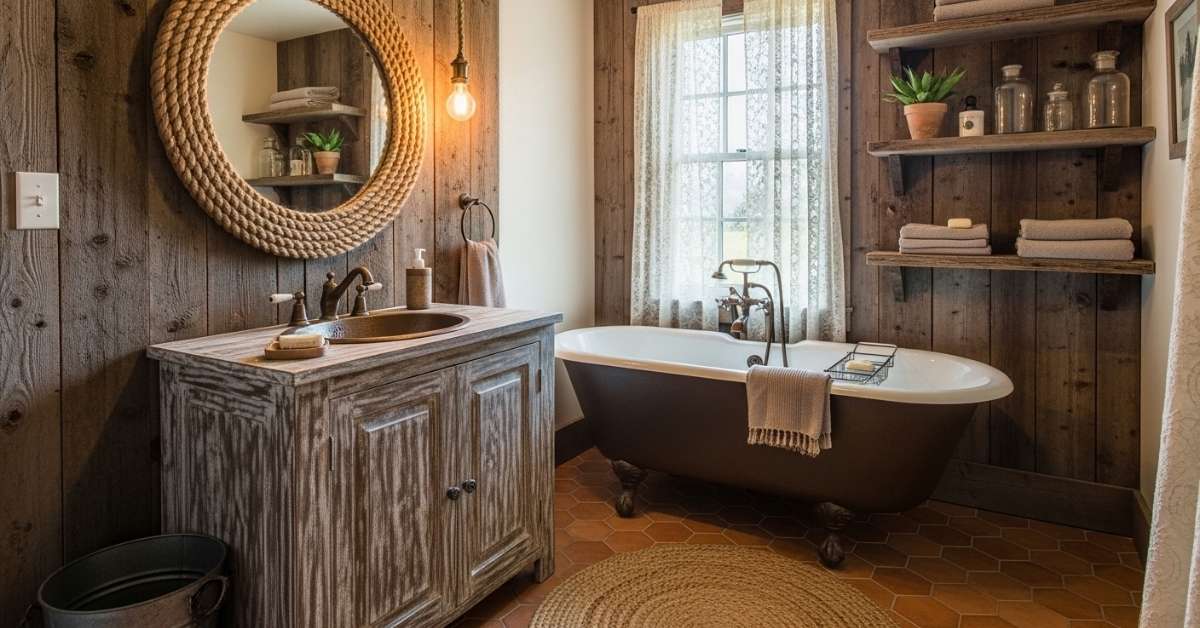
If you’ve been staring at a bathroom that looks fine but doesn’t feel like anything, this is the list for you. These rustic small bathroom ideas are grounded in what actually works: the right lighting, materials that age well, Rustic Small Bathroom Ideas and layouts that don’t fight the room’s natural proportions. Whether you’re renting or renovating, most of these can be adapted to any budget or skill level.
For anyone working with a bathroom under 50 square feet or a rental where you can’t touch the walls there are plenty of options here that rely on accessories, lighting, and surface-level changes rather than construction.
Shiplap Accent Wall Behind the Vanity
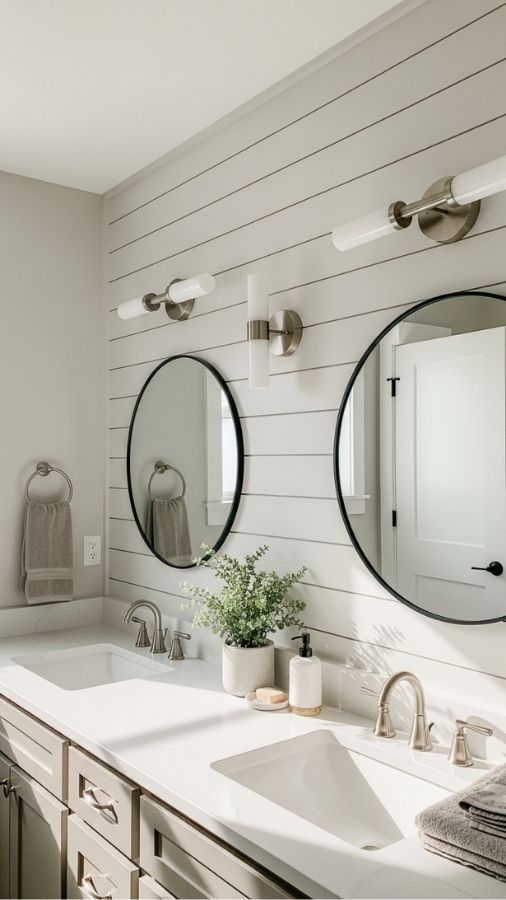
Shiplap tends to get overused in open living rooms, but in a small bathroom it has a very specific and practical effect: it gives the eye something to follow horizontally, which visually widens a narrow space.
Keep it to one wall ideally behind the vanity rather than wrapping the entire room, or you risk the texture feeling heavy. Painted white or left slightly off-white, shiplap reads as clean and bright while still carrying that warmth that plain drywall never delivers. Pair it with matte black fixtures and a vessel sink for contrast without fighting the rustic tone.
This works especially well in bathrooms with low ceilings where adding height isn’t the goal; the horizontal lines balance the proportions instead.
Floating Wood Vanity with Open Storage Below
A floating vanity does two things at once: it makes the floor visible, which expands the sense of space, and if you choose open storage below, it replaces a cabinet that would otherwise eat up visual volume.
In my experience, this setup works best when the open shelf holds something that actually looks like good woven baskets, stacked white towels, or a few small plants. Walnut or reclaimed wood gives the most depth, but even pine with a warm stain reads as intentional rather than cheap.
The key is keeping the area below tidy open storage in a bathroom is a commitment to staying organized. This setup suits apartments and older homes particularly well because the floating design sidesteps the need to match existing cabinetry.
Stone or Pebble Floor Tile for Natural Ground Texture
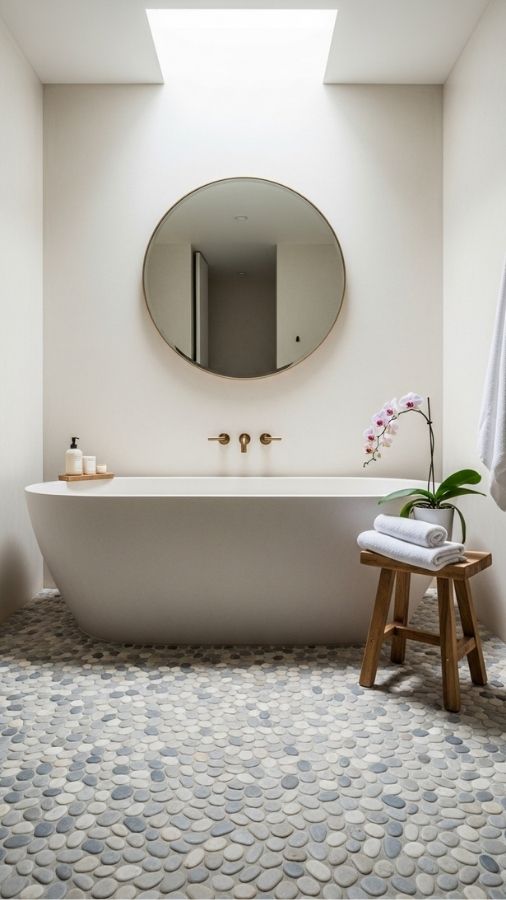
Pebble tile on a bathroom floor is one of those decisions that feels slightly risky and ends up being the most-talked-about detail in the room.
The texture underfoot is genuinely pleasant; it functions like a gentle foot massage and the irregular, natural color variation makes the floor look far more expensive than it usually is.
From a spatial standpoint, pebble tile works because the small scale of each stone creates visual busyness at floor level, which draws attention downward and makes the walls feel taller by contrast.
This is a good option for bathrooms with plain white or neutral walls that need ground-level interest without adding color. It’s worth noting that grout maintenance is higher than with flat tile, so this suits homeowners more than short-term renters.
Antique or Reclaimed Wood Mirror Frame
Swapping a frameless mirror for one with a reclaimed wood frame is the single highest-impact low-effort change you can make in a rustic small bathroom. The frame creates a defined visual focal point, which small rooms desperately need without one, the eye bounces around looking for somewhere to land.
A wider, slightly oversized frame (think 4–6 inches of wood) also makes the mirror feel like a piece of furniture rather than a utility item, which shifts the overall tone of the room. The wood grain adds warmth that you simply can’t get from painted frames or metal.
For renters, this is completely reversible and works in any style of bathroom as long as the wood tone coordinates with at least one other element in the room.
About More About: 52+ Cozy Farmhouse Living Room Rustic Decor Ideas That Actually Work in Real Homes
Exposed Wooden Ceiling Beams for Vertical Drama
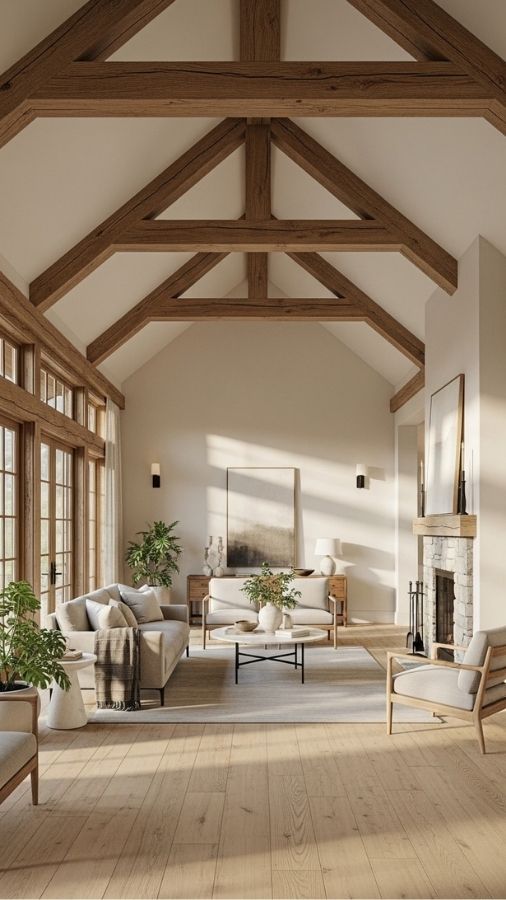
Exposed beams in a small bathroom are counterintuitive you’d think they’d lower the ceiling and make the space feel tighter. But when done right, they actually draw the eye upward, which has the opposite effect.
The trick is proportion: one or two beams, painted or stained dark (walnut, espresso, or weathered gray), against white or cream walls creates contrast that makes the ceiling height feel intentional rather than cramped.
In older homes where structural beams already exist, leaving them exposed rather than drywalling over them is one of the most character-preserving decisions you can make. Pair with a simple white tile or plaster wall to let the beams carry all the visual weight.
Clawfoot Tub as a Statement Centerpiece
A clawfoot tub in a small bathroom sounds illogical until you realize that tight spaces often benefit from one large, high-quality statement piece more than they benefit from multiple mid-level items trying to compete.
The clawfoot tub is self-contained, doesn’t require a surround, doesn’t visually attach to any walls, and its curved form creates movement in a room that might otherwise feel boxy.
Floor space around the tub is still usable for a small stool, bath tray, or plant. The vintage silhouette naturally anchors a rustic palette and pairs well with exposed pipe fixtures in oil-rubbed bronze or unlacquered brass.
This works best when the bathroom is at least 7 feet in the longest dimension; tight 5×7 bathrooms may need a smaller soaking tub instead.
Woven Wicker and Rattan Accessories for Texture Without Weight
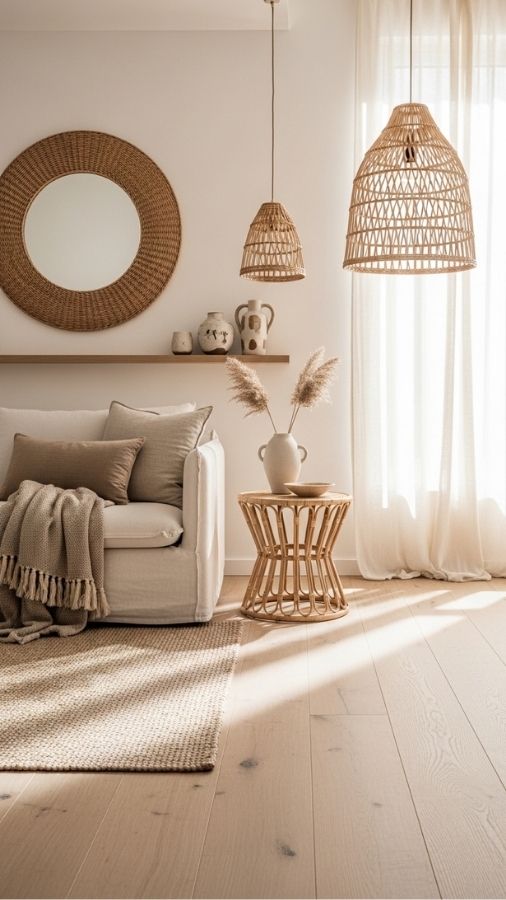
Rattan and wicker accessories are one of the easiest ways to add rustic warmth to a bathroom without committing to any structural changes. The material is light in color (which doesn’t darken the space), light in actual weight (easy to move or replace), and it introduces an organic texture that makes a room feel more lived-in without cluttering it. Use a rattan-framed mirror, wicker baskets on open shelving for toiletry storage, and a woven waste bin for a cohesive but unfussy look.
The visual payoff is much higher than it sounds on paper, natural fiber in a bathroom that otherwise leans white and simple suddenly makes the whole room feel warmer.
This is one I’d recommend trying first if you’re hesitant about committing to rustic design more permanently.
About More About: 53+ Rustic Farmhouse Decor Ideas That Make Any Room Feel Warm, Lived In, and Pulled Together
Board and Batten Wainscoting in a Neutral Tone
Board and batten on the lower half of a bathroom wall is one of the most practical architectural details you can add to a small space. It protects the wall from moisture and splashing (genuinely useful in bathrooms),
Adds visual structure that makes the room feel designed rather than default, and gives you a natural transition point between two wall treatments if you want to use a different color or material on the upper half.
The look reads as both farmhouse-rustic and quietly elevated; it doesn’t feel trendy in a way that dates quickly. Painted in a warm white or soft greige, it adds depth through shadow lines without adding color.
For a renter, removable board and batten panels (attached with command strips or thin adhesive) have become increasingly popular and relatively convincing.
Concrete Sink for Industrial Meets Rustic Look
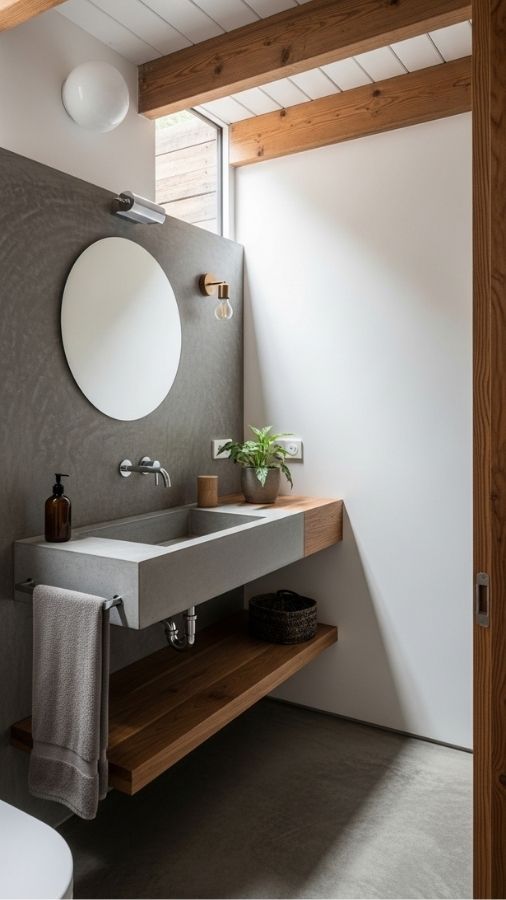
A concrete sink introduces a material that’s genuinely distinct from the typical bathroom palette; it reads as intentional, almost architectural, and it ages beautifully as small marks and patina develop over time. In a small bathroom, a concrete vessel sink on a dark wood base creates significant visual contrast without adding square footage.
The rough texture of concrete against smooth tile or painted walls is the kind of material pairing that makes a room feel designed rather than decorated.
Pair it with exposed pipe fixtures in black or aged iron for a look that’s industrial at its base but warmed up by the wood and any softer textiles nearby.
Sealing properly is critical because unsealed concrete in a wet bathroom environment will stain and degrade.
Warm Edison Bulb Lighting Over the Vanity
Most small bathrooms are lit by a single overhead fixture, which creates one big, flat shadow across the face at the vanity and makes the room feel more clinical than comfortable. Replacing it or supplementing it with exposed Edison bulbs mounted horizontally across the mirror creates warm, diffused light that wraps around rather than pressing down from above.
The amber tone of Edison-style bulbs shifts the entire color temperature of the room in the evening, making white tiles look cream, wood look richer, and the overall atmosphere feel intentional.
From a spatial perspective, horizontal light bars draw the eye sideways, subtly widening the perceived width of the vanity wall. This is one of the more affordable upgrades on this list and one of the highest-visibility ones; it changes the feel of the room every time you use it.
Shaker-Style Vanity Cabinet in a Muted Earth Tone
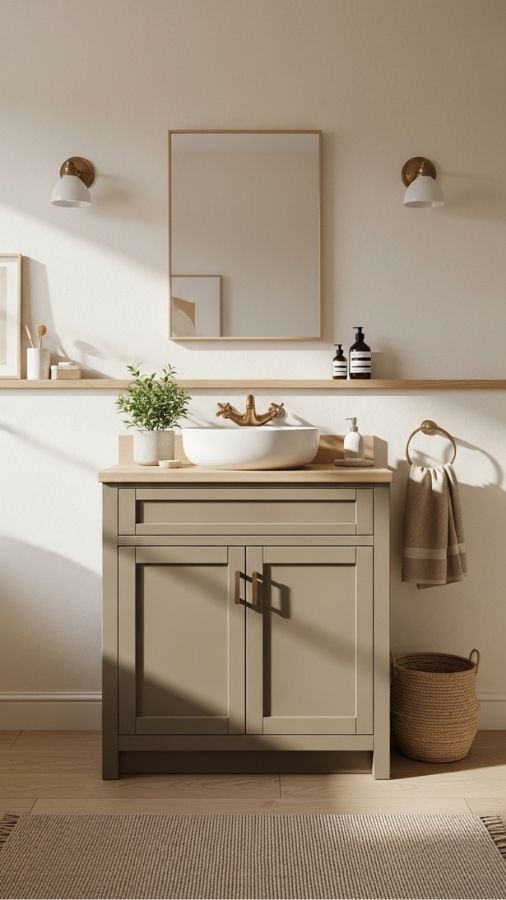
A Shaker-style cabinet in a non-white color is one of the smartest moves in a small rustic bathroom because it adds color and architectural detail simultaneously without overwhelming a tight space.
Earth tones, dusty sage, warm terracotta, olive, deep taupe perform especially well because they’re muted enough to not compete with other materials in the room, but distinct enough to anchor the color palette.
The recessed panel of a Shaker door creates a shadow line that adds visual depth, making the vanity look more substantial than a flat-fronted cabinet of the same size. Pair with aged brass or matte black hardware for a look that sits squarely in the rustic-modern sweet spot.
This style is having a clear moment in 2026 the shift away from all-white kitchens and bathrooms has made earthy cabinet colors feel current rather than retro.
Read More About: 54+ Wall Decor Ideas for Living Room That Actually Work in Real Homes
Galvanized Metal Accents as Rustic Hardware
Galvanized metal the slightly matte, slightly industrial silver finish is one of the more underused finishes in bathroom design.
It reads as rustic and farmhouse-adjacent without veering into overtly country territory, and it pairs naturally with wood, white, and neutral stone. Replace standard chrome hardware (towel bars, toilet paper holders, robe hooks) with galvanized or weathered metal versions, and the shift in tone is immediate.
It works especially well in bathrooms that have some wood tone already. The cool metal creates contrast against warm grain without the coldness that polished chrome can introduce. Renters can swap out hardware and swap it back when leaving without any permanent changes.
Live Edge Wood Floating Shelf Above the Toilet
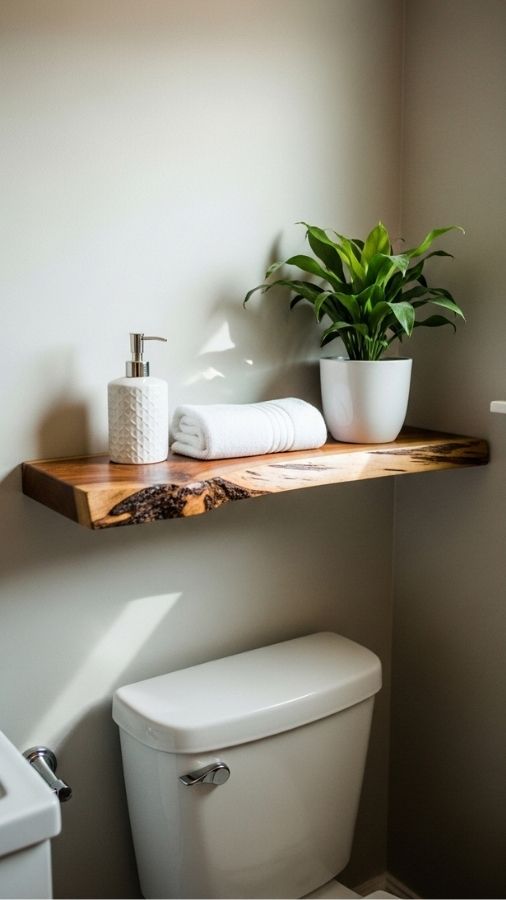
The space above the toilet is one of the most underused vertical zones in a small bathroom, and a live-edge wood shelf is one of the most visually interesting ways to activate it.
Unlike standard box shelving, a live-edge slab has natural curves along the outer edge, the preserved contour of the original tree, which introduces an organic form that no flat surface can replicate.
At 36–40 inches above the tank, a single shelf can hold folded hand towels, small plants, a candle, and a minimal set of toiletries without feeling cluttered. The natural wood grain does the decorative work, so you don’t need to style it heavily. Aesthetically, one well-placed live-edge shelf punches significantly above its size.
Terracotta Floor Tile for Warmth Underfoot
Terracotta tile has moved from niche designer choice to a genuinely mainstream option, and it earns that attention in small bathrooms specifically.
The warm red-orange tone brings heat to a space without relying on paint color, and the slight variation in each tile (a natural result of the clay-firing process) means the floor never looks flat or repetitive
. Hexagonal terracotta tiles create a pattern that feels vintage and intentional, while square terracotta with thin grout lines reads as more modern and streamlined.
Either way, the warmth underfoot changes the feel of the room. Terracotta makes a bathroom feel less like a utility space and more like a room you actually want to spend time in. Seal it annually to prevent staining from water and soap.
Linen and Cotton Textiles to Soften Hard Surfaces
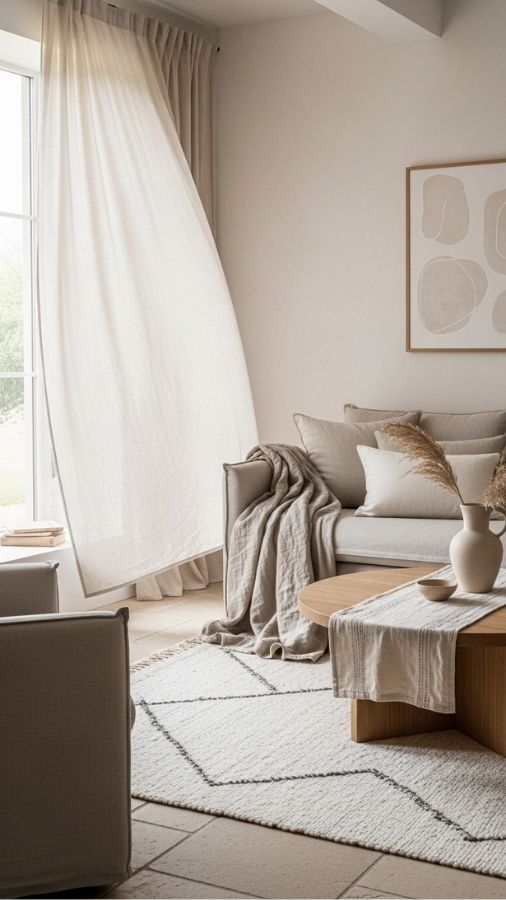
In a bathroom that has tile, stone, and wood all hard, reflective, or cool surfaces linen and cotton textiles are the corrective layer. A linen shower curtain diffuses light in a way that a vinyl or polyester curtain never does, adding softness and a slight warmth to the entire space.
Waffle-weave cotton bath mats, unbleached cotton towels, and a simple linen window panel don’t sound like design choices, but they collectively shift the atmosphere of a small bathroom from functional to considered. The rule of thumb: the more hard material you have in a small bathroom, the more intentional your textile choices need to be. Natural fibers in undyed or neutral tones always work; they don’t date, they don’t compete, and they wear well.
Beadboard Paneling as a Budget-Friendly Wall Treatment
Beadboard is one of the most cost-effective ways to add architectural character to a plain bathroom wall.
The vertical groove pattern creates a subtle texture that reads as cottage-rustic without being heavy, and painted white or cream it actually makes the room feel lighter by bouncing light off the ridges.
Applied to the lower half of the wall, it functions as visual wainscoting that grounds the room the eye reads the lower portion as finished and intentional, which makes the upper portion (often just paint) feel purposeful rather than incomplete.
Pre-finished MDF beadboard panels are widely available and can be installed with construction adhesive and finishing nails, making it a viable weekend project for confident DIYers.
Vintage or Antique Fixtures for Aged Charm
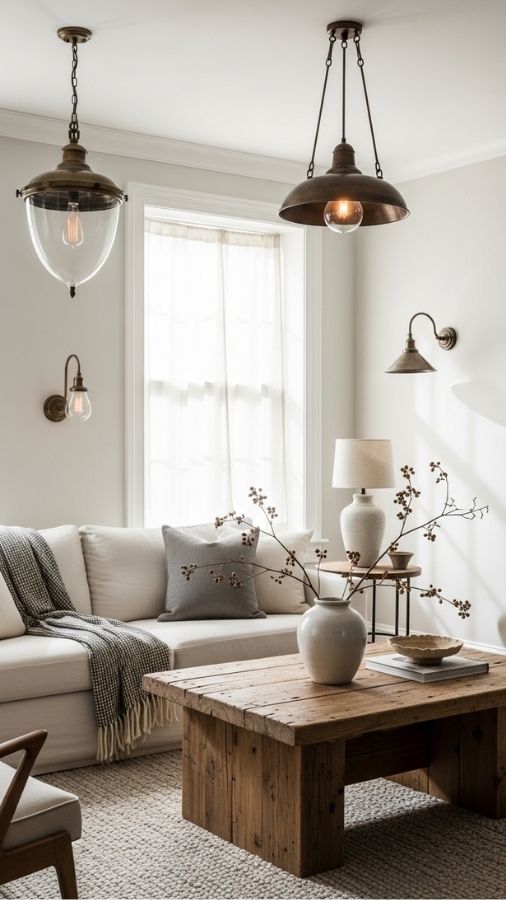
Genuinely vintage fixtures or convincing replicas do something that new fixtures rarely manage: they suggest that a room has a history. In a small bathroom, where you’re typically choosing between a handful of finishes and a handful of forms, introducing one fixture with real age (or the aesthetic of age) shifts the entire room’s tone.
Aged brass and unlacquered brass in particular are having a sustained moment because they patina naturally over time, which means the finish actually improves with use rather than looking worn.
A bridge-style faucet on a pedestal sink, or a cross-handle valve set in a shower, reads as both antique and high-end. These details are especially impactful in older homes where the bathroom’s bones already suggest a certain era.
Matte Black Fixtures as Modern Rustic Contrast
Matte black is a finish that bridges rustic and industrial without fully committing to either, which makes it particularly versatile in a small bathroom where you want warmth from wood and natural materials but don’t want the space to feel too country-traditional.
Against white shiplap or white subway tile, matte black fixtures create sharp, clean contrast that reads as intentional and slightly elevated.
In a small space, this contrast is useful because it gives the eye a clear hierarchy; the fixtures are the punctuation marks of the room. This works best when the black appears in more than one place (faucet, towel bar, light fixture, mirror frame) so it reads as a design choice rather than an oversight.
Exposed Pipe Shelving for Industrial Rustic Storage
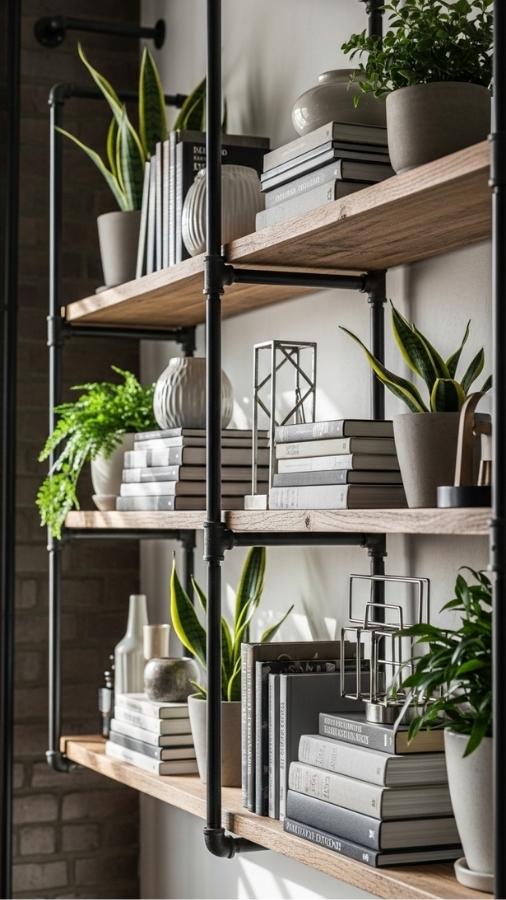
Pipe shelving iron pipe fittings with reclaimed wood planks serves a genuinely functional purpose in a small bathroom that lacks built-in storage, and it does it without taking up floor space.
Wall-mounted between the vanity and the ceiling, or bracketed along an empty wall, a single run of pipe shelving can hold towels, jars, small plants, and a reasonable number of toiletries in a way that looks organized rather than cluttered.
The raw industrial contrast of iron pipe against wood and white walls is a core part of the rustic-industrial aesthetic that has proven to have real staying power. The material cost is low, the installation is straightforward, and the visual payoff is high especially in bathrooms where plain walls make the room feel unfinished.
Natural Stone Tile Accent Shower Wall
One natural stone wall inside the shower slate, travertine, or rough-cut limestone introduces a material weight and texture that transforms the shower from a functional box into a space with genuine character.
The key in a small bathroom is keeping it to one wall (usually the back of the shower, opposite the door) and keeping the remaining walls simple plain white tile or subway tile. This contrast is what makes the stone wall feel intentional rather than overwhelming.
Stone also interacts with light differently than glazed tile it absorbs rather than reflects, which creates a softer, warmer visual environment inside the shower itself. Pair with a frameless glass door (no track) to keep the lines clean and the space visually open.
Potted Plants and Greenery for Organic Life
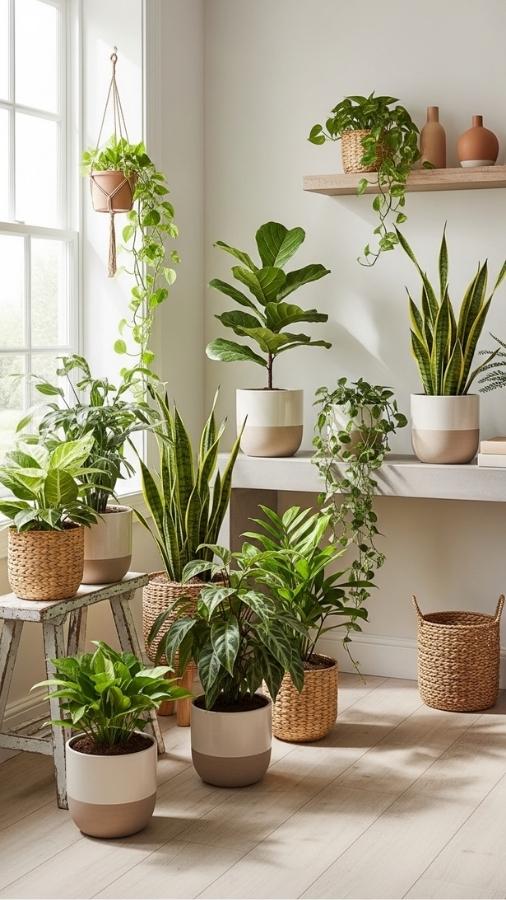
Plants in a bathroom are one of those ideas that sounds obvious but gets underexecuted most of the time. In a small rustic bathroom, the right plant in the right spot adds organic life and color that no textile or accessory can replicate.
Eucalyptus hung from the shower rod fills the room with fragrance and visual interest every time you run hot water.
A snake plant or ZZ plant on a shelf handles low-light and humidity without requiring much attention. Small trailing pothos on a high shelf adds downward movement. The point isn’t to create a jungle, it’s to add one or two living elements that remind you the room is part of a living space, not a staging area. Terracotta pots tie the plant containers back into the rustic palette without any effort.
Barn Door Bathroom Entry for Space and Style
A barn door solves one of the most specific small-bathroom problems: the door swing. In a bathroom where the door arc overlaps with the vanity, toilet, or any usable floor space, a traditional swing door actively reduces usable square footage every time it opens.
A sliding barn door on an exterior-mounted track removes that swing radius entirely, freeing up the floor area directly inside the entrance. Visually, the door becomes a feature wall in the hallway or bedroom; it opens onto a wide plank-style sliding door in reclaimed or rustic wood that immediately signals design intent.
Honestly, this is one of those changes that is as functional as it is aesthetic, which is rare in bathroom upgrades.
Hex Tile Floor in a Neutral Earth Tone
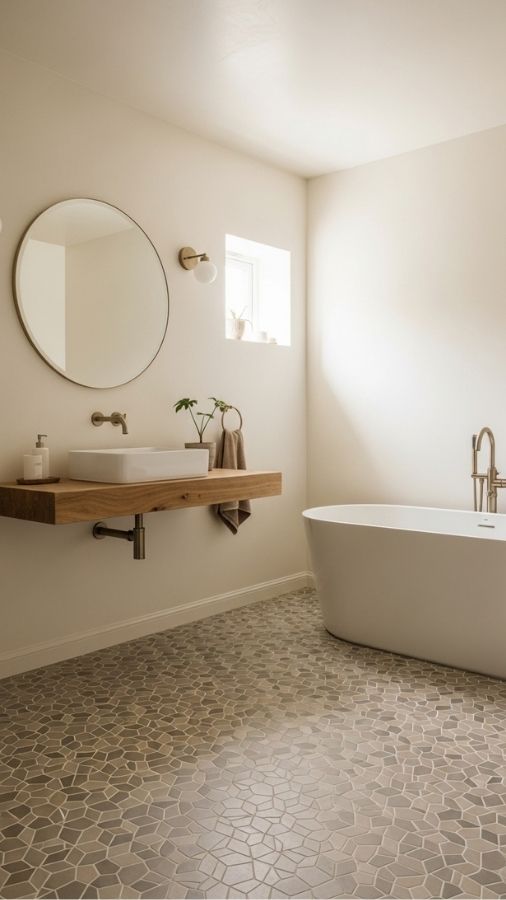
Hexagonal tile at the floor level creates pattern and movement without adding visual noise the way a busy print would. In earth tones warm gray, dusty beige, soft sage, off-white a hex floor reads as both classic and current.
The geometric pattern draws attention to the floor in a way that simple square tile doesn’t, which in a small bathroom is useful because it pulls the eye downward and creates the perception of more depth underfoot.
From a practical standpoint, small-format tile (hex is typically 2–4 inches) means more grout lines, which give traction genuinely safer on a wet bathroom floor. The neutral color family means hex tile in these tones coordinates with almost any other material in the room.
Vessel Sink with a Rough Cut Marble or Stone Look
A vessel sink one that sits on top of the vanity rather than being recessed into it immediately elevates the visual interest of a bathroom counter.
When the vessel is made from or designed to look like travertine, raw marble, or rough-cut stone, it becomes the most architecturally interesting element in a small room.
Practically, it means the vanity top itself doesn’t need to be anything remarkable; a simple dark wood slab or even a painted MDF surface is enough when the sink is doing the heavy lifting. The height of a vessel sink also naturally elevates the counter-to-faucet proportion, which reads as slightly more elegant than the flat recessed sink standard.
Pair with a tall wall-mounted faucet to maintain proportion and avoid a cramped-looking countertop.
Dark Grout with White Tile for a Vintage Map Effect
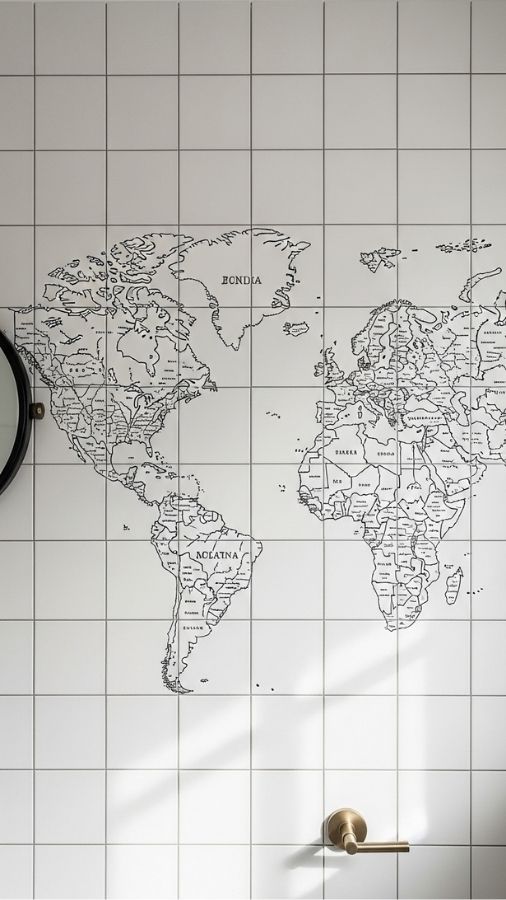
Standard white tile with white grout is clean and safe, but it’s also the single most forgettable choice in a small bathroom. The same white tile with charcoal or dark gray grout becomes a completely different design decision.
The contrast creates a visible grid pattern across the wall or floor that reads as slightly vintage, slightly graphic, and deeply intentional. In a rustic small bathroom, dark grout works especially well because it connects the tile to the darker tones of wood, aged metal, and natural stone elsewhere in the room.
There’s also a practical benefit: dark grout hides daily grime far better than white grout, which requires regular scrubbing to avoid a dingy appearance.
Pendant Light Instead of Overhead Fixture
Swapping the standard overhead light for a single pendant (or two pendants flanking a mirror) changes both the direction and quality of light in a small bathroom. An overhead fixture pushes light down from directly above, which creates strong top shadows and makes the room feel more like a utility space.
A pendant hung at eye level (or slightly above) creates a different glow that wraps around the space rather than pressing into it. Rattan-shaded pendants in particular diffuse the bulb completely, creating a warm, dappled light that plays well with wood and stone.
In a small bathroom, the pendant itself becomes a decorative element that fills visual space without taking up floor space, a rare thing in a tight room.
Stacked Towel Ladder for Functional Wall Décor
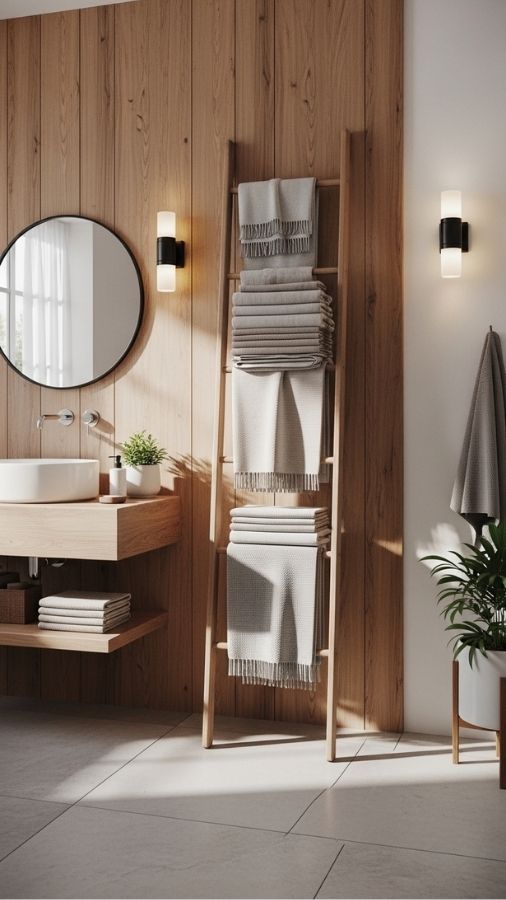
A leaning towel ladder, a simple reclaimed wood or bamboo ladder propped against the wall is one of those solutions that looks like decor but functions as full towel storage.
In a small bathroom where wall space is limited, it uses vertical floor space instead, keeping towels accessible without requiring any mounting hardware.
Visually, the diagonal lean of the ladder breaks the rigid horizontal-vertical grid of most bathroom elements, adding movement to the composition. Folded towels in a single neutral color stacked on the rungs look organized and considered.
The entire piece can be moved, replaced, or switched out without leaving a mark which makes it ideal for renters or anyone who likes to refresh the room without committing to a change.
What Actually Makes These Rustic Small Bathroom Ideas Work
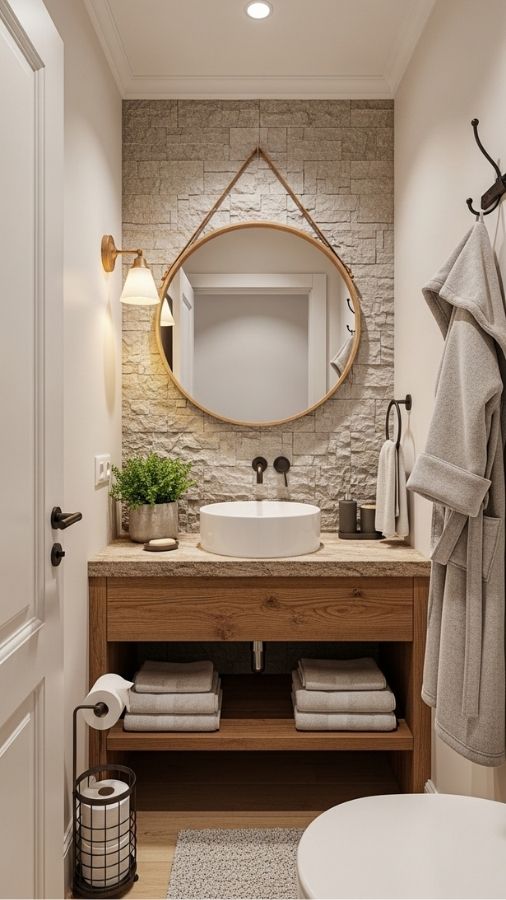
Rustic design succeeds in small bathrooms specifically because of how its core materials wood, stone, natural fiber, aged metal interact with light. Unlike polished finishes that either reflect harshly or disappear into the wall, textured and matte surfaces catch and hold light in a way that adds visual depth without taking up space. The room looks more dimensional than it actually is, which is exactly the effect you want in a small space.
The other factor is material layering. A rustic bathroom that works typically has three to four material families in play: something structural (tile or plaster walls), something warm and organic (wood vanity, shelf, or floor), something with fine texture (linen, wicker, or stone), and something with age or patina (fixture finish, frame, or hardware). When those four layers are present, the room feels complete even if it’s just 45 square feet. When one layer is missing, usually the texture or the patina, the room feels like it needs something, even if you can’t name what.
Lighting is the multiplier. Natural or warm artificial light makes every rustic material more effective. Cool white light flattens wood grain, makes stone look gray, and strips linen of its warmth. If you change nothing else in a small rustic bathroom, changing the bulb temperature to 2700K–3000K will make every material in the room look better immediately.
Rustic Small Bathroom Setup Guide by Space Type
| Idea | Space Type | Core Benefit | Problem It Solves | Difficulty |
| Shiplap accent wall | Any | Adds warmth + visual width | Plain, cold-feeling walls | Medium |
| Floating wood vanity | Compact / square | Opens floor space | Heavy, enclosed look | Medium–High |
| Pebble tile floor | Any | Texture without color | Boring or flat flooring | High |
| Wood-framed mirror | Any | Focal point + warmth | Unanchored vanity area | Low |
| Board and batten | Rental-friendly | Architectural character | Blank, featureless walls | Low–Medium |
| Live-edge shelf above toilet | Very small | Vertical storage | Dead wall space | Low |
| Edison bulb vanity light | Any | Warm, diffused light | Harsh overhead lighting | Low |
| Barn door entry | Space-limited | Eliminates door swing radius | Swing door eating floor space | Medium |
| Exposed pipe shelving | No built-ins | Wall-mounted storage | Clutter, no storage options | Low–Medium |
| Clawfoot tub | 7ft+ minimum | Statement piece | Generic, unmemorable space | High |
Common Rustic Small Bathroom Mistakes That Make the Space Feel Smaller
Overdoing the dark wood.
Wood in a small bathroom should ground the space, not dominate it. When every surface floor, vanity, shelves, mirror frame, ceiling is the same warm brown tone, the room feels enclosed rather than cozy. Balance darker wood with white or light-toned walls and at least some reflective surface (a mirror, light-colored tile) to keep the room from absorbing all available light.
Ignoring scale.
Rustic design often features large-scale elements, wide plank flooring, oversized beams, thick stone and in a small bathroom, scale mismatches are immediately obvious. A vanity that’s too large for the room doesn’t read as statement-making; it reads as a planning error. Scale everything to leave at least 24 inches of walkable space at the widest point.
Using too many competing textures at once.
Shiplap, stone tile, rattan, woven baskets, rough linen, pebble floor each one individually adds warmth and character. All of them together in a 40 square foot bathroom creates visual chaos that makes the room feel busy and small. Pick two or three textures to anchor the design and let the others support.
Choosing the wrong grout color.
Light grout on a rustic tile floor or wall will look dingy within weeks in a heavily used bathroom. Dark grout not only fits the aesthetic better, it practically maintains better and avoids the ongoing effort of bleaching and scrubbing to maintain an appearance of cleanliness.
Neglecting ventilation when adding wood and natural materials.
Wood warps, rattan molds, and natural fiber degrades in a chronically humid bathroom without proper ventilation. If you’re investing in quality materials, make sure the exhaust fan is functioning properly ideally rated for the square footage of the bathroom plus a margin. A rustic bathroom that smells damp or shows mold on the ceiling undermines everything you’ve worked to build.
FAQ’s
What makes a small bathroom feel rustic without making it feel cramped?
The key is using rustic elements that add visual warmth without adding visual weight. Stick to one accent wall rather than covering every surface, use natural materials in light or medium tones (warm white, natural oak, cream stone), and keep fixtures and accessories minimal. The goal is layered texture, not layered stuff.
Which rustic materials work best in a humid bathroom environment?
Sealed wood (not raw or unsealed), natural stone tile, glazed ceramic, rattan and wicker used in ventilated areas, and galvanized or powder-coated metal all hold up well in typical bathroom humidity. Avoid unsealed terracotta, unpainted MDF in splash zones, and untreated wood near the shower or tub.
How do I add rustic warmth to a rental bathroom without permanent changes?
Focus on swappable elements: a wood-framed mirror, a leaning towel ladder, wicker baskets, linen textiles, Edison-bulb lighting on a plug-in cord, and removable peel-and-stick tile for the floor or a small accent area. Hardware swaps (faucet, towel bar) are reversible if you keep the originals and reinstall when leaving.
Is rustic design practical in a bathroom under 35 square feet?
Yes, but it requires restraint. In a very small bathroom, choose two or three rustic elements rather than a full room treatment. A wood-framed mirror, one shelf in natural wood, and warm-toned textiles are enough to shift the feel of the space without crowding it visually.
Barn door vs. traditional swing door in a small bathroom: which is better?
A barn door is better specifically when the swing radius of a traditional door conflicts with the vanity, toilet, or usable floor space. If your bathroom layout has a clear arc for the door that doesn’t impede movement, a traditional door is simpler and less expensive. The barn door earns its place when it solves a functional layout problem, not just as a style choice.
What lighting temperature is best for a rustic bathroom?
Aim for 2700K to 3000K (labeled “warm white” on most bulb packaging). This temperature range brings out the warmth in wood grain, stone, and natural fiber, making every rustic material look its best. Cooler temperatures (4000K+) work against the aesthetic by making warm tones look flat or grayish.
Can rustic design work with modern or minimal fixtures?
It works well. In 2026, the dominant direction in rustic bathroom design is pairing raw, natural materials with clean-lined modern fixtures matte black, aged brass, or unlacquered metal in simple forms. The contrast between organic texture and geometric simplicity is more interesting than either aesthetic alone, and it prevents the room from feeling like a period reconstruction.
Conclusion
A small bathroom doesn’t need more space to feel better, it needs more intention. The rustic ideas in this list are built around materials, light, and layering rather than renovation budgets or square footage, which means most of them are accessible regardless of what you’re working with. Even small changes such as a warm-toned bulb swap, a live-edge shelf above the toilet, a linen shower curtain in place of a vinyl one, shift the atmosphere of the room in a way that’s immediately noticeable.
Start with one or two ideas that match your current bathroom’s bones and your comfort level with change. If the room has a plain wall that needs something, try the reclaimed wood mirror or a run of board and batten. If the floor is the problem, look at terracotta hex tile or a pebble option. The key is finding what works for your specific space rather than chasing a complete aesthetic from the start. Small, considered changes almost always outperform a rushed total overhaul.