40+Home Decor Ideas for Your Living Room That Actually Work in Real Homes
If your living room looks fine on paper but still feels off when you walk in, you’re not alone. Most spaces don’t fail because of bad furniture, they fail because of layout decisions that quietly fight against the room’s natural flow. A sofa pushed too close to the TV, overhead lighting that flattens everything, shelves that hold too much or too little. These small misalignments add up.
This list is built around real living rooms, apartments, rentals ,Home Decor Ideas Living Room
compact spaces, and open-plan layouts that need to do more than just look good in photos. Whether you’re starting from scratch or tweaking what you already have, these home decor ideas for your living room are grounded in how people actually use the space day to day.
If your style leans neutral, minimal, or somewhere in between, you’ll find setups here that are easy to implement without a full renovation or a major budget.
Anchor the Room With a Rug That’s Actually Big Enough
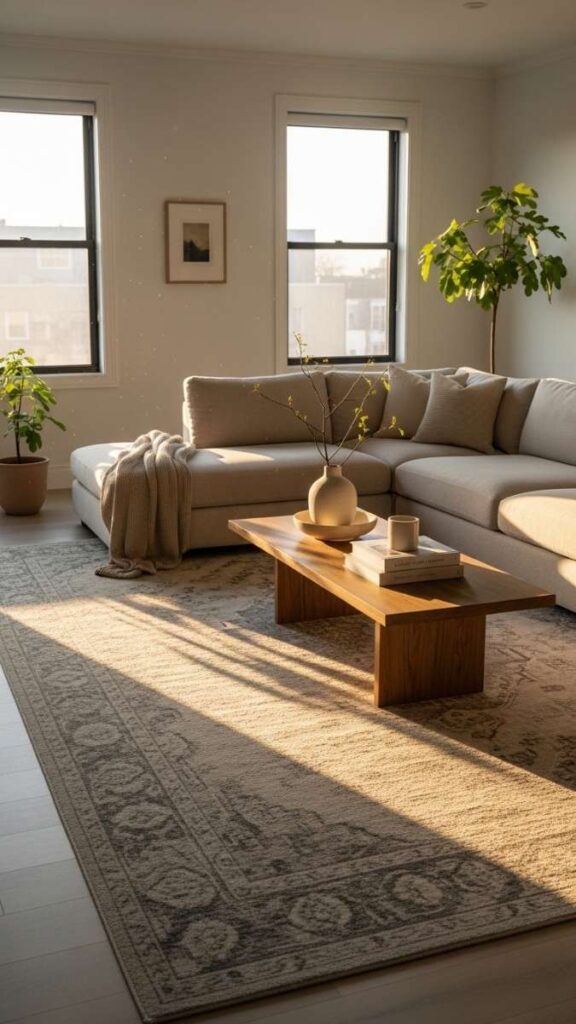
The single most common layout mistake in living rooms is a rug that’s too small. When a rug doesn’t reach the front legs of the sofa and chairs, it floats in the middle of the room and visually fragments the space. A correctly sized rug, one where all major seating pieces have at least their front legs resting on it, pulls the seating group together into one intentional zone.
This works especially well in open-plan spaces where the living area needs to feel defined without walls doing the work. In smaller rooms, a larger rug (counterintuitively) makes the space read as bigger because it establishes clear boundaries. Go for low-pile natural fibers like jute or wool if you want texture without visual weight.
Float Your Sofa Away From the Wall
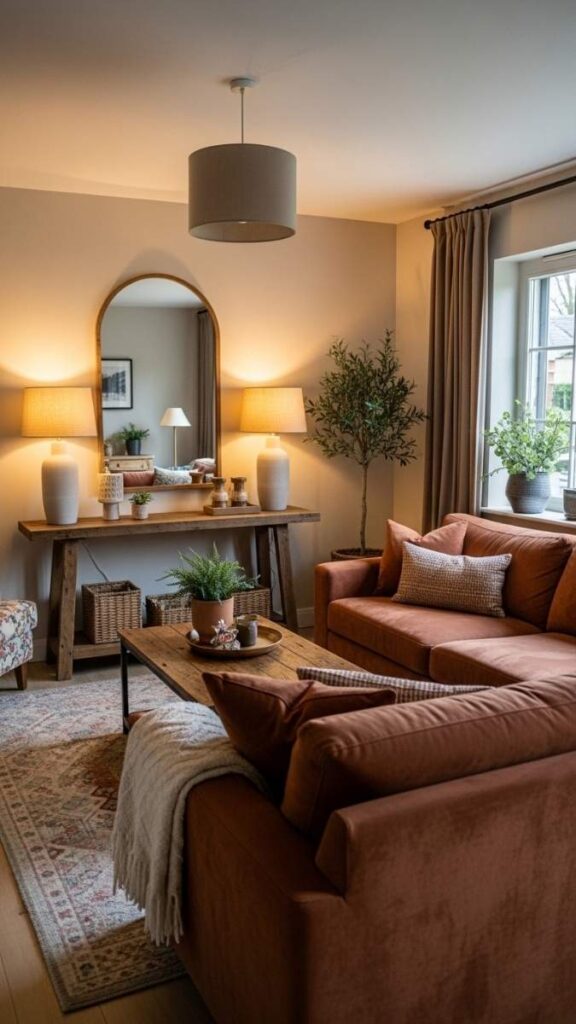
Pushing every piece of furniture against the wall is a reflex, not a design strategy. Floating the sofa even 10 to 12 inches away creates breathing room and makes the layout feel intentional rather than cautious. It also opens up the option of placing a slim console table behind the sofa, which adds a surface for lamps, books, or decor without requiring extra floor space.
This setup works best in rooms that are at least 12 feet wide, where pulling the sofa forward doesn’t block movement paths. In tighter rooms, even a few inches of clearance from the wall makes a noticeable difference in how the space reads. The room stops feeling like a waiting area and starts feeling like a place people actually settle into.
Use a Floor Lamp to Break Up a Dark Corner
Overhead lighting does a poor job of making a living room feel warm; it flattens the room and casts unflattering shadows. A single arc floor lamp placed behind or beside an armchair creates a reading zone and adds vertical interest to a corner that would otherwise be dead space.
This is one of the easiest fixes in any living room, and one I’d actually recommend trying first before investing in anything else.
The warm pool of light from a floor lamp changes the entire mood of the room in the evening without touching the ceiling or the walls. Works especially well in rentals where permanent lighting changes aren’t an option.
Layer Lighting With Three Sources at Different Heights
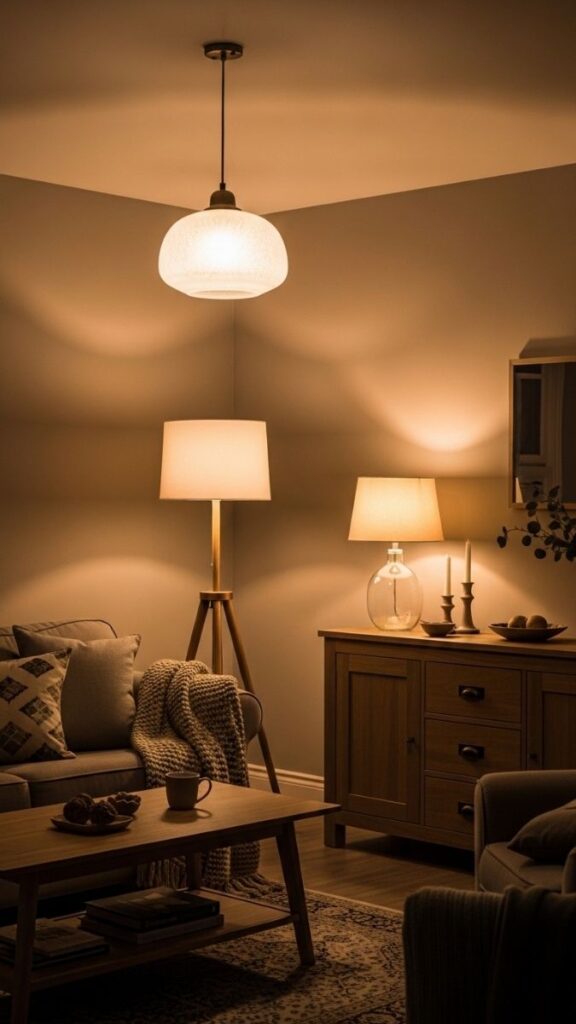
A living room lit by a single overhead fixture feels institutional regardless of how nice the furniture is. The fix is layering one overhead source for general light, one mid-height source like a table lamp on a sideboard or console, and one low source like a floor lamp near seating. Three points of light at different heights create depth and make the room feel finished.
In 2026, warm-toned LED bulbs (2700K–3000K) have made this easier and more energy-efficient than ever. The goal isn’t to flood the room with light, it’s to eliminate the flat, shadowless effect of single-source lighting and give the room dimension. This approach works in any size room and requires zero structural changes.
Read More About: 39+Modern Luxury Kitchen Design Ideas 2026 That Make Everyday Cooking Feel Different
Place the Coffee Table Closer to the Sofa Than You Think
Most people place the coffee table too far from the sofa usually because it looks balanced from across the room. But a table that requires leaning forward uncomfortably to reach is a functional failure. The ideal distance is 14 to 18 inches from the front of the sofa, close enough to use without effort, far enough to walk around.
A coffee table that’s too far away also makes the seating group feel disconnected and the center of the room feel empty. Pulling it closer tightens the arrangement and makes the space feel more like a room people use rather than one they photograph.
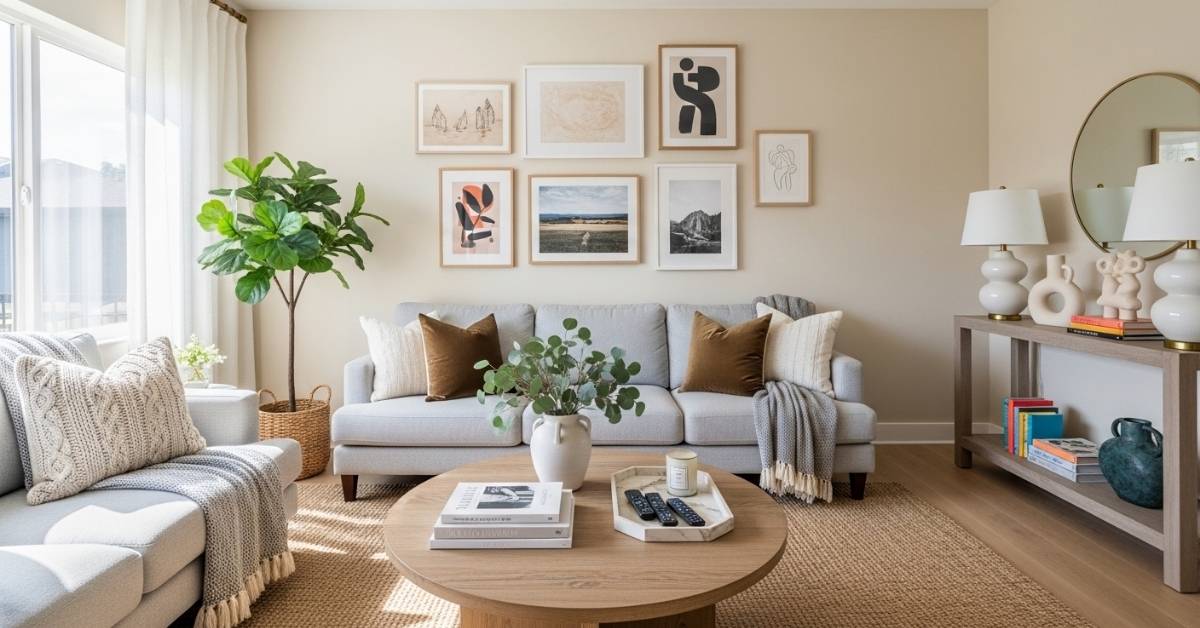
Add a Gallery Wall Home Decor Ideas Living Room
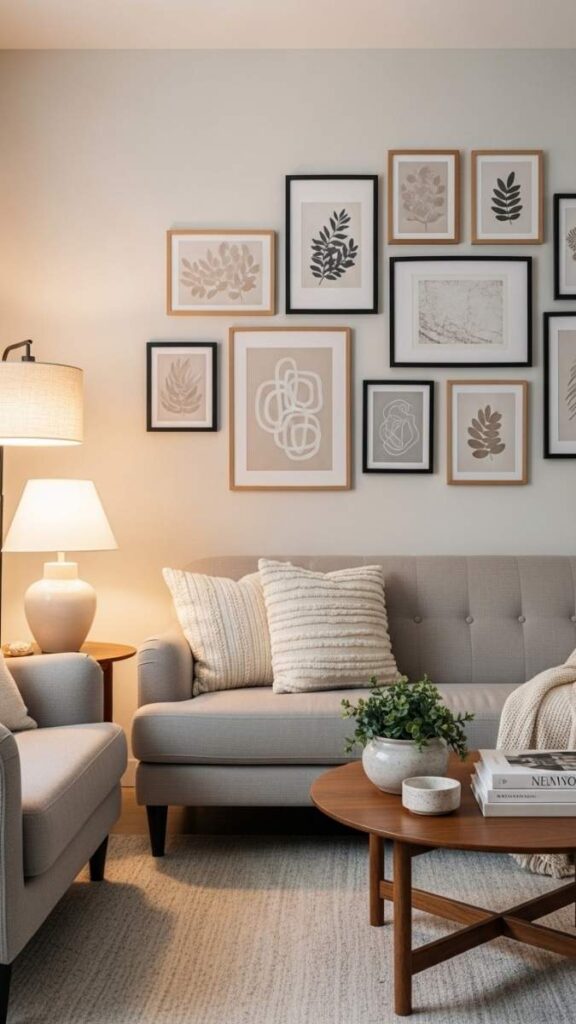
A sofa wall with nothing above it creates visual imbalance: the lower half of the room feels heavy while the upper half disappears. A gallery wall doesn’t need to be large or elaborate to solve this.
A cluster of five to seven frames in two coordinating finishes (black and natural wood, for example) at eye level above the sofa creates a visual anchor that balances the room vertically.
The key is to keep the bottom of the arrangement about 6 to 8 inches above the sofa back, not higher. Hanging art too high is one of the most common decor mistakes and makes ceilings feel lower, not higher.
This setup works on any wall, in any size room, and is renter-friendly with proper hooks.
Bring in a Second Seating Option Beyond the Main Sofa
A living room built around a single large sofa often feels like a showroom. There’s technically enough seating, but no real sense of conversation or flow. Adding a second seating option across from the sofa two accent chairs, a loveseat, or even a bench creates a proper conversation layout and gives the room a sense of balance.
This matters most in larger rooms where a single sofa gets swallowed by the space. Two chairs opposite the sofa also allow for better traffic flow and make the room usable for more than one purpose.
If budget is a constraint, a pair of simple chairs in a solid fabric does the job without competing with the rest of the room.
Use Open Shelving to Add Storage Without Blocking Light
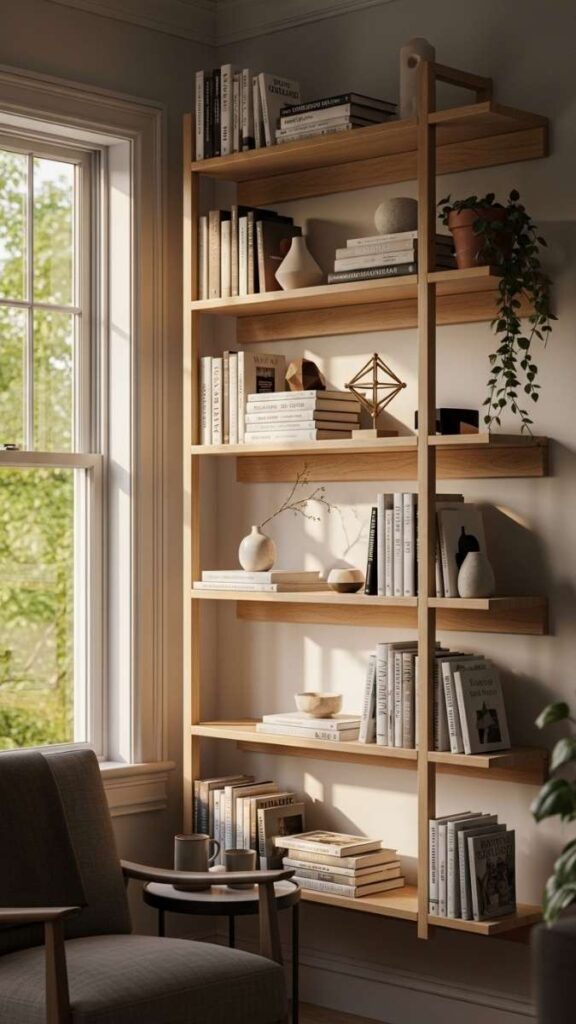
Closed storage units tend to be bulky and can make a room feel smaller than it is. Wall-mounted open shelving installed beside or flanking a window adds storage and display space while keeping the floor clear and the room visually open.
Arranged in clusters of three (one tall object, one horizontal, one small) rather than filled end to end, shelves read as curated rather than cluttered.
This works well in apartments or small living rooms where floor space is genuinely limited. The vertical lines of the shelves also draw the eye upward, which makes low ceilings feel less oppressive. Avoiding negative space on a shelf is a design element, not wasted space.
Introduce Texture Through Cushions and Throws, Not More Furniture
When a living room feels flat despite having good furniture, the issue is usually a lack of material contrast. Smooth walls, a plain sofa, and a single-material rug read as visually quiet in a way that feels unfinished. Adding cushions in different textures linen, boucle, cotton and a throw in a contrasting weight introduces visual interest without adding bulk or changing the layout.
The rule of thumb varies texture before varying color. A room in all-neutral tones can feel rich and layered if the materials are different enough from each other.
This is one of the most budget-conscious ways to update a living room and one of the fastest to reverse if your preferences change.
Place a Mirror Strategically to Reflect Natural Light
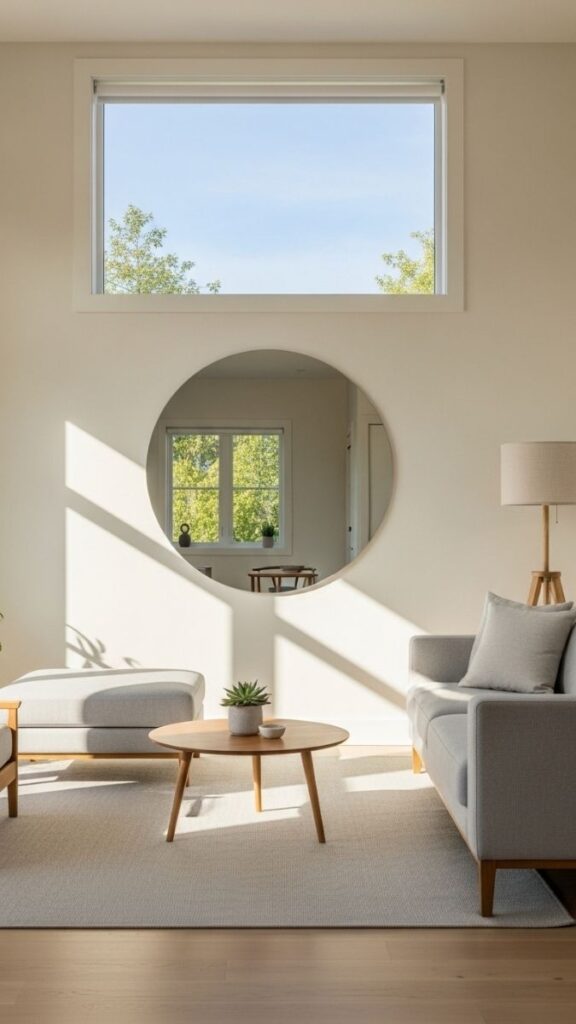
A mirror placed directly across from a window reflects daylight into the parts of a room that don’t receive it directly. In north-facing rooms or layouts where the main window sits to one side, this makes a genuine difference in how bright and open the space feels throughout the day.
The frame matters as much as the position a large round mirror in a simple metal or wood frame reads as a decor element rather than just a functional object.
Lean a large mirror against the wall instead of hanging it if you want flexibility without putting holes in walls. In my experience, this works best in rooms where natural light enters from a single source rather than multiple windows.
Create a Reading Nook in an Underused Corner
Corners in living rooms are consistently underused; they either collect clutter or simply sit empty. A single armchair, a floor lamp angled over the shoulder, and a small side table or wall-mounted shelf is enough to define a reading corner without requiring much floor space.
This setup carves out a sense of purpose in a part of the room that would otherwise feel forgotten.
It also improves the room’s layout by distributing visual weight more evenly instead of all the furniture clustering toward the center, one seating element occupies the periphery and the room feels more balanced. Works especially well in square rooms where the center tends to dominate.
Read More About: 38+Living Room Luxury Decor Ideas That Feel High-End Without the Designer Price Tag
Choose a Sofa Color That Works With Your Existing Light Conditions
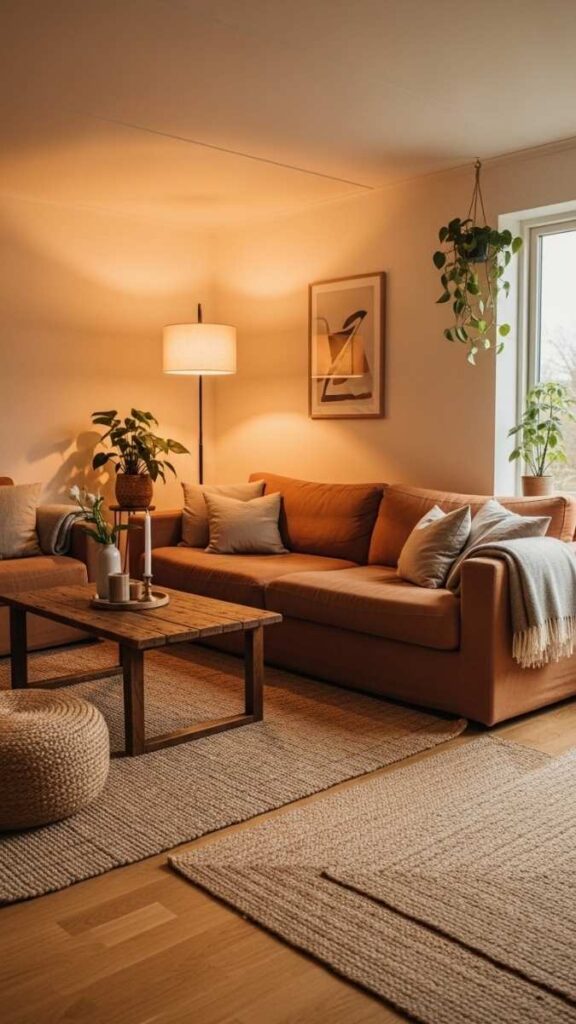
Sofa color isn’t just an aesthetic decision, it’s directly tied to how the room behaves under its specific light conditions. A cool gray sofa in a north-facing room with limited natural light will read as dull and cold for most of the day.
A warm sand, terracotta, or warm white in the same room holds its tone much better under artificial light.
This is a decision most people make from a swatch under store lighting that looks nothing like their home. Before committing to a sofa color, test a large sample or bring in cushions in that tone and observe them at different times of day.
Warm neutrals are forgiving across a wide range of light conditions, which makes them the safer choice for most rooms.
Use a Bookcase as a Room Divider in Open-Plan Spaces
Open-plan living rooms often struggle with a lack of definition; the space flows into the dining or kitchen area without a clear sense of where one zone ends and another begins.
A tall bookcase positioned perpendicular to the wall (rather than against it) creates a soft visual boundary without blocking light or closing off the space completely.
This approach works because it defines the living area without adding walls, which matters enormously in smaller apartments where every square foot counts. Style the shelves on both sides to make the piece feel intentional from any angle. This is also a renter-friendly solution since it requires no structural changes.
Add a Console Table Behind the Sofa for Extra Surface Space
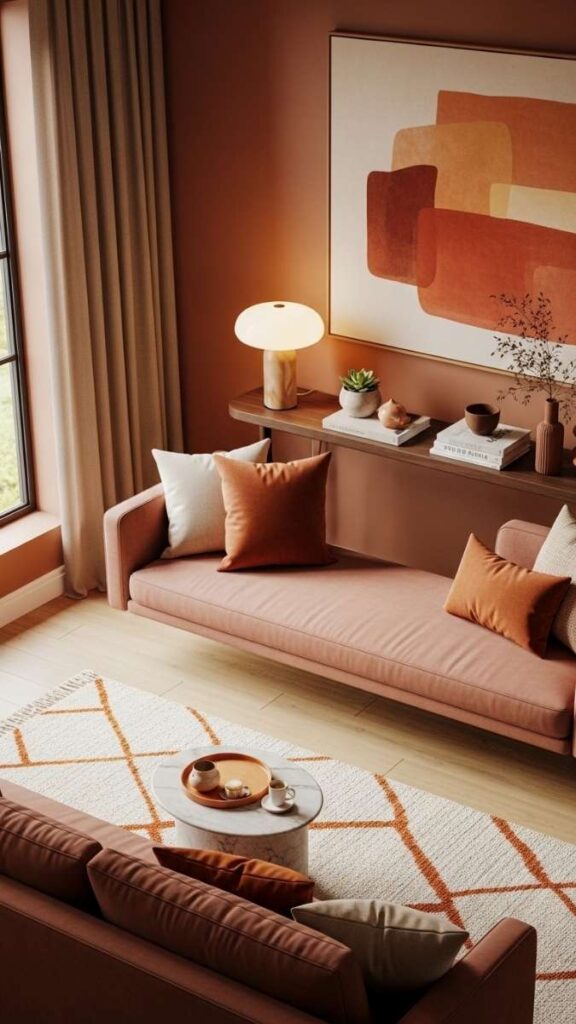
If your sofa is floating in the room (or even close to the center), the space behind it becomes a design opportunity rather than a dead zone. A slim console table around 10 to 12 inches deep fits neatly behind most sofas without adding much footprint. It provides a surface for a lamp, a plant, books, or small decor that the sofa itself doesn’t offer.
This setup does double duty: it fills the visual gap between the sofa back and the wall and adds functional surface space in a room that often lacks it.
Avoid consoles with closed cabinetry here unless the room is large enough to absorb the visual weight. Keep the styling light to two or three objects at most.
Hang Curtains Higher and Wider Than the Window Frame
Curtains hung directly at the window frame or worse, just below it make ceilings feel lower and windows feel smaller. Hanging curtain rods 4 to 6 inches above the frame (or near the ceiling) and extending the rod 6 to 12 inches past each side of the window creates the impression of a much larger window and a taller room.
This is a well-established layout trick that costs almost nothing extra if you’re already buying curtains; the panels just need to be longer
Floor-length curtains in a lightweight linen or cotton let in diffused light when closed and frame the window beautifully when open. It’s one of the most effective changes you can make to a living room wall without touching the wall itself.
Keep One Focal Point Per Wall, Not Multiple
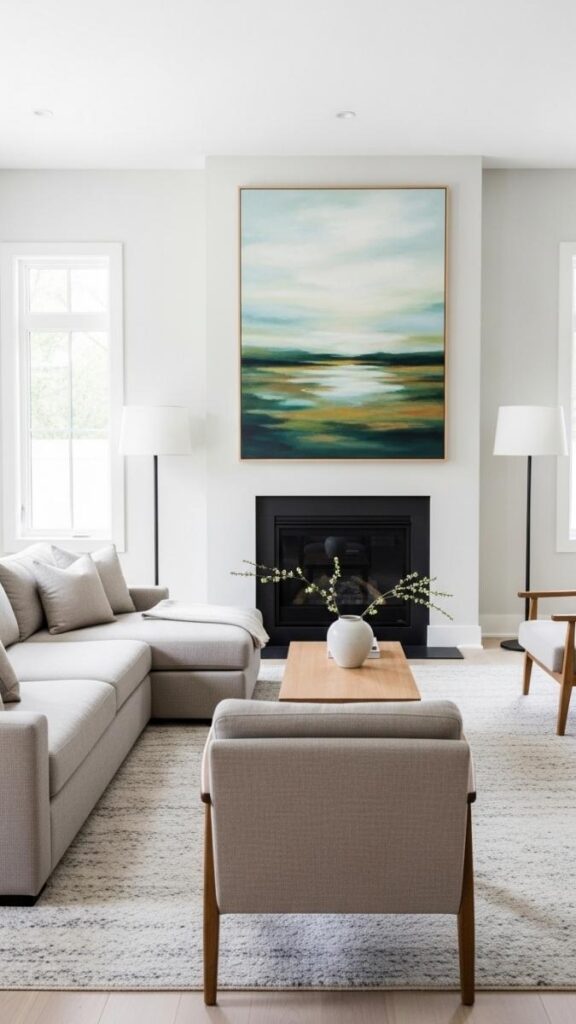
When every wall in a living room has multiple things happening art, shelves, plants, mirrors, sconces the room reads as restless. The eye doesn’t know where to land, which creates a subtle sense of visual noise even when the room is technically tidy.
Assigning one focal point per wall (a large piece of art, a mirror, a shelving unit, a media console) and leaving the surrounding area relatively clear creates calm.
This is less about minimalism as an aesthetic and more about giving each element room to register. A single large piece of art reads as a statement; the same wall with five smaller pieces of similar scale reads as indecision. This principle applies regardless of your personal style or the size of the room.
Read More About: 37+Home Office Layout Ideas That Actually Work in Real Spaces
Use Plants to Fill Vertical Space Without Adding Furniture
Plants are one of the few decor elements that occupy vertical space from floor to ceiling height without adding visual weight the way furniture does. A tall plant like a fiddle-leaf fig, olive tree, or monster in a corner fills space that would otherwise feel empty while adding texture and a natural color break from hard surfaces.
Honestly, the biggest barrier for most people is keeping them alive. If natural light is limited, choose low-maintenance varieties like pothos, snake plants, or ZZ plants rather than compromising placement to chase sun exposure. A plant in the wrong spot that’s struggling looks worse than no plant at all. Match the plant to your actual light conditions first, then adjust placement from there.
Create Visual Cohesion With a Two Tone Color Palette
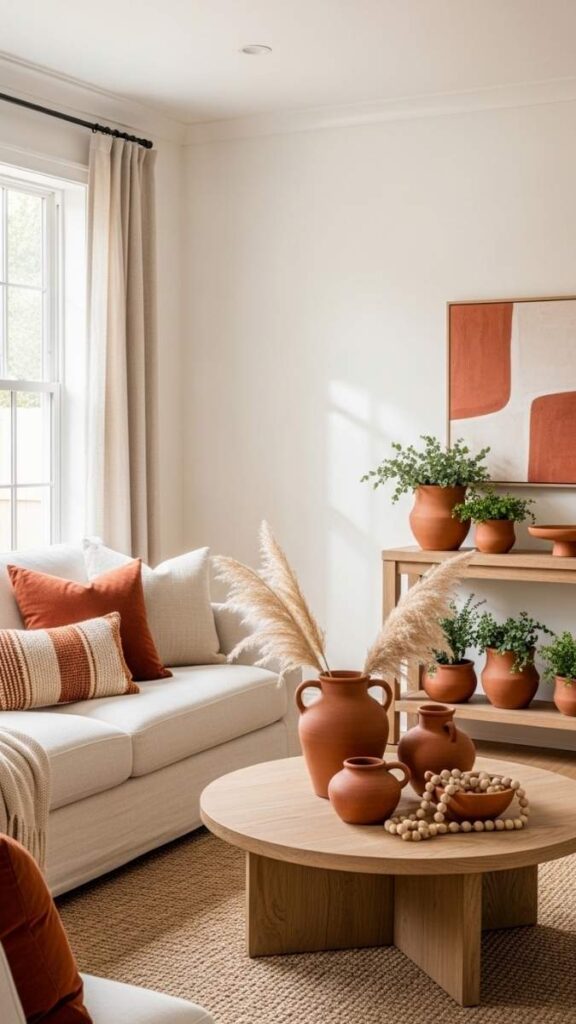
Rooms that feel visually cluttered despite being tidy often have too many competing colors. A two-tone palette, a neutral base plus one warm or earthy accent gives every element something to connect to without requiring everything to match. Terracotta and warm white, sage and cream, charcoal and natural wood these combinations hold together across a range of textures and materials.
The palette should flow from the largest elements (walls, sofa, rug) outward to the smaller ones (cushions, throws, decor objects). If the big pieces share a base tone, the smaller pieces have more freedom to vary without the room feeling chaotic. This is especially useful in rooms where furniture has been accumulated over time rather than purchased as a set.
Mount the TV at Eye Level, Not High on the Wall
TV placement is a layout decision that affects how comfortable the room is to actually use. Mounting a TV high on the wall is a common choice because it “opens up” the wall and forces viewers to crane their necks upward during extended use, which is uncomfortable. Eye level when seated is around 42 to 48 inches from the floor to the center of the screen, depending on sofa height.
A low media console with the TV mounted just above it keeps the viewing angle natural and grounds the room visually. This also frees up the wall space above the TV for art, a mirror, or simply nothing which often looks better than the TV dominating the entire upper wall.
Use a Bench or Ottoman Instead of a Second Sofa
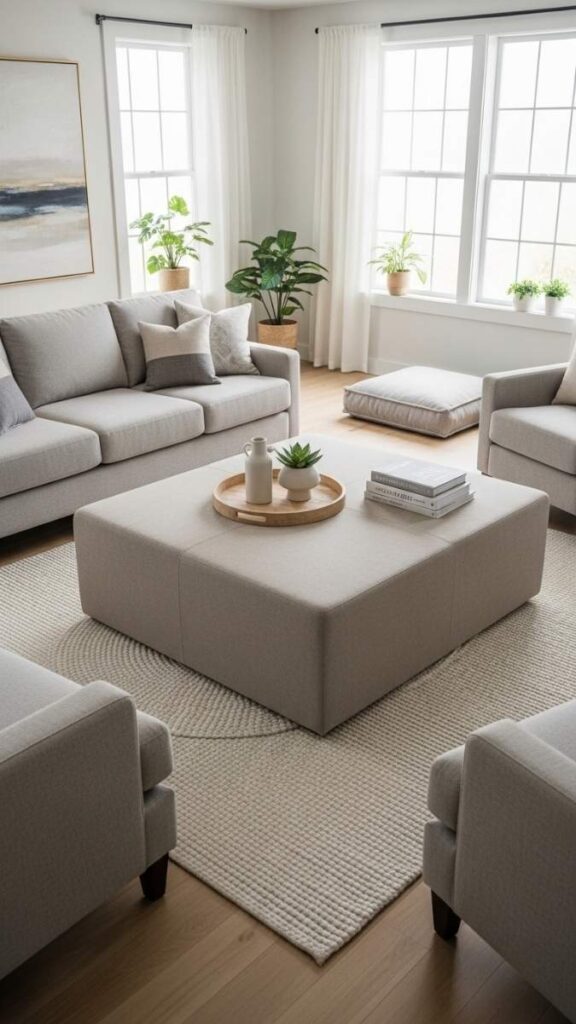
A large upholstered ottoman can do the work of a coffee table and an extra seat simultaneously, which makes it an efficient choice in rooms where floor space is genuinely tight. Topped with a tray, it functions as a stable surface. Pushed to one side, it creates seating for an extra person without requiring a full chair.
This works best in rooms that need flexibility spaces that shift between everyday living and occasional hosting. The ottoman is also softer and less visually imposing than a solid wood coffee table, which is useful in small rooms where a large furniture piece at the center would feel heavy.
Add a Tray to Your Coffee Table to Control Surface Clutter
A coffee table without any organizing principle becomes a landing pad for remotes, cups, books, and miscellaneous objects within a week. A tray leather, rattan, lacquer, or wood creates a contained zone that defines where objects belong and makes the surface look intentional even when it’s not perfectly styled.
The tray doesn’t need to be expensive or elaborate. The point is visual containment. Anything inside the tray reads as curated; anything outside it reads as clutter.
Two or three objects inside the tray, a candle, a small plant, and a book is enough. The surrounding table surface can hold functional items without the whole thing feeling chaotic.
Use Wall-Mounted Lighting to Free Up Surface Space
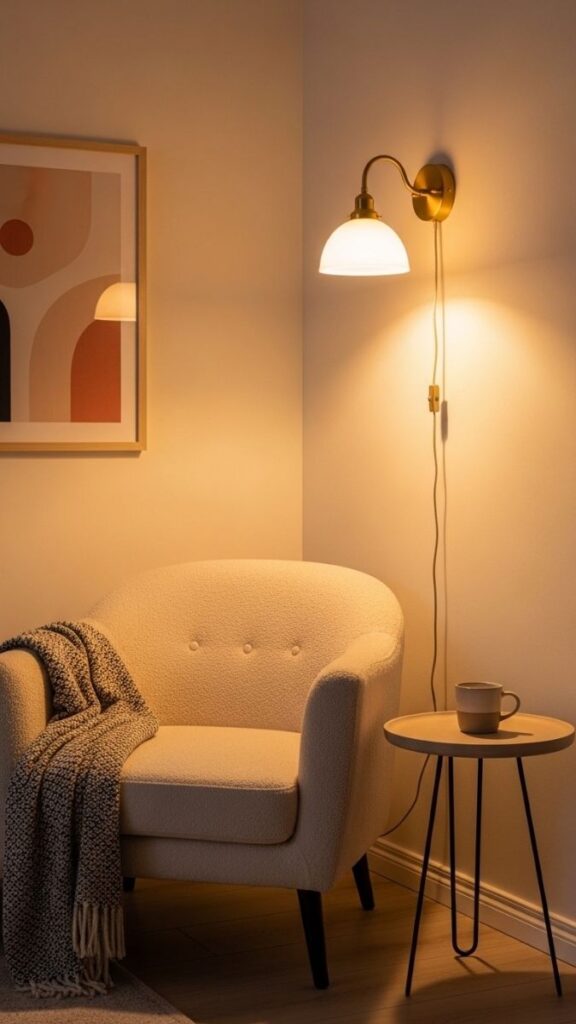
Side tables in small living rooms are often half-consumed by a table lamp, leaving almost no usable surface. Replacing the table lamp with a wall-mounted sconce plug-in version for renters frees up the entire side table surface for functional use. The light source also sits at a better height for reading or ambient light.
This is a practical swap that most people don’t consider because wall-mounted lighting feels permanent. Plug-in sconces have changed that. They’re easy to install, easy to move, and available in a range of styles that fit both minimal and warmer aesthetics. Works especially well alongside armchairs or at either end of a sofa.
Style Shelves in Groups of Three at Varying Heights
Shelves styled by filling every inch feel crowded and hard to read. Grouping objects in odd numbers preferably threes at varying heights creates visual rhythm without requiring a perfect symmetry. One tall object (a vase, a sculptural piece), one horizontal object (a stack of books, a small tray), and one small accent (a plant, a candle) is a reliable combination that works across most shelf sizes.
Leave at least 20 to 30 percent of each shelf as negative space. That open space is what allows the rest of the objects to register as intentional. This applies whether the shelf holds books, plants, or purely decorative objects.
Choose a Coffee Table With a Lower Shelf for Hidden Storage
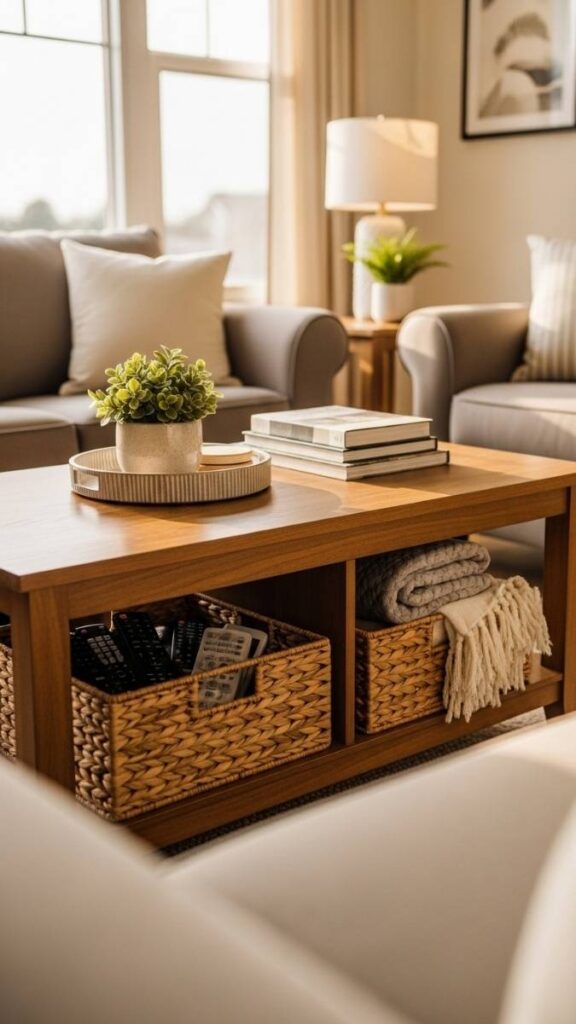
A coffee table with a lower shelf doubles the storage potential of the piece without increasing its footprint. The lower shelf is the ideal place for baskets holding remotes, chargers, and the things that typically pile up on the surface above. Out of sight when sitting on the sofa, accessible when needed.
This is a smarter investment than a solid table at the same price point, especially in living rooms that lack other storage. Woven baskets on the lower shelf also add texture and soften the look of the table. Look for tables where the shelf has enough clearance (at least 8 inches) to actually hold useful items rather than just a decorative tray.
Define a Work Zone With a Compact Desk in the Living Room
Multi-use living rooms, especially in studios and one-bedroom apartments, need a workspace that doesn’t announce itself the moment you walk in. A compact desk in a corner, in a finish that matches the existing furniture, reads as part of the room rather than an intrusion. The key is keeping the desk surface clear when not in use and avoiding office-specific accessories that clash with the living room aesthetic.
A wall-mounted fold-down desk is even more space-efficient if the desk is only needed part of the time. When closed, it disappears. This setup works for people who need a functional workspace but don’t want their living room to feel like a home office with a sofa in it.
Use a Large Piece of Art as a Budget-Friendly Statement Wall
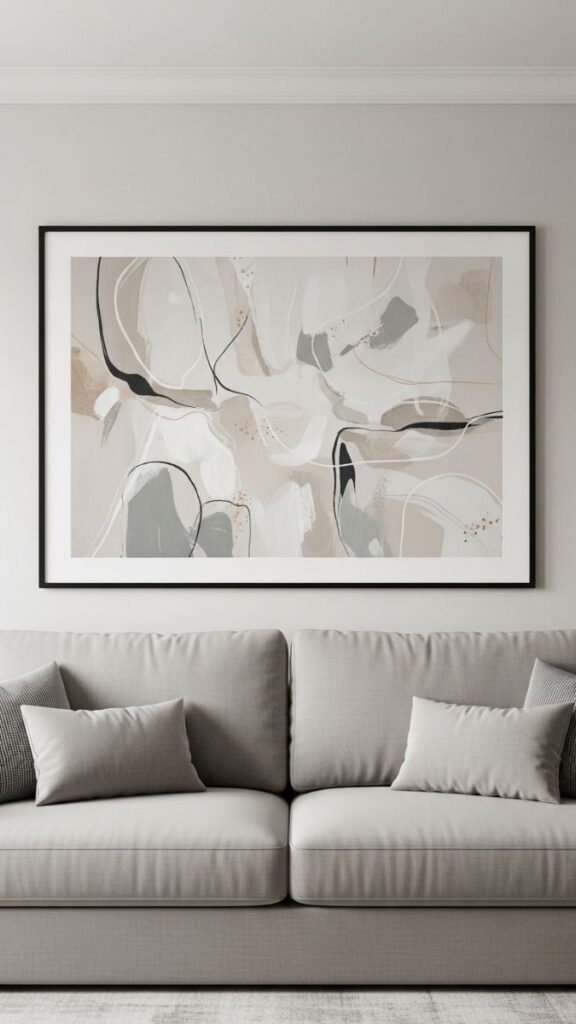
A single large piece of art printed and framed at home or sourced from a print shop does the same visual work as an elaborate gallery wall at a fraction of the cost and effort. Oversized prints in simple frames read as considered and deliberate, especially against a clean wall with minimal surrounding decor.
The size matters: a 24×36 or larger print above a sofa fills the wall proportionally without requiring multiple pieces to be aligned. This is a good option for anyone who finds gallery walls difficult to execute well or who prefers a quieter, more minimal approach to decorating walls.
Bring in Natural Materials to Add Warmth Without More Color
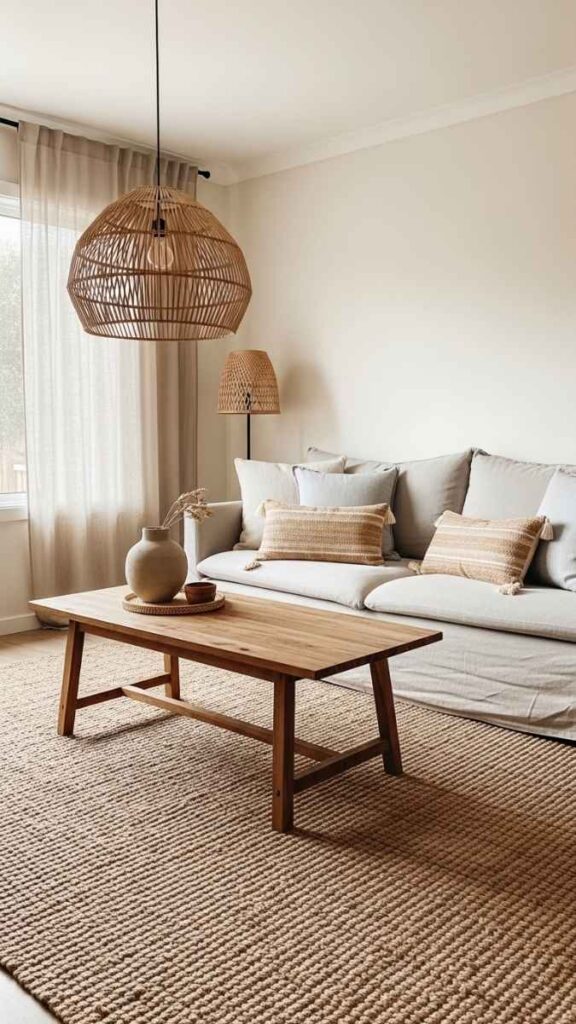
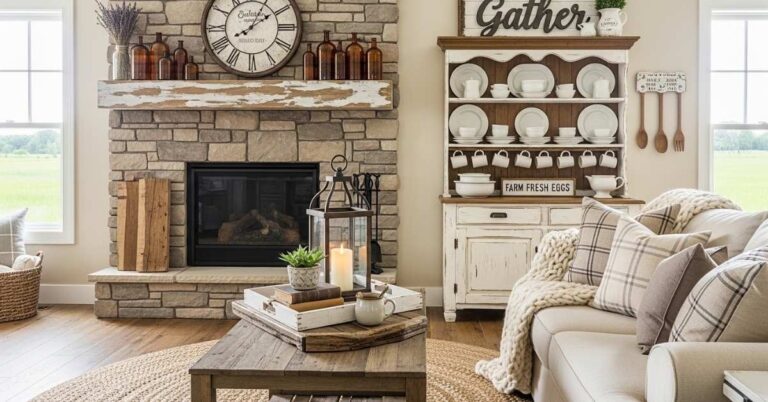
When a neutral living room feels cold or sterile rather than calm and cozy, the issue is usually material monotony rather than color. A jute rug, a wooden coffee table, a rattan pendant, and linen upholstery all sit within a neutral palette but introduce enough material contrast to make the room feel warm and layered.
Natural materials wood, rattan, linen, jute, stone work well together because they share an organic, imperfect quality that manufactured materials don’t. They age well, photograph well, and tend to feel cohesive regardless of the exact combination. This approach is especially effective in rooms where adding more color would feel out of place or where the existing palette is already settled.
What Actually Makes These Living Room Decor Ideas Work
Most home decor advice focuses on what to add to a room. The ideas that make the most difference are usually about proportion, placement, and material not quantity.
Scale before style.
A beautiful sofa in the wrong size for the room will undermine the entire layout. Before purchasing any large furniture, measure the room and map out the arrangement on paper or with a free floor plan tool. The most common regret in furnished living rooms is furniture that’s either too large (blocks movement) or too small (floats in the space without anchoring it).
Light before decor.
If the lighting in a room is wrong, too flat, too bright, too cold no amount of styling will make it feel right. Fix the light first, add a floor lamp, swap bulbs to a warmer tone, layer sources. The room’s other elements will immediately read better without any other changes.
Flow before furniture.
Every room needs clear paths through it from the entrance to the seating area, from the seating area to the kitchen or hallway. If furniture placement forces people to walk around or squeeze through, the room will always feel uncomfortable regardless of how it looks in photos. Leave at least 30 to 36 inches of clear walking space on main paths.
Negative space is part of the design.
An empty wall, an undecorated shelf section, a clear floor area these aren’t mistakes. They’re what allow the intentional elements to register. Rooms that feel cluttered are almost always rooms where negative space has been eliminated.
Living Room Decor Setup Comparison
| Setup | Best For | Space Type | Problem Solved | Difficulty |
| Floated sofa + console | Open-plan or large rooms | Medium to large | Dead wall space, flat layout | Easy |
| Gallery wall above sofa | Empty or unanchored walls | Any | Visual imbalance, bare walls | Moderate |
| Floor lamp in corner | Dark or flat-lit rooms | Any, especially small | Poor ambiance, single-source light | Easy |
| Open shelving beside window | Limited storage, small rooms | Small to medium | Clutter, lack of display space | Easy |
| Bookcase as room divider | Open-plan, studio apartments | Open-plan | Undefined zones, lack of layout structure | Moderate |
| Ottoman as coffee table | Flexible, multi-use rooms | Small to medium | Limited seating, rigid layout | Easy |
| Desk in corner | Work-from-home, studios | Studio/1BR | No dedicated workspace | Easy to Moderate |
| Large single artwork | Budget-conscious decorators | Any | Bare walls, gallery wall fatigue | Easy |
How to Arrange Your Living Room for Better Flow and Function
Layout is the foundation that everything else builds on. A well-styled room in a poorly arranged layout will still feel frustrating to live in.
Start with the focal point.
Every living room has a fireplace, a large window, or the TV wall. Arrange the main seating to face or angle toward it. If there’s no natural focal point, create one with a large piece of art or a media console.
Map the traffic paths first.
Before placing any furniture, identify where people enter the room and where they need to move through it. Keep these paths clear 30 to 36 inches minimum. Furniture placed across a natural traffic path creates daily frustration even if the layout looks fine on paper.
Group seating for conversation.
Seating pieces placed too far apart (more than 8 to 10 feet between facing seats) make conversation uncomfortable. The room ends up feeling like a waiting room rather than a social space. Tighten the arrangement and the room becomes noticeably more functional.
Balance the visual weight.
If all the furniture is on one side of the room, the layout will feel lopsided. Distributing weight across the room a floor lamp or tall plant on the lighter side can do the work of a full piece of furniture in terms of visual balance.
Leave room to breathe.
Resist the urge to fill every corner and surface. A room that’s 80 percent furnished with intentional pieces reads better than one that’s 100 percent filled. The remaining space allows the room to feel open and lets each element register clearly.
FAQ’s
What is the most important element of living room decor?
Layout is the foundation of any well-functioning living room. Before choosing colors, furniture styles, or decor objects, establish a layout that allows clear movement paths, proper furniture scale, and a defined focal point. Everything else layers on top of that structure.
How do I make my small living room feel bigger?
Use a rug that’s large enough to anchor all the main seating pieces. Float the sofa slightly away from the wall. Hang curtains above the window frame and extend the rod past the sides. Use open shelving instead of closed storage. Each of these adjustments increases the perceived size of the room without changing its footprint.
What’s the best sofa placement for a living room?
Position the sofa to face the room’s main focal point, a fireplace, window, or TV wall with clear walking space on at least one side. Avoid pushing it flush against the wall if the room is large enough to allow floating it forward even slightly. The ideal distance between a sofa and a facing chair or coffee table is 14 to 18 inches.
Warm vs. cool lighting in a living room which works better?
Warm-toned lighting (2700K to 3000K) works better for most living rooms because it creates a sense of comfort and softness that suits relaxation. Cool lighting reads well in workspaces and kitchens but makes living rooms feel clinical. Layer warm sources at different heights rather than relying on a single overhead fixture.
How many decor items should be on a coffee table?
Two to four objects is the practical range. More than that tends to feel cluttered; fewer can feel bare depending on the table size. Using a tray to group objects, a candle, a small plant, and a book or two is a reliable combination. The tray creates visual containment so the items read as intentional rather than scattered.
Is a gallery wall or a single large piece of art better for a living room?
A single large piece is easier to execute well and tends to feel more confident as a design choice. Gallery walls work well when the frames and prints are thoughtfully curated, but poorly executed gallery walls are one of the most common decor missteps. Go for a large single piece if you want a lower-risk, high-impact result.
How do I add warmth to a neutral living room without changing the color palette?
Introduce natural materials jute, wood, linen, rattan, stone rather than adding more color. Material contrast creates warmth and visual interest in a way that reads as organic rather than decorative. Warm-toned lighting and soft textiles like throws and boucle cushions also contribute without shifting the overall palette.
Conclusion
A living room that works well isn’t necessarily the most decorated one; it’s the one where the layout makes sense, the lighting feels right, and every element earns its place. Most of the ideas in this list don’t require significant spending or major changes. They’re adjustments in proportion, placement, and material that compound into a space that genuinely feels better to live in.
Start with one or two ideas that address the most obvious friction point in your current setup whether that’s a rug that’s too small, lighting that falls flat, or a layout that doesn’t quite flow. Small, grounded changes made in the right order tend to have more impact than a full room overhaul done all at once.