75+ Farmhouse Lighting Ideas That Make Every Room Feel Warm
Farmhouse lighting has quietly become one of the most searched interior topics and it’s not hard to see why. There’s something about the combination of warm bulbs, natural materials, and understated fixtures that makes a space feel genuinely comfortable rather than staged. If your home feels a little cold, flat, Farmhouse Lighting Ideas or just unfinished, lighting is usually the first thing worth revisiting.
This isn’t about matching every fixture to a catalog aesthetic. Real farmhouse lighting works because it layers warmth, anchors furniture arrangements, and solves practical problems: dim corners, harsh overhead glare, rooms that feel too open or too cramped. If you’re working with a rental, a modest budget, or a space that never quite feels cohesive, the right lighting setup can shift all of that without a single renovation.
For anyone trying to make their home feel more intentional and settled, not just “decorated” this list covers setups that actually function in real rooms.
A Shiplap Backed Sconce Pair in the Entryway
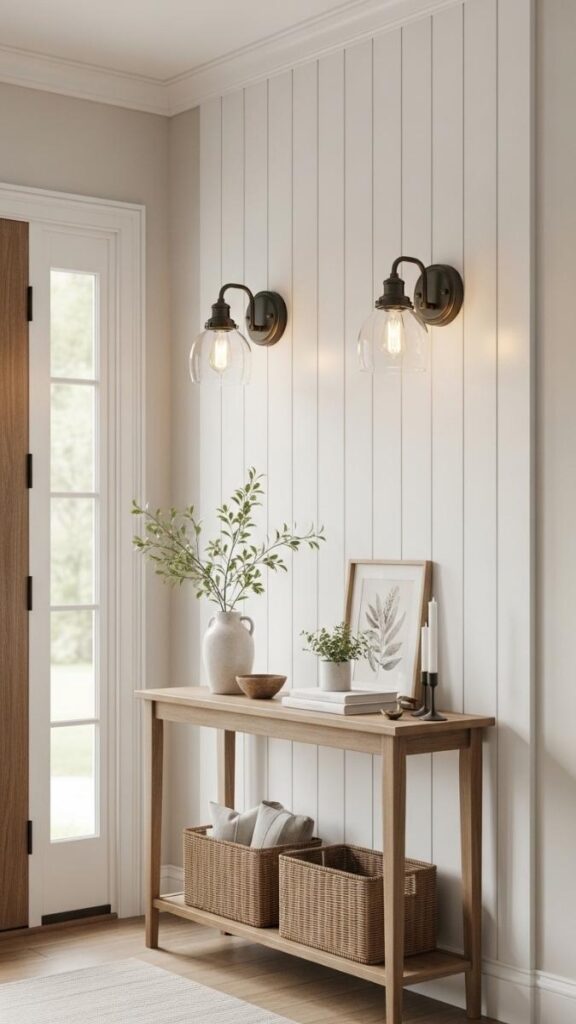
Most entryways suffer from one of two problems: a single harsh overhead fixture, or no real lighting at all. Flanking a shiplap accent wall or a simple entry mirror with two matching wall sconces immediately creates balance.
The key is keeping the sconce style simple black iron or aged brass with an open cage or linen shade work best here. Position them at roughly eye level (about 60–65 inches from the floor) so the light grazes the wall rather than pointing straight down.
This setup works especially well in narrow entryways where there’s no room for a table lamp, and it gives the space a warm, deliberate feel the moment you walk in.
An Oversized Woven Pendant Over the Dining Table
Scale matters more than most people realize with dining pendants. A fixture that’s too small floats awkwardly above the table and does almost nothing for the room’s atmosphere. Go larger than feels comfortable for a standard rectangular dining table, a pendant between 24 and 36 inches wide is usually the right range. Woven rattan or seagrass shades diffuse the bulb light beautifully, casting a warm, slightly textured glow across the table surface.
Hang it low enough that the bottom of the shade sits around 30–34 inches above the table. In my experience, this single change does more for a dining room’s warmth than almost any furniture update.
Exposed Bulb Industrial Pendants in the Kitchen
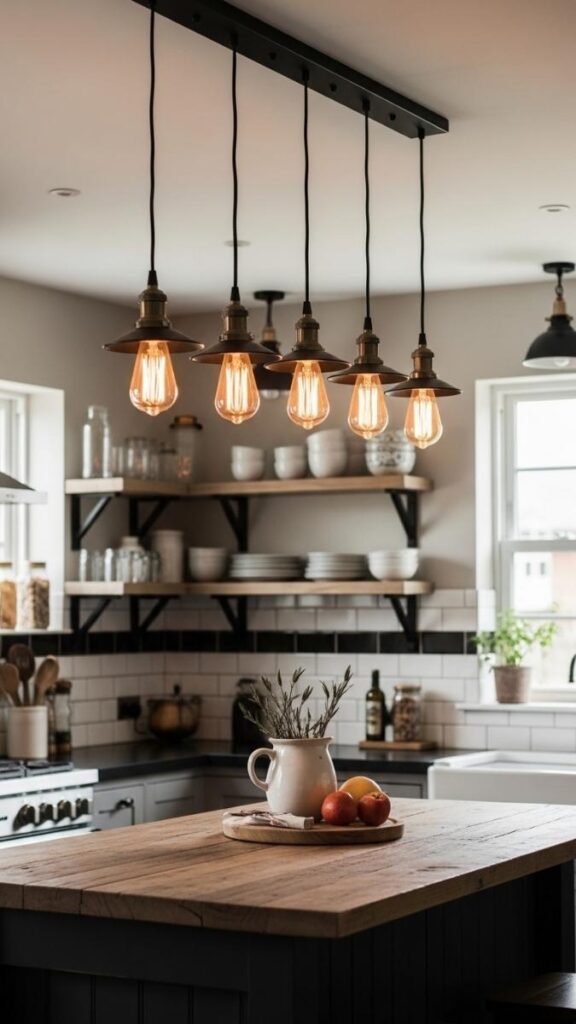
Open-cage or cage-style pendants over a kitchen island hit a specific sweet spot in farmhouse design; they’re industrial enough to feel modern but simple enough not to compete with natural wood or white cabinetry.
Use Edison-style bulbs (the amber-tinted kind) rather than clear LEDs for warmth. Hang them in a pair over an island or peninsula, spacing them about 24 inches apart and centering them over the countertop.
This works particularly well in kitchens with white or light grey cabinetry because the contrast between the dark metal and pale surfaces keeps things from looking flat. It also solves the underpowered single-fixture problem that makes so many kitchens feel like a break room.
A Lantern-Style Chandelier in the Living Room
The lantern chandelier is one of those fixtures that sits comfortably between traditional and modern farmhouse; it reads as architectural rather than decorative, which makes it easier to work around different furniture styles.
A four- or six-light lantern in matte black or oil-rubbed bronze over a seating area gives the room a central anchor point that doesn’t demand a matching aesthetic from the rest of the space.
For rooms with standard 8-foot ceilings, look for fixtures no taller than 20–24 inches so the scale stays proportional. This setup is especially useful in open-plan living spaces where the ceiling fixture needs to define the seating zone without walls doing the work.
Layered Bedroom Lighting With a Drum Shade Overhead and Bedside Sconces
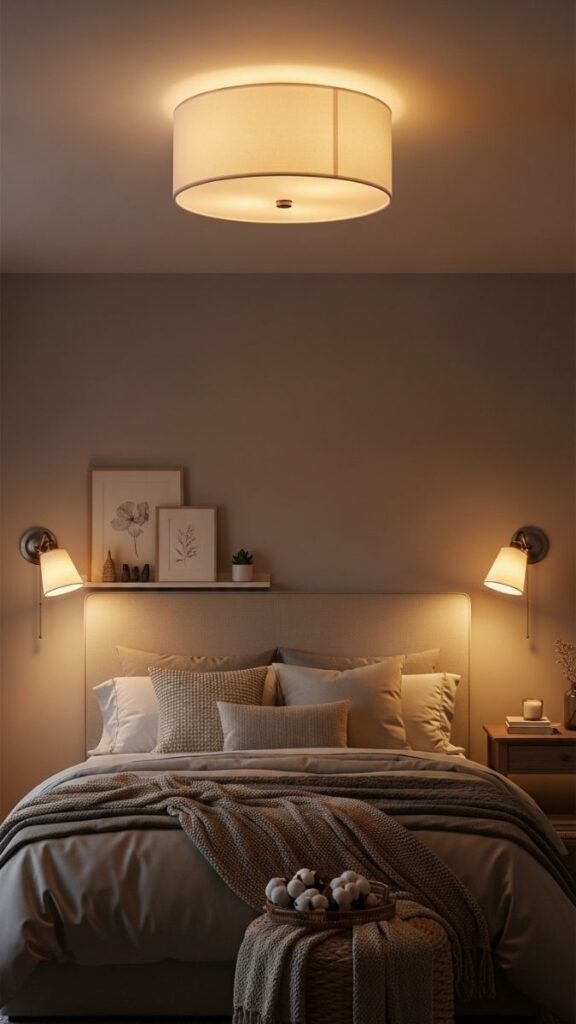
Single overhead lighting in a bedroom is almost always a mistake; it flattens the space and makes everything feel equally lit, which is the opposite of restful. Pair a simple linen or cotton drum shade overhead (for ambient light) with two wall-mounted reading sconces on either side of the bed. The sconces handle task lighting without requiring table lamps, which frees up the nightstand surface. In smaller bedrooms where nightstands are tight, this setup is genuinely practical. The combination of two light levels also makes the room feel more dimensional. Go for warm white bulbs (2700K) throughout to keep the palette consistent.
A Galvanized Metal Pendant in a Farmhouse Bathroom
Bathrooms are consistently overlighted usually with a harsh bar fixture that washes everything out. A galvanized metal dome pendant or a simple cage fixture above the vanity (where ceiling height allows) brings warmth and texture to what is typically the coldest room in the house.
If ceiling height is limited, a flush-mount version of the same style works just as well. This is a particularly good option for bathrooms with shiplap walls or board-and-batten paneling, where the metal finish bridges industrial and rustic without looking forced. Make sure the bulb is rated for damp locations if the fixture is close to the shower zone.
Read More About: 74+ Small Coastal Setup Ideas That Make Any Room Feel Like a Beachside Retreat
A Rope Wrapped Pendant in the Kitchen Breakfast Nook
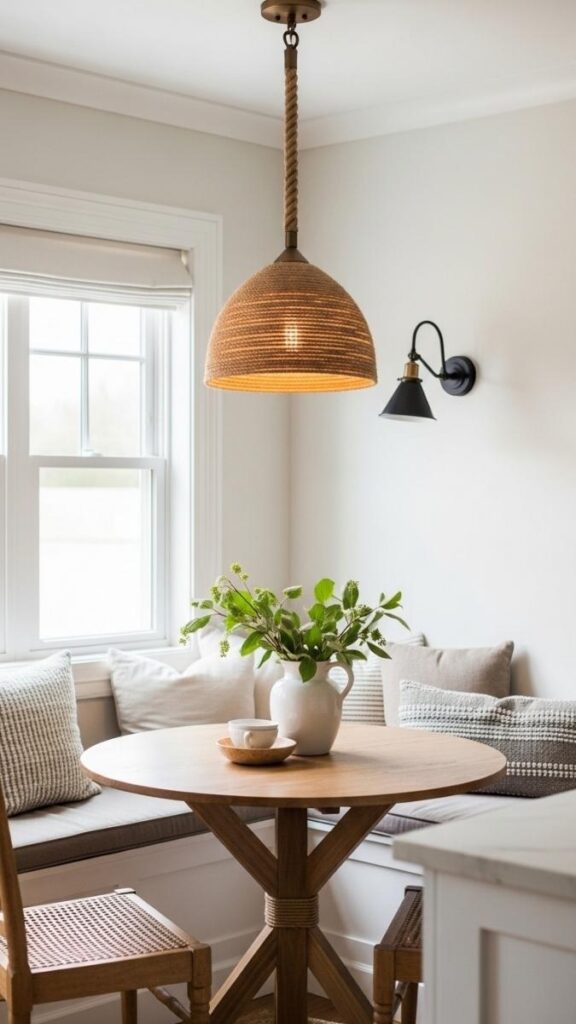
Breakfast nooks are often treated as afterthoughts lighting-wise either they share an overhead fixture with the main kitchen or they’re left entirely dark. A single rope-wrapped or jute pendant hung directly over the nook table solves both problems.
The material adds texture and warmth, and the lower hanging position (about 28–32 inches above the tabletop) makes the nook feel like its own defined space rather than just a corner of the kitchen. This is one I’d actually recommend trying first if your kitchen has an underused breakfast nook, because the impact-to-cost ratio is unusually high for a single fixture swap.
Black Iron Barn Sconces in the Hallway
Hallways rarely get lighting attention, which is why they so often feel like afterthoughts, bright overhead, no warmth, no rhythm. Installing barn-style sconces at regular intervals (every 6–8 feet) replaces that utilitarian feel with something that actually looks considered.
The barn sconce silhouette, a simple half-dome shade in black or dark bronze, is one of the most versatile fixtures in the farmhouse vocabulary because it works in traditional, transitional, and modern-rural spaces equally well.
Hardwired versions are ideal, but plug-in sconces with cord covers are a practical option for renters who can’t touch the walls.
A Beaded Chandelier in a Neutral Bedroom
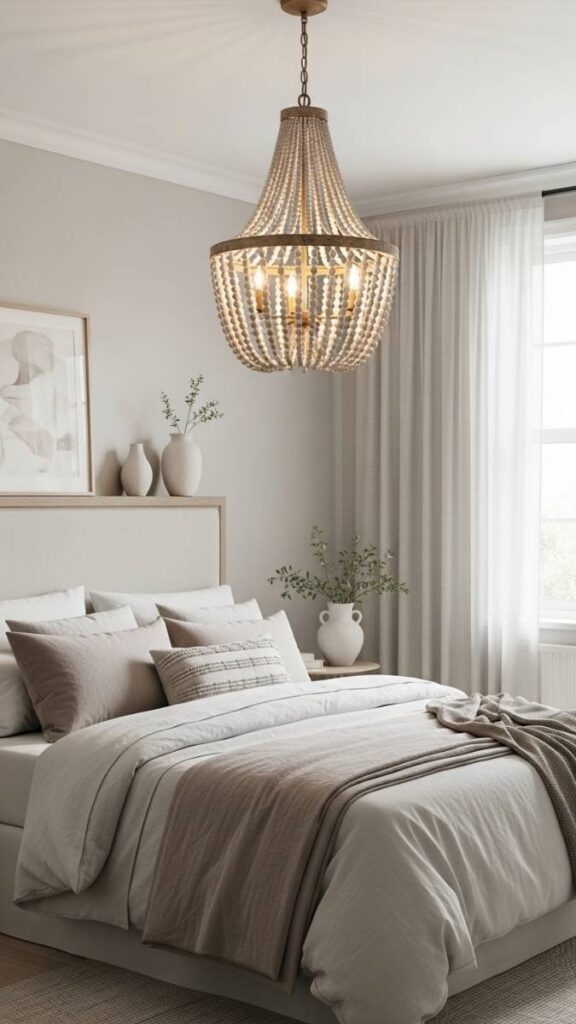
Beaded chandeliers sit in an interesting category: they’re decorative enough to be a focal point but neutral enough not to overpower a simple room.
A white-painted or natural wood bead design in a bedroom adds visual interest without adding color, which makes it especially useful in rooms where the palette is already warm and quiet.
Hang it centered over the bed rather than centered on the ceiling (these often aren’t the same point) for proper visual balance. This works well in rooms that need a little more visual weight at the ceiling level without going toward something heavy or formal.
Plug-In Sconces as Bedside Lighting in Rented Spaces
Renters consistently lose out on the layered lighting options that make bedrooms feel finished, because most solutions require hardwiring. Plug-in wall sconces, particularly the kind with a linen or cotton shade in white or cream, solve this directly.
Run the cord straight down the wall and tuck it behind the nightstand, or use a slim cord cover that blends with the wall. The result looks intentional rather than improvised. Position the shade so the center sits roughly at shoulder height when seated in bed, which keeps the reading angle comfortable.
Honestly, some of these plug-in options are nearly indistinguishable from hardwired versions once they’re installed.
Read More About: Coastal Bathroom Ideas That Actually Work in Real Homes
A Flush Mount Mason Jar Fixture in a Low Ceiling Room
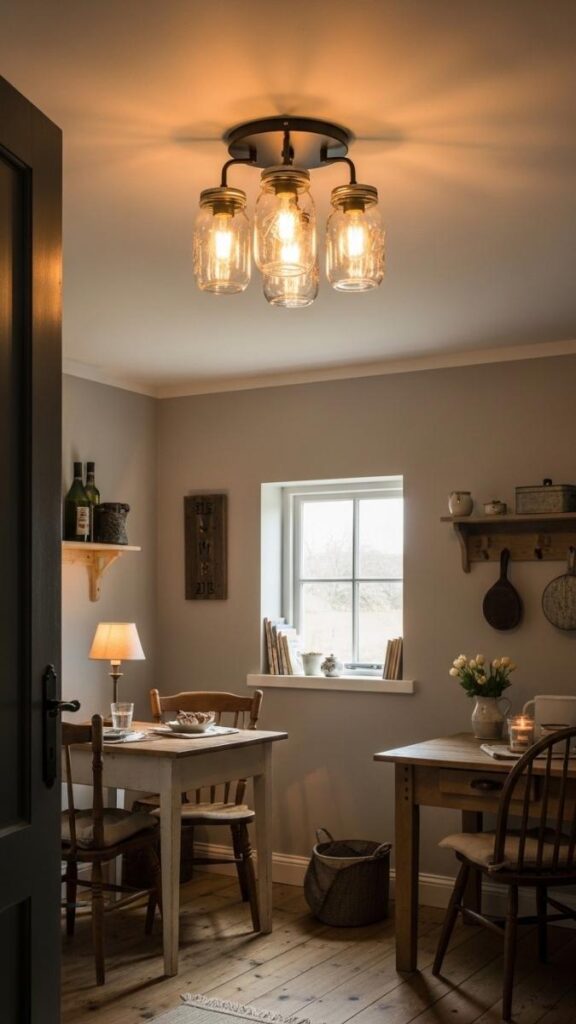
Flush-mount fixtures have a reputation for being boring, but mason jar cluster designs change that equation significantly. These fit tightly against the ceiling ideal for rooms under 8 feet while still delivering the warm, textured quality of exposed Edison bulbs.
The glass diffuses light gently without completely hiding the bulb, which gives the room a slightly industrial, slightly rustic quality that works in farmhouse spaces. This is a strong option for bedrooms, laundry rooms, or mudrooms where hanging fixtures aren’t practical but the space still needs warmth and character.
Vintage-Style Edison Bulbs in Open Shelving Displays
This is less about fixtures and more about ambient fill; small globe or tubular Edison bulbs woven between open shelving displays add warm, low-level light to corners that standard ceiling fixtures never reach.
They’re not meant to be task lighting; they’re there to create depth. Layer them behind ceramic vessels, plants, or cookbooks so the light source isn’t immediately obvious. This works particularly well in kitchens and living rooms where open shelving is already a design feature; it turns functional storage into something that actually looks considered in the evening.
A Statement Wagon Wheel Chandelier in a High Ceiling Space
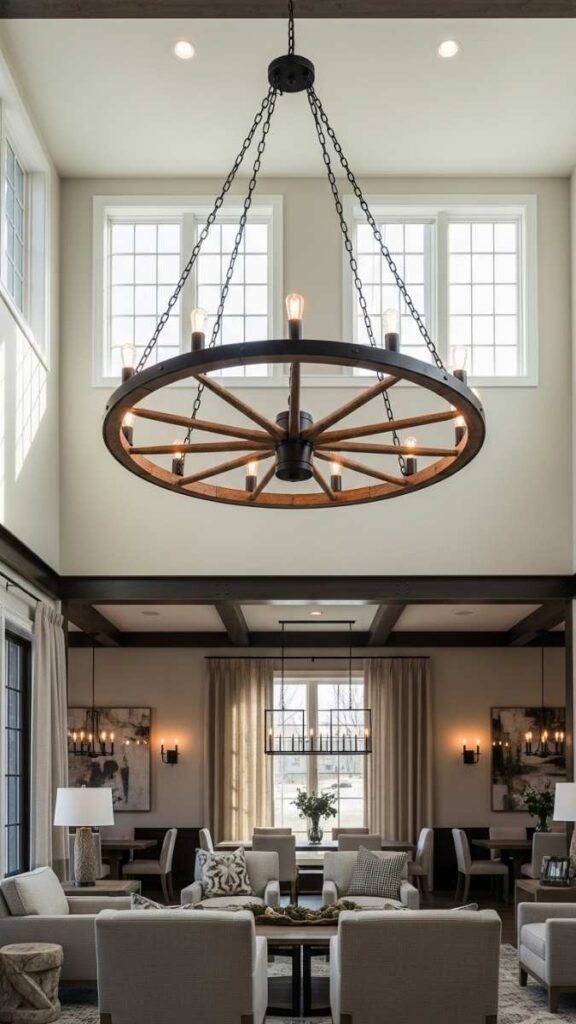
High-ceiling rooms and open-plan great rooms often feel underfurnished at the ceiling level, all that vertical space with nothing to fill it. A wagon wheel chandelier is one of the few fixtures that can hold its own in a double-height space without looking overcrowded. Size matters in a room with 12+ foot ceilings, you want a fixture that’s at least 36–48 inches in diameter, possibly larger.
These work best in rooms that already lean toward a more traditional or rustic farmhouse aesthetic; they’re not a subtle choice, so the rest of the room needs to be able to carry the weight of the fixture’s presence.
Under-Cabinet Lighting in a Farmhouse Kitchen
Under-cabinet lighting is consistently underused in kitchens, especially in farmhouse designs where the aesthetic leans toward warmth and natural materials. A warm LED strip or puck lights mounted under upper cabinets illuminate the countertop directly which is where prep work actually happens without adding more ceiling fixtures.
On a butcher block or marble surface, this creates a warm, layered glow that makes the kitchen feel genuinely inviting rather than just functional. Battery-powered options or plug-in strips mean this is also one of the easiest lighting upgrades available without any electrical work.
A Linen Shade Table Lamp on a Console or Sideboard
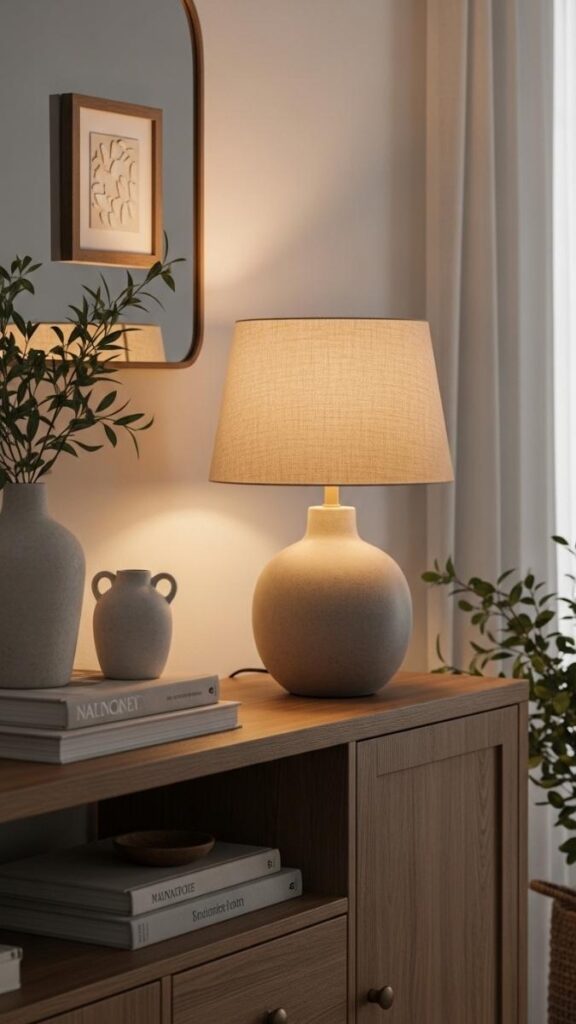
Table lamps in farmhouse spaces tend to do their best work when they’re placed at transition points at the end of a sofa, a console table in the entryway, or a sideboard in the dining room. A linen shade with an aged brass or black iron base hits the right balance warm enough to feel inviting, simple enough not to draw too much attention.
The height matters too; the bottom of the shade should sit roughly at eye level when seated, which typically means a lamp in the 24–28 inch range. This is one of the most flexible and budget-friendly ways to add warmth to a room that feels flat.
A Cluster Pendant Installation Over an Island
Instead of two matching pendants, a cluster of three mini pendants hung at slightly varying heights adds visual movement without becoming chaotic. Stagger the heights by 3–5 inches so the grouping has some dimension. Keep the fixture style consistent (same finish, similar shape) and let the arrangement do the work.
This setup is particularly effective over wider islands 7 feet or more where two pendants would feel sparse. It also photographs well, which matters if you’re staging or selling, but the practical benefit is more even light distribution across the full counter surface.
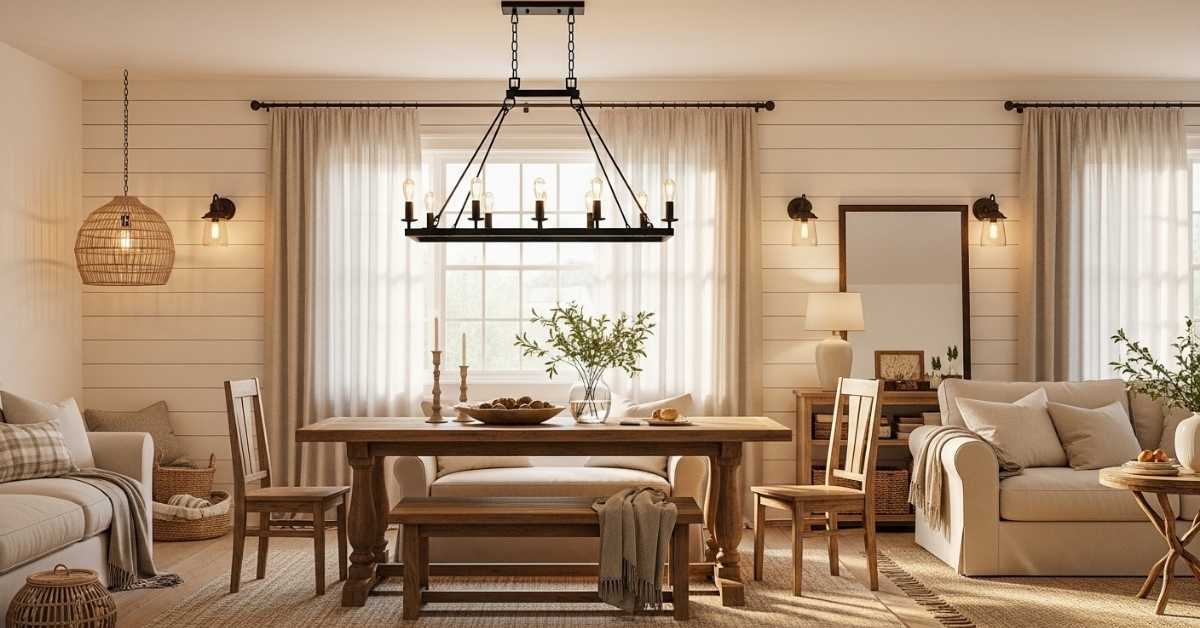
A Candelabra Style Chandelier in a Farmhouse Dining Room
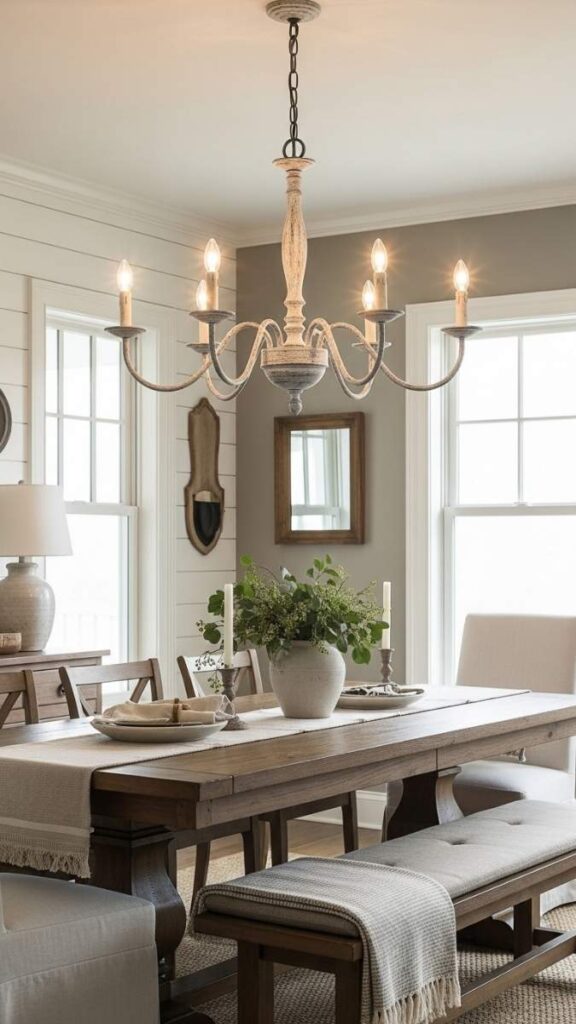
The candelabra chandelier is a direct nod to traditional farmhouse and colonial aesthetics, but in a matte black or aged iron finish it reads much more current. The unshaded bulb design works best with decorative filament bulbs either a classic Edison or a newer globe style where the bulb itself is part of the visual.
This setup creates a very specific kind of light warm, slightly directional, with a candlelit quality that works well for evening meals. It doesn’t perform well as the only light source in the room, so plan for a dimmer switch and at least one secondary source (sideboard lamp or sconces) to fill in for daytime use.
Read More About: 17+ Coastal Color Palette Ideas That Make Any Room Feel Calm, Airy
Recessed Lighting With Warm Bulbs and a Statement Pendant
Recessed lighting gets unfair criticism in farmhouse design circles; the real issue isn’t the fixture type, it’s the bulb temperature.
Switch any existing recessed lights to 2700K warm white bulbs and the difference in atmosphere is significant. Then use a single statement pendant: a lantern, a rattan shade, a cluster over the dining or kitchen island to give the space a focal point that recessed lighting alone can’t provide.
This combination solves the practical need for even ambient light while still delivering the visual warmth that makes farmhouse spaces feel intentional. It’s a particularly smart approach for open-plan spaces where one fixture style can’t do everything.
A Tripod Floor Lamp in a Living Room Corner
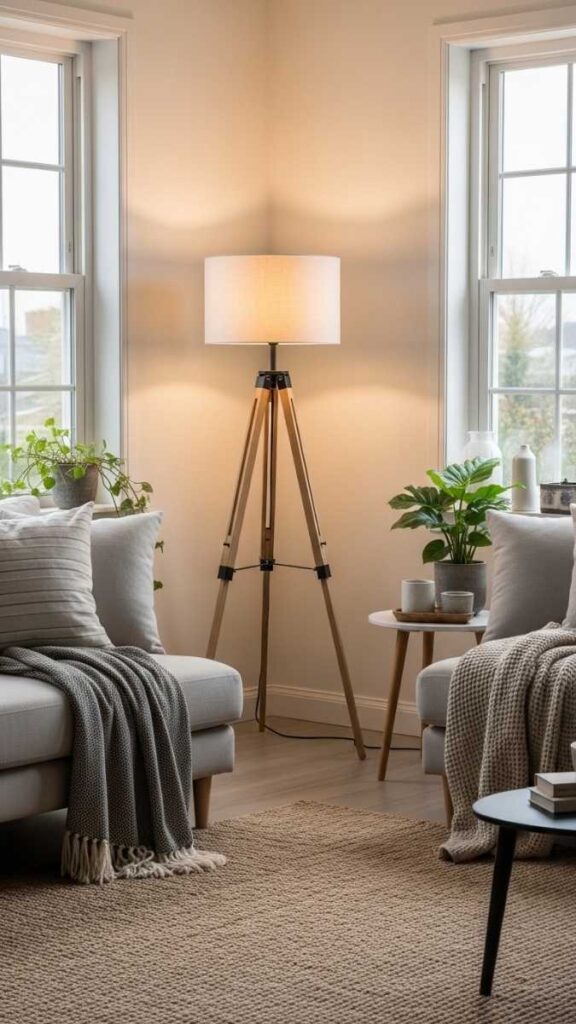
Floor lamps solve a specific problem in rooms where the ceiling fixture is centered but the seating area is off to one side, leaving half the room in shadow. A tripod floor lamp, especially one with a natural wood or black metal frame and a simple linen shade fills that gap without requiring any installation.
Position it at the back corner of a sofa or chair grouping so the light falls over the seating area rather than pointing directly at anyone’s eyes. I’ve noticed this style tends to work better in farmhouse spaces than traditional torchiere lamps because the tripod base has an architectural quality that reads as intentional rather than practical.
A Rustic Candle Style Wall Sconce in the Dining Room
Flanking sconces in a dining room serve a dual purpose: they add ambient fill light that softens the overhead harshness, and they make the walls feel like part of the overall design rather than just a backdrop. Candle-style sconces, thin arms, no shade, small flame-tip bulbs work well in dining rooms because they don’t project light aggressively; they glow.
On a dimmer (if hardwired) or with a smart bulb (for plug-in versions), these can be adjusted to create a genuinely atmospheric dinner setting. The key is pairing them with something with minimal plain walls, shiplap, or board-and-batten so the sconce hardware reads clearly.
Outdoor Barn Lights on a Front Porch
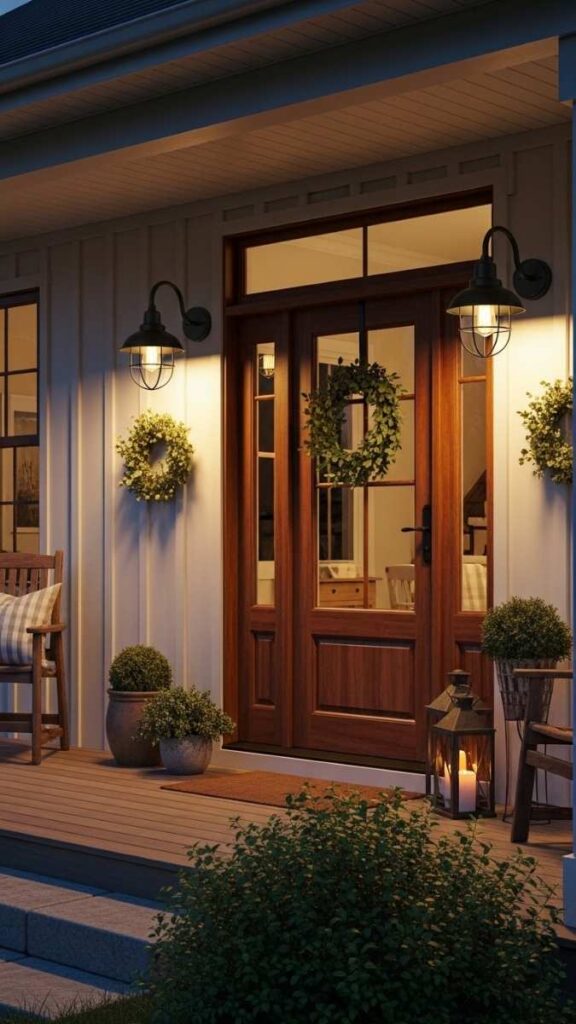
Gooseneck barn lights are among the most recognizable elements of farmhouse exterior design: the curved arm, the dome shade, the open bulb.
Mounted on either side of a front door or above a garage entrance, they establish the farmhouse vocabulary immediately and solve the practical problem of porch lighting without resorting to coach lights that feel more traditional or suburban.
Black or dark bronze finish reads as modern farmhouse; galvanized metal leans more rustic. The fixture size should scale with the wall on a wide porch or garage facade, go with a shade diameter of at least 12–16 inches or the lights will look undersized.
A Wrought Iron Multi Arm Chandelier in the Foyer
A double-height foyer is one of the few spaces where a large, visually heavy chandelier is not just acceptable but necessary as the scale of the space demands it. Wrought iron multi-arm designs in a matte or satin black finish are well-suited here because they’re substantial without being ornate.
For ceiling heights between 14 and 18 feet, the fixture should hang so the bottom sits around 7 feet from the floor high enough to clear traffic but low enough to feel connected to the space rather than floating near the ceiling. This setup is specifically for homes with formal entry volumes; in a standard 8–9 foot entry, this scale of fixture would overpower the room.
A Schoolhouse Globe Pendant in the Kitchen or Mudroom
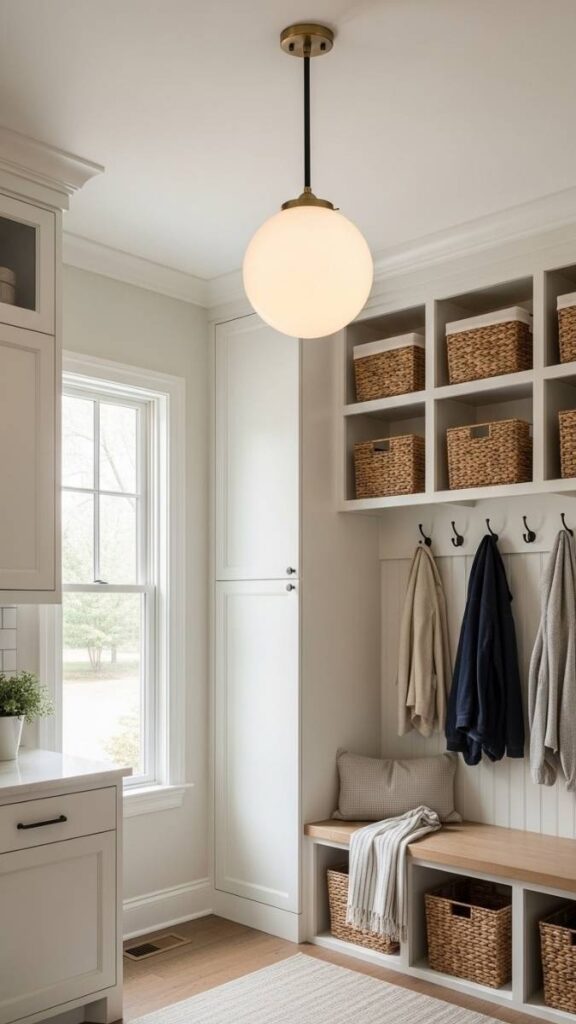
The schoolhouse globe a white glass dome with a black or brass fitter, is one of those fixtures that has been around for over a century because it genuinely works. It diffuses light evenly, it pairs with almost any cabinet or wall color, and the silhouette is clean enough to work in both vintage and modern farmhouse spaces.
Use it as a single pendant in a mudroom or breakfast area, or in a cluster of two or three over a kitchen island. The white glass keeps the light soft and even no harsh shadows, no hot spots which is particularly valuable in work-heavy spaces like kitchens.
String Lights on a Covered Back Porch
Covered porches almost always underperform on lighting a single ceiling fixture that casts a circle of light while the rest of the space falls into shadow. Stringing warm bulb string lights (either globe or Edison style) across the ceiling in a grid or zigzag pattern solves this completely.
The distributed light source means no dark corners, and the warm tone makes the space feel genuinely inviting after dark. Use outdoor-rated string lights and run them between hooks screwed into the ceiling joists or porch beams with no special hardware needed. This is one of the most cost-effective lighting upgrades for any outdoor living space.
A Drum Pendant With a Metal Frame in the Home Office
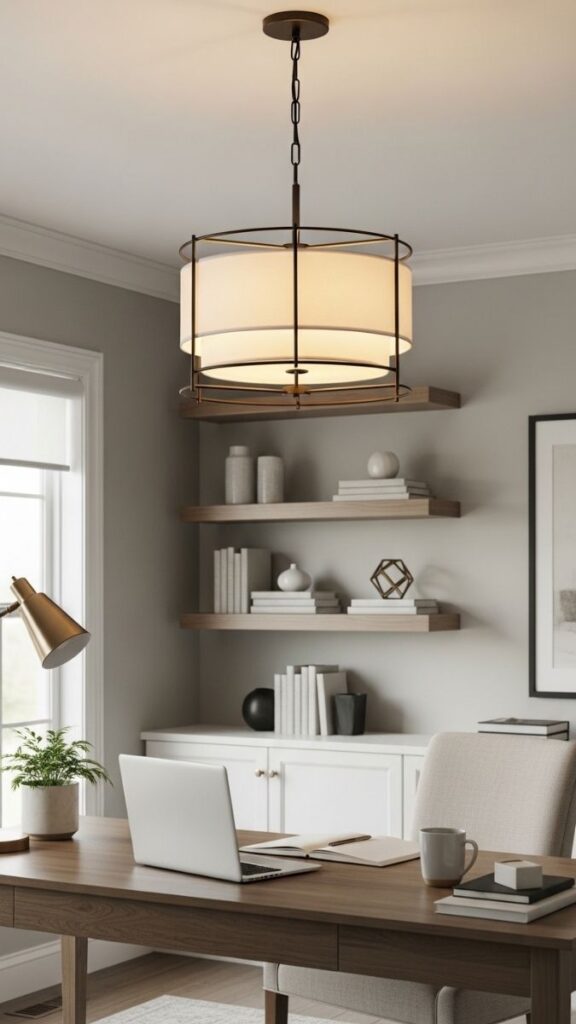
Home offices in farmhouse spaces often default to whatever fixture came with the house, usually something generic and either too bright or too dim for focused work. A drum pendant with a metal outer frame (black iron or brass) and a fabric liner provides diffused, downward-directed light that works well for desk work without the clinical feel of a bare bulb or recessed light directly overhead.
Position it centered over the desk rather than centered on the ceiling if the two don’t align task lighting needs to be where the work happens. This also gives the home office a more considered, finished quality that a lot of dual-use spaces (bedroom offices, living room desks) genuinely lack.
A Vintage-Look Wall Lantern in the Bathroom
Vertical wall lanterns mounted beside (rather than above) a bathroom mirror provide directional side lighting that is significantly better for tasks like applying makeup or shaving than overhead bar fixtures.
The farmhouse-appropriate version black iron or aged bronze with clear or seeded glass panels adds a slightly old-world quality to what might otherwise be a very plain space. One fixture on each side of the mirror is ideal, but if space is tight, a single larger lantern on one side still improves on a single overhead source.
This works especially well in bathrooms with a single window where natural light comes from one direction the lantern balances the asymmetry.
Layered Lighting in the Living Room Ambient, Accent, and Task Together
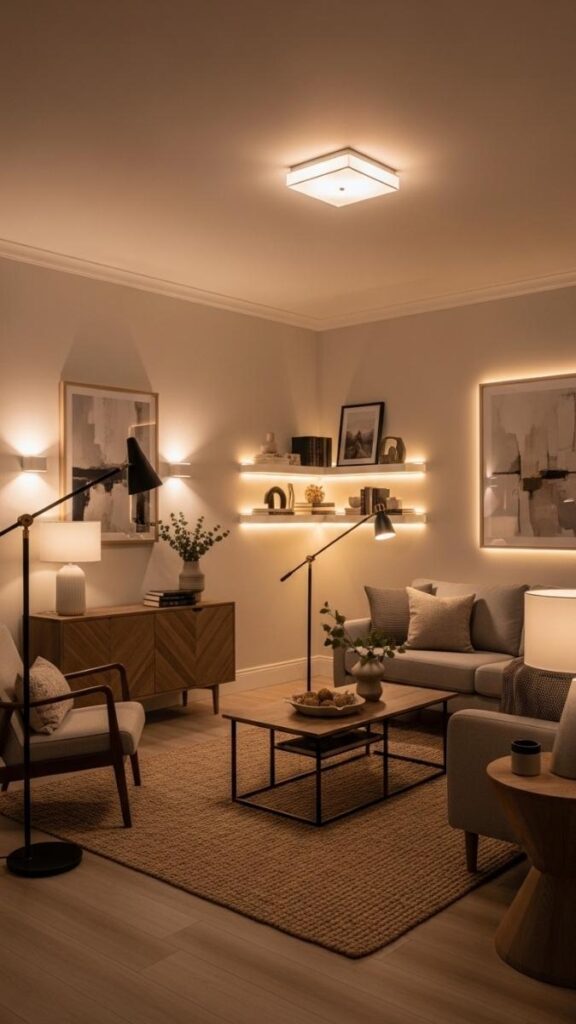
Farmhouse living rooms that feel genuinely warm almost always have three light sources operating at once: ambient (ceiling or overhead), accent (floor lamp, wall sconce), and task (table lamp near reading or work areas).
The mistake most rooms make is relying entirely on one source, usually the ceiling which makes the space feel flat and slightly institutional regardless of how good the furniture is. You don’t need expensive fixtures to achieve this; a simple pendant overhead, one floor lamp, and one table lamp will do the work.
The key is keeping bulb temperatures consistent (all 2700K or all 3000K) so the different sources blend rather than fight.
What Actually Makes Farmhouse Lighting Work
Farmhouse lighting isn’t really about a specific fixture style, it’s about a set of conditions that the right fixtures create. Understanding those conditions makes it easier to make decisions that hold up in real rooms rather than just looking good in photos.
Warm bulb temperature is non-negotiable.
The range to work within is 2700K to 3000K. Anything cooler (4000K+) pushes a space toward clinical or industrial, which isn’t what farmhouse lighting is trying to achieve. This applies to every fixture type pendants, sconces, floor lamps, under-cabinet strips. Consistency across the room matters as much as the individual bulb choice.
Scale is the most common error.
Most people go too small. A pendant that’s correct on paper ends up looking undersized in the room because the ceiling height, furniture scale, or room size was underestimated. A general rule for pendants over a table or island, the fixture diameter should be roughly half the table width. For ceiling chandeliers, the room’s width and length in feet added together gives roughly the appropriate fixture diameter in inches.
Material contrast drives visual interest.
Farmhouse lighting works visually because of the contrast of dark iron against white shiplap, warm rattan against grey-white walls, clear glass against matte black fittings. A fixture in the same tone as the surrounding walls tends to disappear. Think about what the fixture will sit against and choose accordingly.
Layering is what separates good lighting from great lighting.
A single fixture however well chosen creates one dimension of light. Add a second source at a different height and the room immediately gains depth. Add a third and it feels genuinely alive. The principle isn’t complicated, but it does require committing to more than one fixture per room, which is where most setups stop short.
Farmhouse Lighting Ideas Quick-Reference Setup Guide
| Idea | Best Room | Space Type | Problem It Solves | Budget Level |
| Woven rattan pendant | Dining room | Any size | Flat, uninviting dining area | Low–Mid |
| Barn sconces (pair) | Entryway / Hallway | Small or narrow | Harsh overhead, no warmth | Low–Mid |
| Lantern chandelier | Living room | Medium–Large | No focal point, open-plan feel | Mid |
| Layered bedroom lighting | Bedroom | Any size | Single overhead, flat atmosphere | Low–Mid |
| Flush-mount mason jar | Low-ceiling rooms | Small | Limited fixture clearance | Low |
| Candelabra chandelier | Dining room | Medium | Lacks evening atmosphere | Mid |
| Plug-in sconces | Bedroom | Rental / any | No hardwiring, poor bedside light | Low |
| Edison cluster pendant | Kitchen island | Medium–Large | Uneven task light | Mid |
| Tripod floor lamp | Living room | Any | Dark corners, off-center layout | Low |
| Gooseneck barn lights | Exterior / Porch | Any | Weak porch lighting | Mid |
| String lights | Covered patio | Any | Single-source outdoor lighting | Low |
| Under-cabinet LEDs | Kitchen | Any | Dark countertops, flat prep lighting | Low |
Common Farmhouse Lighting Mistakes That Make Your Space Feel Flat or Disconnected
Even well-chosen fixtures can underperform if the installation decisions around them are off. These are the mistakes that come up most consistently and they’re all fixable.
Hanging pendants too high.
The single most common error in dining rooms and kitchens. When a pendant hangs too close to the ceiling, it loses its connection to the surface below and the warm, directed light it’s supposed to provide never reaches the table or counter. A pendant over a dining table should have its bottom shade edge around 30–34 inches above the tabletop. Over a kitchen island, 28–32 inches is the general range depending on ceiling height.
Using daylight bulbs in farmhouse fixtures.
This is particularly frustrating because a beautifully chosen fixture in matte black or aged brass ends up casting a bluish, flat light that works against everything the aesthetic is trying to do. The fix is simple warm white (2700K) in every socket. If you’re buying bulbs and they don’t specify color temperature, check the packaging “soft white” is typically 2700K; “bright white” or “daylight” will be 4000K or higher.
Ignoring the ceiling in high-contrast rooms.
In rooms with dark walls or bold wallpaper, a plain white ceiling and a small, plain fixture creates a visual disconnection. The ceiling and fixture together should anchor the top of the room. A slightly more substantial fixture, more arms, a larger shade, more visual weight helps the ceiling feel like part of the room rather than a blank overhead plane.
Treating the dining room fixture as the only light source.
A chandelier or pendant over a dining table is meant to anchor the space, not light it entirely. Without supplementary light from sconces or a sideboard lamp, the table gets lit but the surrounding walls fall into shadow, which makes even a nice room feel slightly claustrophobic after dark. One additional source, even a single table lamp changes the balance significantly.
Skipping the dimmer.
Farmhouse lighting relies on warmth, and warmth is partly about intensity. A chandelier or pendant at full brightness often washes out the very quality that makes the fixture appealing. A basic in-wall dimmer for hardwired fixtures, or smart bulbs for plug-in setups, is a straightforward upgrade that dramatically expands how usable a lighting scheme actually is.
Frequently Asked Questions
What defines farmhouse lighting style?
Farmhouse lighting typically uses natural or industrial materials: rattan, iron, wood, galvanized metal, clear or seeded glass paired with warm Edison-style bulbs. The overall effect is functional and unpretentious, with warmth prioritized over polish or formality.
What bulb temperature is best for farmhouse lighting?
Stick to 2700K to 3000K (labeled soft white or warm white). This range produces the amber warmth that makes farmhouse spaces feel grounded and inviting. Cooler temperatures (4000K+) tend to work against the aesthetic entirely.
How do I add farmhouse lighting to a rental without hardwiring?
Plug-in wall sconces with cord covers, battery-powered pendants with remote dimmers, and floor lamps are all viable no-install options. Many plug-in sconces now use standard Edison base bulbs and look nearly identical to hardwired versions once installed.
How low should a farmhouse pendant hang over a dining table?
The bottom of the pendant shade should sit 30–34 inches above the tabletop for standard 8-foot ceilings. For higher ceilings, you can raise it slightly, but anything above 36–38 inches from the table loses the warm, directed quality that makes a dining pendant effective.
Is farmhouse lighting still current in 2026?
The aesthetic has shifted toward what designers are calling “organic modern farmhouse” , fewer overtly rustic elements (barn wood, mason jars) and more emphasis on natural textures, matte finishes, and sculptural forms like woven pendants and ceramic-base lamps. The core principles of warmth, natural materials, and layered light remain very much in use.
Can farmhouse lighting work in a modern or minimalist home?
Yes, if you lean toward the cleaner end of the farmhouse spectrum simple iron frames, linen shades, globe pendants rather than heavily rustic pieces. The overlap between modern farmhouse and Scandinavian-minimal is significant, and fixtures in that zone work across both aesthetics.
What’s the best farmhouse lighting setup for a small bedroom?
Skip the ceiling fixture if ceiling height is limited and use two plug-in wall sconces flanking the headboard instead. Add a small table lamp or a portable rechargeable lamp on the dresser for ambient fill. This keeps the floor and surfaces clear while creating layered warmth that a single overhead light can’t achieve.
Conclusion
Good farmhouse lighting isn’t about filling a room with decorative fixtures, it’s about building a lighting scheme that makes the space feel warm, functional, and settled at any time of day. The ideas here cover everything from single fixture swaps to full layered setups, which means most of them are accessible regardless of budget or whether you’re renting or own your space. Small changes swapping bulb temperatures, adding one floor lamp, lowering a pendant often do more than a complete fixture overhaul.
Start with the room that bothers you most, pick one or two ideas that fit your ceiling height, space type, and budget, and work from there. Farmhouse lighting is forgiving; it doesn’t require matching sets or a strict aesthetic framework. The only consistent requirement is warmth, and that’s easier to achieve than most people expect.