Coastal Bathroom Ideas That Actually Work in Real Homes
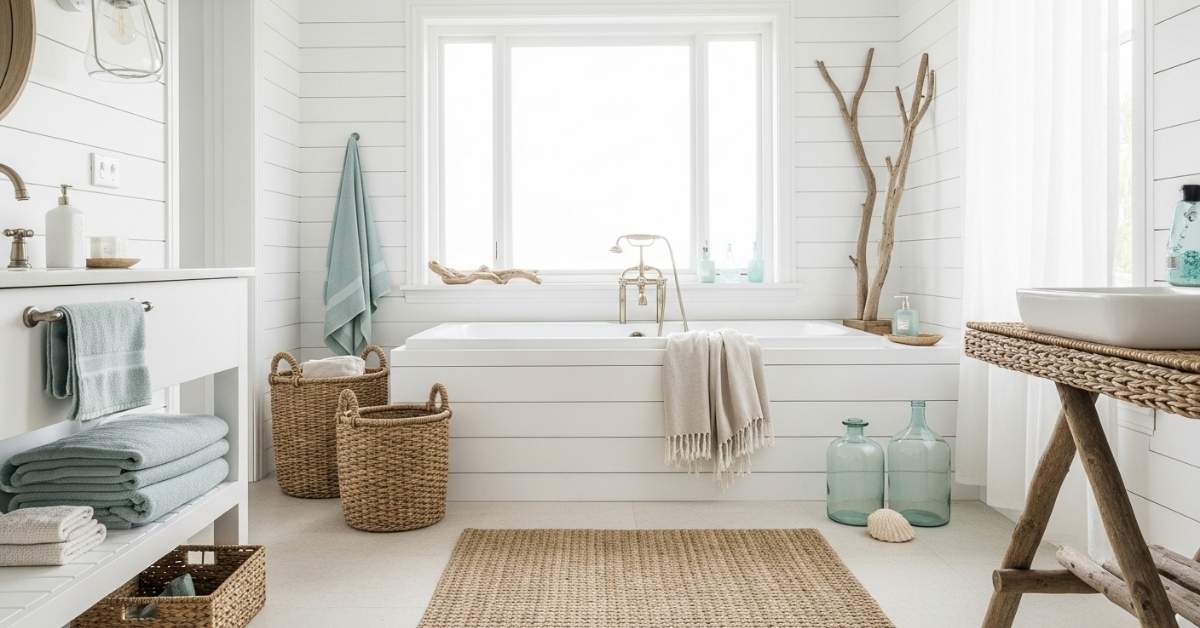
If your bathroom currently feels either too dark, too cluttered, or just weirdly unfinished, a coastal direction often fixes all three without requiring a full renovation. The color palette naturally leans light, Coastal Bathroom Ideas the materials favor texture over ornamentation, and the overall aesthetic rewards simplicity.
For anyone working with a small or mid-size bathroom the kind where layout and light matter more than square footage these ideas are specifically useful.
Shiplap Accent Wall Behind the Vanity
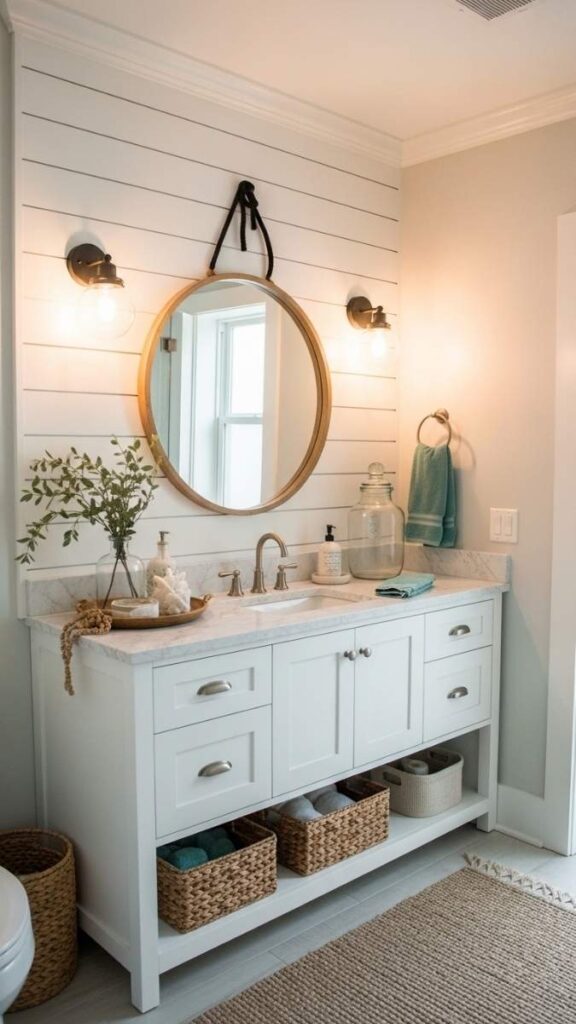
Shiplap in a bathroom isn’t just a nod to coastal aesthetics; it adds visual depth to what’s often the flattest surface in the room. Mounting it horizontally behind the vanity creates a backdrop that reads as intentional and architectural without requiring tile work.
Pair it with a simple floating vanity in white or light oak and wall-mounted sconces at eye level for even, shadow-free lighting. This setup works especially well in bathrooms that lack architectural character; the shiplap does the heavy lifting.
It also adds a subtle tactile contrast against smooth countertop surfaces like quartz or poured concrete. For renters, peel-and-stick shiplap panels are a reasonable workaround that read surprisingly well in photos and in person.
Soft Blue Gray Paint With a Warm White Trim
Muted blue-gray think dusty teal or weathered slate, not primary blue, sits at the center of most effective coastal color palettes. It photographs well, reflects natural light, and creates a sense of coolness without making the room feel cold.
The key is pairing it with warm white trim rather than bright white, which can make the contrast too stark. This combination works particularly well in north-facing bathrooms or those with limited natural light because it brightens without overcompensating.
It also reads cleanly behind most fixture styles chrome, brushed nickel, or aged brass all work. One paint change, one color decision. This is probably the single most efficient move in coastal bathroom design.
Woven Seagrass or Rattan Baskets for Open Storage
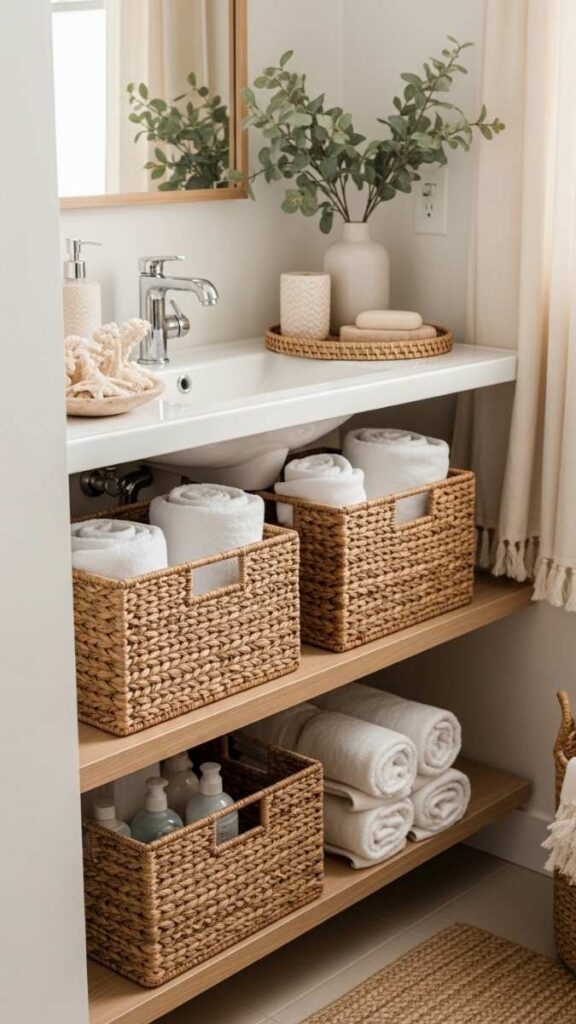
Open storage in a bathroom only works if the containers carry some visual interest on their own. Woven seagrass or rattan baskets do exactly that; they introduce organic texture in a way that feels deliberate rather than thrown together.
Use them to store rolled towels, backup toiletries, or haircare products you don’t want sitting on the counter. The rougher, natural texture of the weave contrasts well against smooth tile, painted drywall, and ceramic fixtures.
This setup works best in bathrooms where you need storage but don’t want to commit to built-in cabinetry. Functionally, they’re also easy to move, swap out, or replace. In my experience, this works best when you limit the basket variety to one or two similar styles rather than mixing multiple materials.
Pebble Tile Flooring in the Shower
Pebble tile flooring has a tactile, grounding quality that almost nothing else replicates at this price point. The rounded stones, typically river pebbles in gray, warm brown, or cream, are mounted on mesh backing and installed like standard tile, but the finished effect reads as genuinely artisanal.
Beyond aesthetics, the varied surface provides natural grip, which is a practical advantage in a wet area. It pairs well with smooth subway or large-format tile on the walls, since the contrast between rough and smooth keeps the space from feeling monotonous.
This is a permanent installation, so it’s better suited to homeowners than renters, but the labor cost is often comparable to standard floor tile. The grout color matters a lot: mid-tone sand or warm gray integrates better than stark white.
Driftwood Mirror Frame Above the Vanity
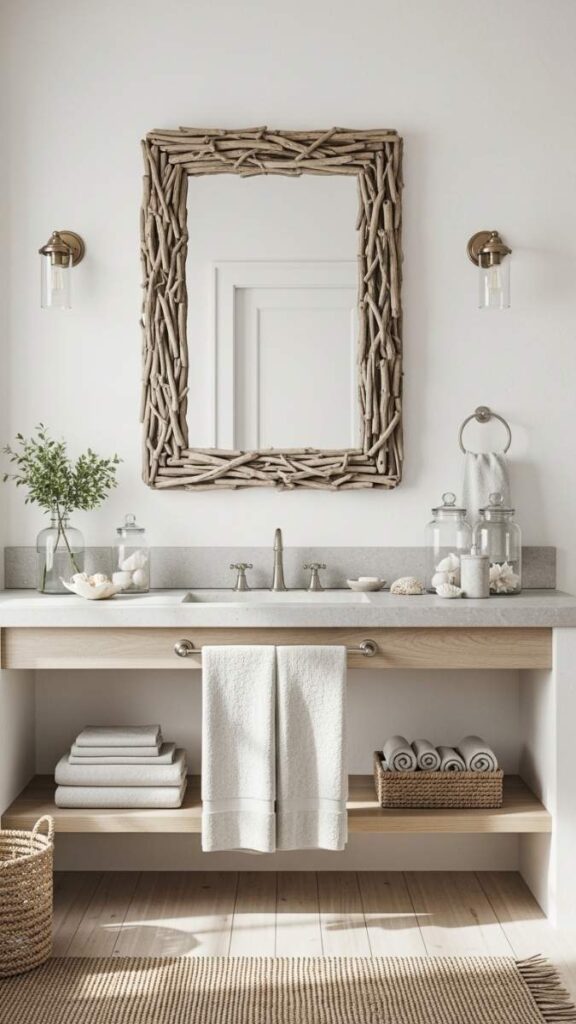
A mirror with a driftwood or weathered wood frame works harder than it looks. It breaks up the predictability of the standard rectangular frameless mirror while adding a warm organic element above what’s often a cold, reflective zone.
Driftwood frames tend to run lighter and more textural than other wood styles, so they don’t feel heavy above a small vanity. Functionally, the shape matters: a circular driftwood mirror above a rectangular vanity creates a geometric contrast that feels balanced rather than random.
For a narrow bathroom, a vertically oriented oval is a better choice since it draws the eye upward and makes the wall feel taller. This is a straightforward swap with no installation complexity beyond hanging which makes it one of the easier high-impact changes on this list.
Read More About: 17+ Coastal Color Palette Ideas That Make Any Room Feel Calm, Airy
Limewash Paint for a Lived In, Coastal Wall Finish
Limewash paint is having a genuine moment in 2026, and for good reason it gives walls an uneven, layered texture that reads as old and considered, not bare and empty. In a coastal bathroom context, it mimics the worn quality of beach-adjacent architecture without being literal about it.
The mottled surface means that natural light plays across the wall differently depending on the time of day, which keeps the room from feeling flat. Unlike flat or satin paints, the chalky, slightly irregular finish also hides minor wall imperfections better.
It works especially well in bathrooms with a freestanding tub or statement fixture; the background texture makes the focal piece stand out without needing additional decor. Most limewash paints are fully DIY-applicable with a wide brush and a dampened wall.
Vertical Subway Tile for Added Height
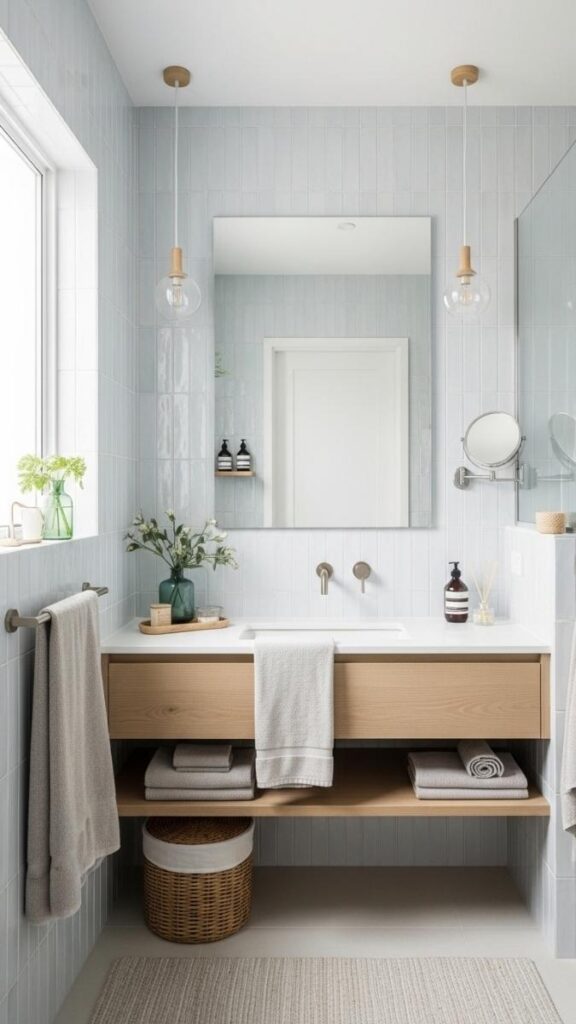
Standard subway tile installed vertically rather than horizontally changes how the room reads spatially. The eye follows the vertical lines upward, which makes low-ceilinged bathrooms feel taller than they are. This is especially useful in bathrooms under 8 feet, where the ceiling height can feel oppressive.
The coastal connection here is subtle vertical tile reads cleaner and more coastal when paired with soft grout in a warm beige or pale gray, rather than the crisp white grout that’s more common. The vertical orientation also suits smaller tiles better, giving the layout more movement without looking busy.
No additional cost over standard horizontal installation the material is the same. Just a layout decision that earns more than its effort.
Nautical Rope Towel Hooks
Hooks are often overlooked as a design element, but they sit in one of the most visible parts of the bathroom at eye level, used every day.
Rope-wrapped towel hooks add a coastal texture reference without being overtly themed. The rope material contrasts with the smooth wall surface and introduces a natural, hand-crafted quality that store-bought metal hooks don’t deliver.
Installed in a cluster of three on an unused wall section, they solve a real storage problem (towel hanging space) while adding visual rhythm. This is especially useful in bathrooms without a dedicated towel bar or where a bar doesn’t fit the layout. Most rope hooks screw into a standard wall anchor, so installation is simple.
They also hold up well in humid environments if they’re made with treated or synthetic rope.
A Single Piece of Coastal Artwork to Anchor the Space
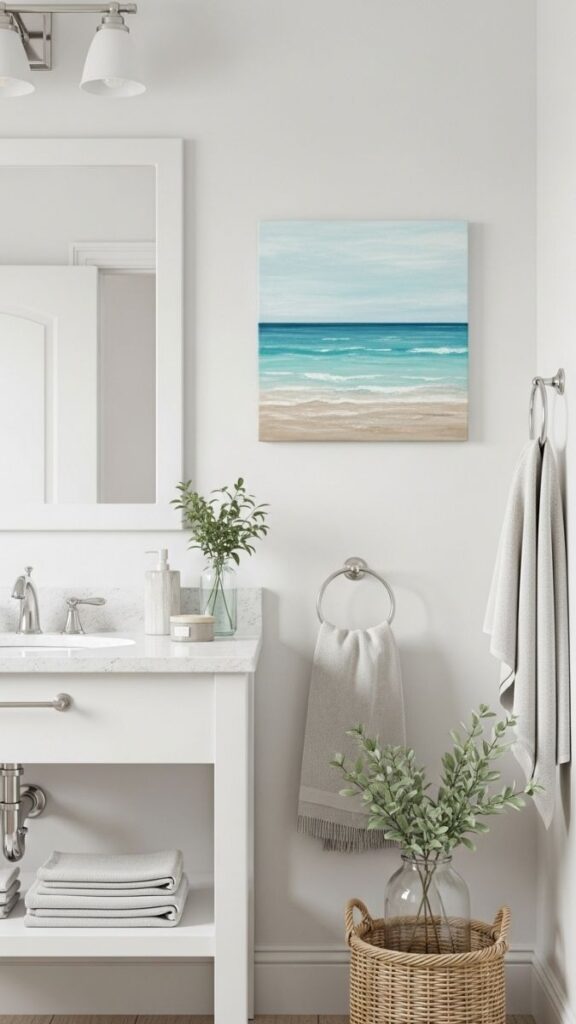
Artwork in a bathroom tends to go one of two directions: either too themed (pelicans, “BEACH” typography) or entirely absent. The stronger choice is a single, well-framed piece of abstract or photographic coastal art watercolor waves, an aerial ocean photograph, or an abstract in soft blue and sand tones.
Positioned above the toilet tank or on the wall facing the door, it becomes the room’s focal anchor and signals intentional design rather than decoration-by-default. Scale matters here. A print that’s too small on a large wall reads as timid. Generally, a frame that spans 60–70% of the wall width behind it looks proportionate.
For humid environments, choose prints behind glass and use a sealed frame to prevent warping. This is often the least expensive way to give an otherwise neutral bathroom a clear identity.
Freestanding Soaker Tub in White With Organic Curves
A freestanding tub is primarily a layout decision. Placed against a wall with space to walk around at least two sides, it makes the bathroom feel less like a utility room and more like a room with a purpose. Organic, slightly curved silhouettes work better for coastal aesthetics than the sharp-edged modern rectangle; the roundness echoes the softness of the overall palette. The visual weight of a tub is significant, so the surrounding elements should stay minimal: a simple floor-mounted faucet, a low bath caddy, a single candle.
This works best in bathrooms with at least 60 square feet of floor space and a floor that can support the tub weight when filled. It’s a major purchase, but one of the few bathroom additions that changes how the space feels daily.
Read More About: 74+ Small Coastal Setup Ideas That Make Any Room Feel Like a Beachside Retreat
Whitewashed Wood Floating Shelves for Layered Storage
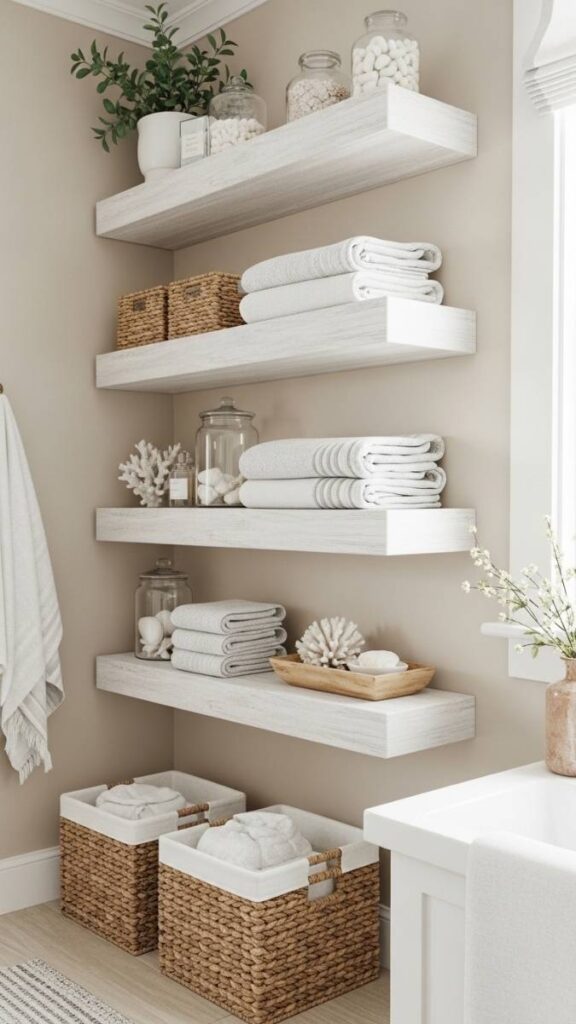
Whitewashed or limed wood has a particular quality in bathrooms: it reads as weathered without looking rough or unfinished, which makes it easier to keep the space feeling clean while still textural. Floating shelves in this finish work well as open storage when you need to display things you’d otherwise leave on the countertop.
The key is restraint in what goes on them. Three categories max: folded textiles, a small plant, and a single decorative object. Anything more and the shelf starts reading as clutter rather than curated storage.
This setup is especially practical for bathrooms without built-in linen closets; the shelves add genuine function while the whitewash keeps it visually light. For humid spaces, use a sealed or wax-finished wood rather than raw.
A Coastal Toned Mosaic Tile as a Feature Strip
A mosaic tile band running across the shower wall at waist or shoulder height breaks up the visual monotony of a single large-format tile installation without requiring a full pattern change. Blue-green, seafoam, or warm sand mosaics in 1″ or 2″ squares do this with minimal tile footage, which keeps material costs down.
The strip reads as a deliberate design line like a horizon and adds color exactly where the eye tends to rest in the shower. It also helps define the zone visually in a wet area that would otherwise look entirely uniform.
This works especially well in walk-in showers with glass enclosures, where the uninterrupted view of the wall needs some visual structure. A grout color pulled from the mosaic palette (rather than plain white) ties the strip into the wall more naturally.
Linen or Waffle Weave Shower Curtain in Natural Tones
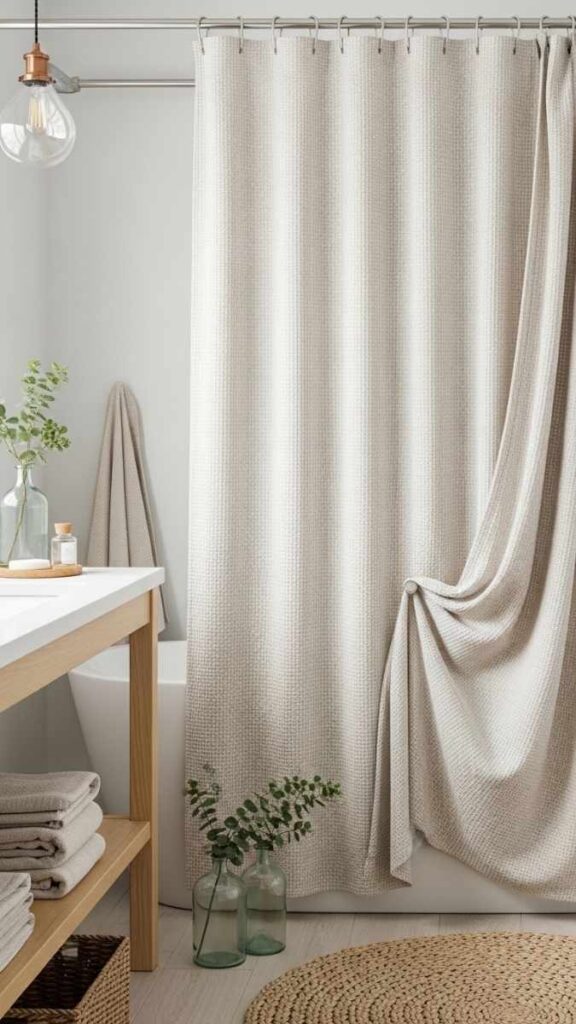
Shower curtains cover a disproportionately large amount of visual space in a bathroom. A floor-to-ceiling linen or waffle-weave curtain in white, natural, or oat immediately softens the room and pulls the ceiling taller particularly when the curtain rod is mounted close to the ceiling rather than just above the tub.
Linen works well for coastal aesthetics because the slight drape and natural texture feel soft without being fussy.
Practically, linen does absorb moisture, so a fabric with a slight polyester blend extends durability without sacrificing appearance. Waffle weave is a good alternative, slightly more structured, still soft, and easier to dry between uses. This is one of the easiest high-impact swaps in the bathroom: one item, significant visual return.
Warm Brass or Aged Brass Fixtures for a Lived-In Look
Warm brass fixtures have largely replaced brushed nickel in coastal and natural-material bathrooms over the past few years, and the shift is functional as much as aesthetic.
Aged brass doesn’t show water spots as readily as polished chrome, has more warmth that pairs well with natural textures, and reads as less clinical against off-white or natural-stone surfaces.
The lived-in quality of an unlacquered brass fixture which develops a patina over time actually becomes more appropriate in a coastal context as it ages. When switching fixtures, commit to a consistent metal across the space: faucet, towel bar, toilet paper holder, and robe hook should all match.
A mixed-metal bathroom requires confident styling choices to look intentional; a single-metal bathroom is much more forgiving of other decisions.
Sea Glass or Blue Bottle Accents on Shelves
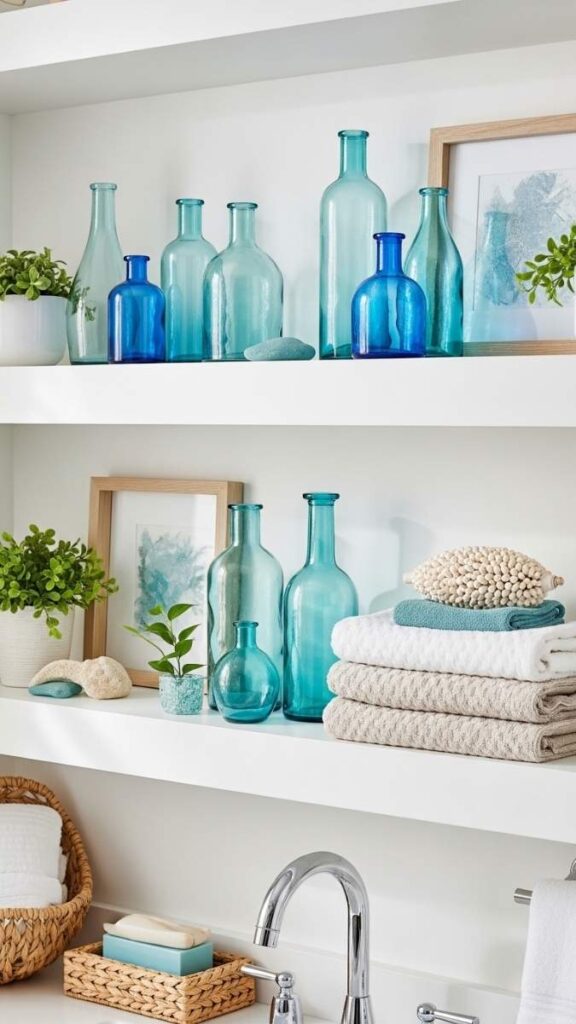
Sea glass and colored glass bottles in pale aqua, muted green, or soft amber work as low-commitment coastal accents that earn their place through color and light interaction. When sunlight or a window reflection hits a cluster of sea glass on a shelf, it scatters soft color across surrounding surfaces in a way that no candle or print replicates.
This isn’t a thematic decoration choice so much as a material one. Glass has transparency and depth; ceramics and textiles don’t. On a whitewashed shelf or a white countertop, a grouping of three to five sea glass pieces adds color with a lightness that heavier objects lack. I’ve noticed this style tends to look most coherent when you stay within one color family either all cool blues and greens or all warm ambers rather than mixing across the spectrum.
Coastal-Inspired Penny Round Tile in the Shower Floor
Penny round tile in seafoam, sage, or muted ocean blue works in the shower floor for the same reason pebble tile does small-format tile is visually interesting and naturally grippy. But penny rounds have a cleaner, more graphic quality that works better in contemporary or minimal coastal bathrooms than the more organic pebble tile.
The circles create a quiet pattern that reads from above as a single color field until you look closely. Grout color makes or breaks the effect: white or light gray grout emphasizes the tile shape, while a grout closely matched to the tile creates a more monolithic, quieter look.
This is a permanent installation that requires standard tile-setting skills accessible for a moderately experienced DIYer or most tile installers. For a bathroom with an otherwise neutral palette, the shower floor is a contained spot to introduce a coastal color without overcommitting.
Read More About: 61+ Small Apartment Ideas That Make Every Square Foot Work Harder
Wood Toned Vanity With a Stone or Concrete Countertop
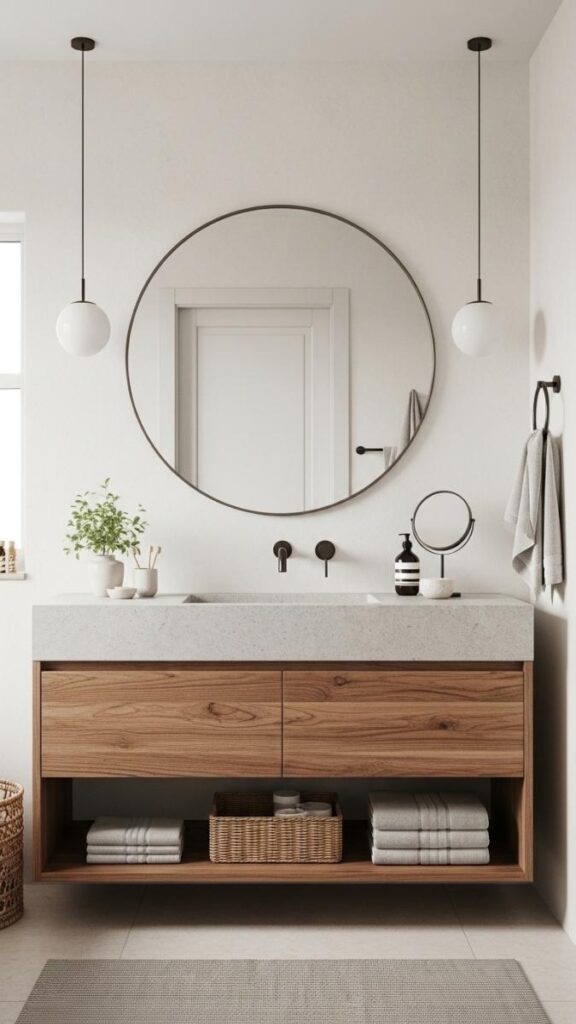
A warm wood vanity paired with a concrete or stone countertop creates a material contrast that’s both grounded and calm. The wood provides warmth; the stone or concrete reads as structural, slightly raw, and cooler in tone, a balance that anchors the space without making it feel cold or clinical.
This pairing works particularly well with undermount sinks (which keep the countertop surface clean and uninterrupted) and simple gooseneck faucets. In small bathrooms, a floating vanity where the cabinet is wall-mounted above the floor makes the floor area appear larger by leaving floor space visible underneath.
This is one of the more involved changes on this list in terms of installation, but it genuinely changes how a bathroom reads from the doorway. It’s the kind of update that photographs well and holds up over time without chasing trend cycles.
Vertical Beadboard Paneling in the Lower Half of the Wall
Beadboard paneling the narrow vertical grooves running floor to chair rail height has strong coastal architecture roots without being aggressively themed. It adds texture at the lower wall zone, which is often the most visually ignored part of a bathroom, and creates a natural horizontal break that makes it easy to use two different finishes or colors (paneling below, paint or tile above).
The vertical lines of the beadboard also make walls feel taller in bathrooms with low ceilings, similar to the effect of vertical subway tile but with a warmer, more traditional quality. Primed and painted beadboard panels installed with adhesive and finish nails are one of the more accessible wall treatments for a DIY approach.
In a small bathroom, limiting it to one feature wall (typically the vanity wall) is enough to read as intentional without closing the space in.
A Rainfall Showerhead for Sensory Impact
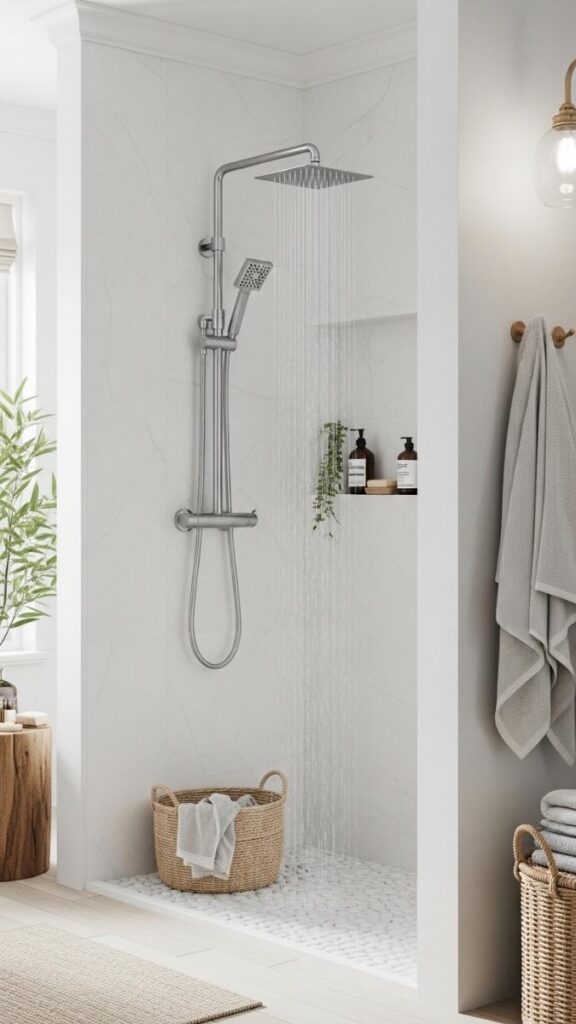
A rainfall showerhead is primarily a sensory decision, but it carries a clear visual effect as well. Mounted flush to the ceiling, it eliminates the standard wall-mounted fixture and leaves the shower enclosure cleaner and less broken up by hardware. In visual terms, the uninterrupted tile wall reads larger and calmer.
In practice, the rainfall spray distributes water across a wide surface, which is more comfortable for a slow, unhurried shower, a quality that aligns naturally with the coastal bathroom’s overall “slow down” orientation. Installation requires ceiling plumbing, which makes this a renovation-level choice rather than a quick swap.
It’s most practical when you’re already doing tile work or replumbing. The fixed overhead position is also worth considering for households with significant height variation; it suits some bodies better than others.
Sandy Beige or Warm Greige Walls as the Base Palette
Not every coastal bathroom needs blue. Sandy beige or warm greige, the mix of gray and beige that dominates natural material palettes, grounds a space in the textures and tones of the shore without the directness of a blue or green wall.
This palette works particularly well as a base for other coastal elements: natural wood, woven textiles, and ceramic accessories all read better against a warm neutral than against a cool white or a saturated blue. It also has more longevity than trend-specific colors. Greige walls work with chrome, brass, or matte black fixtures equally well, which gives you flexibility to update hardware without repainting.
In a bathroom with limited natural light, a warm greige reads more inviting than a cool gray; the underlying beige prevents the room from feeling stark.
Woven Jute Bath Mat in Natural Fiber
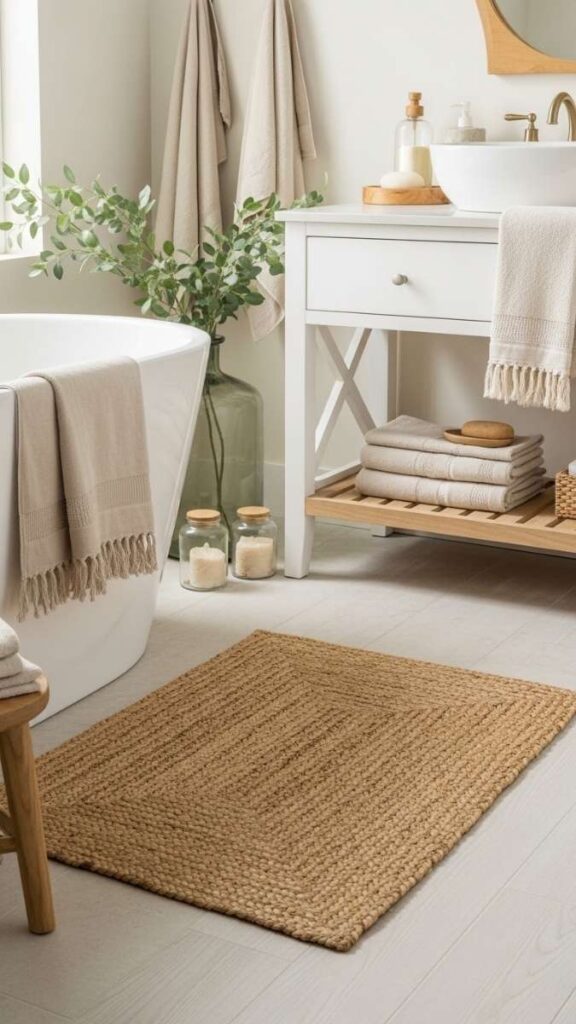
A jute or seagrass bath mat is a small addition that earns attention through texture. The tight natural weave has a weight and roughness that standard fabric bath mats don’t have; it reads more like a design element than a utility piece.
Functionally, jute mats are firm underfoot and hold their shape well, though they’re better suited to bathrooms where the mat dries relatively quickly between uses rather than high-humidity enclosed spaces.
A round jute mat in front of a freestanding tub creates a deliberate pause in the floor surface, a defined moment in the layout rather than a random rectangle of fabric.
For bathrooms with tile floors, the organic texture of the weave contrasts well with the hard surface beneath it. This is an inexpensive way to add the material palette of coastal design at floor level.
Floating Concrete or Stone Ledge in the Shower
A built-in shower ledge solves the practical problem of where to put bottles, a razor, and a small candle while also reading as a design decision rather than an afterthought. A concrete or stone ledge even just 4–5 inches deep at chest height or slightly lower looks intentional in a way that a standard chrome shelf caddy doesn’t.
The material matters: concrete or honed stone reads as the same natural, slightly rough aesthetic that coastal bathrooms favor. It’s also easier to clean.
In layout terms, a full-width ledge running from one side of the shower to the other gives the enclosure a strong horizontal line that makes the space feel wider.
This is a tile-setting project that typically requires a backer board ledge frame accessible for a renovation but not a quick swap.
Coastal Ceiling Treatment in Pale Blue or Soft White
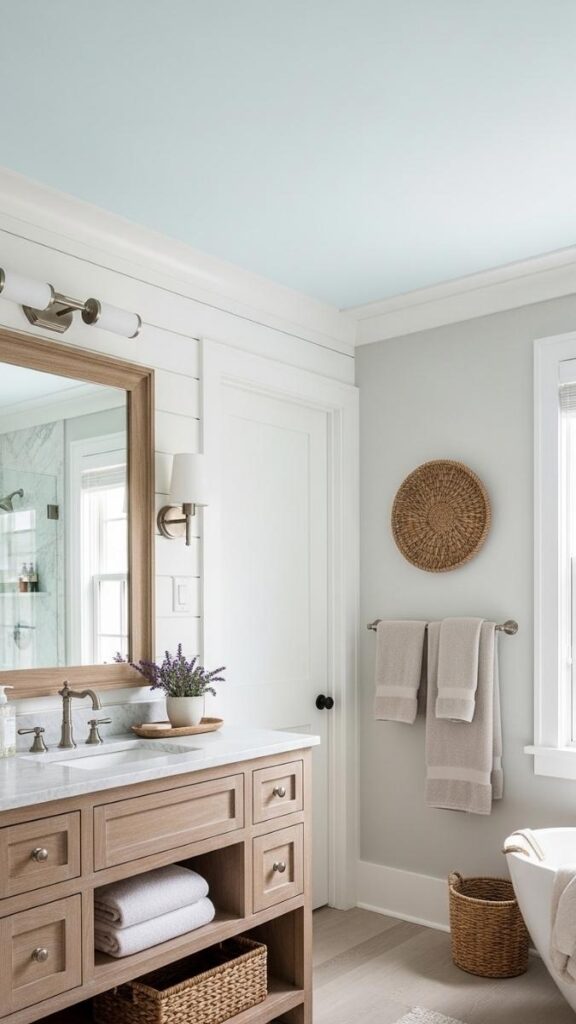
Ceilings are consistently underused in bathroom design. Painting the ceiling a pale blue the color of a hazy sky or shallow water does something interesting to a bathroom’s atmosphere: it softens the boundary between wall and ceiling and makes the room feel more enveloping without making it feel smaller.
Pale blue ceilings specifically make white walls appear slightly warmer by contrast, which helps if the wall color is a very cool white or bright white. In a narrow bathroom, this can work better than a colored wall because it doesn’t eat into the perceived width of the space.
The paint change is inexpensive and reversible, but the ceiling requires ceiling-specific paint (usually a flat or matte finish to hide the imperfections from steam and condensation) and good coverage given the surface area.
A Potted Trailing Plant Near the Window
Plants in bathrooms serve a double function: they introduce living organic texture and, where there’s natural light, they grow visibly and change, which keeps the room from feeling static. Trailing plants like pothos or string of pearls work especially well in bathrooms because they tolerate humidity well and require minimal light.
Positioned on a windowsill or on a shelf near natural light, a trailing plant draws the eye upward and creates movement in a space that’s otherwise all hard surfaces. Coastal design aesthetics lean toward natural elements, and plants are one of the most direct ways to bring that quality in without adding more decor layers.
For bathrooms without natural light, air plants are a low-maintenance alternative that still provide organic texture without requiring photosynthesis.
Dark Grout With White Tile for Contrast and Pattern Clarity
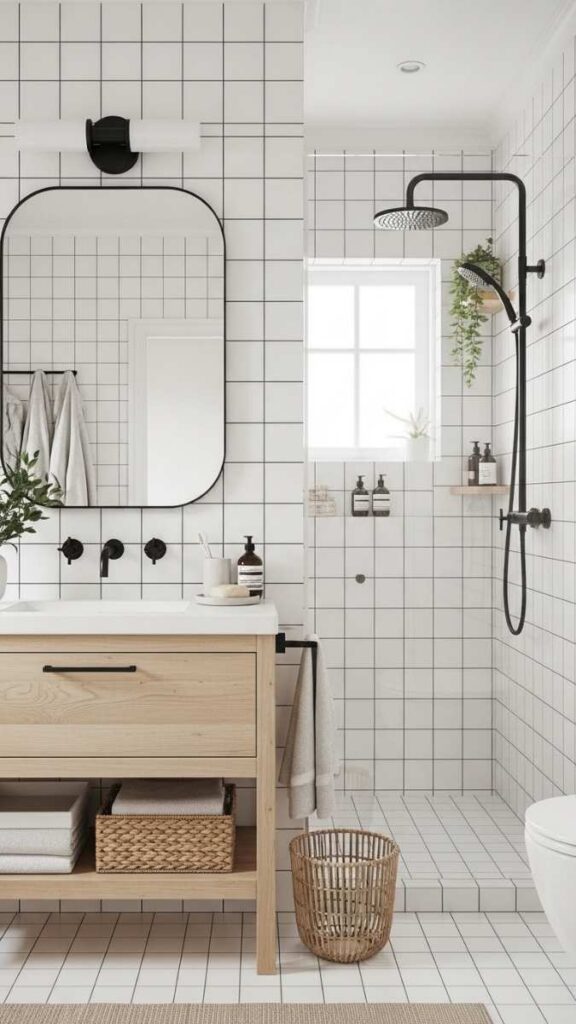
Dark grout on white tile is a design decision that sounds counterintuitive but reads confidently in the finished bathroom. The dark grout lines define the tile grid as a deliberate pattern rather than a background surface, which makes even plain square tile look considered and intentional.
In a coastal bathroom, dark charcoal or slate grout against white subway or square tile creates a graphic quality that grounds the otherwise airy, soft palette a contrast between the clean crispness of white and the earthier tones of a charcoal that resembles dark sand or wet stone.
Functionally, dark grout also hides staining far better than white grout, which degrades over time even with regular cleaning. This is a finishing decision made at installation, a good choice to consider if you’re re-tiling or doing a new build.
Wicker or Rattan Pendant Light Above the Tub or Vanity
Overhead lighting in a bathroom typically comes from a single recessed fixture or a builder-grade flush mount, both of which are functional but visually uninteresting. A woven rattan or wicker pendant light introduces texture at ceiling level while also changing the quality of the light. The woven material diffuses light rather than casting it sharply, which is softer on the eye in a bathroom context.
Positioned above the vanity or centered over a freestanding tub, it also works as a room focal point from the doorway. Pendant installation requires a ceiling junction box straightforward for an electrician, manageable for a confident DIYer.
One practical consideration: the woven basket style diffuses light through the sides and top rather than directing all light downward, so it’s better paired with a secondary sconce at eye level for task lighting at the mirror.
Layered Lighting With a Dimmer Switch
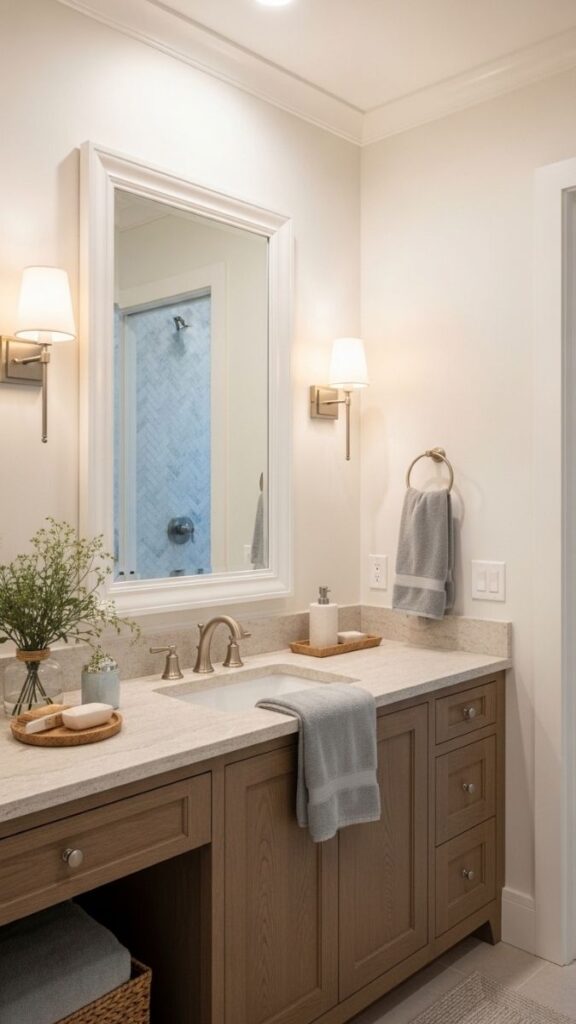
Single-source lighting flattens a bathroom; it casts even illumination with no variation, which removes depth from surfaces, materials, and textures. Layered lighting (overhead ambient, task lighting at the mirror, and a lower accent or toe-kick LED) allows the bathroom to function differently at different times of day. In the morning, all three layers are on.
At night, just the lower accent or the sconces at low warmth. In a coastal bathroom specifically, the layered approach makes natural materials wood, woven rattan, textured tile look better because the angled light catches surface variation.
Adding a dimmer switch costs around $20 and connects to any existing switch box. This is probably the least expensive improvement on this list relative to how much it changes the room’s daily character.
What Actually Makes These Coastal Bathroom Ideas Work
Coastal bathroom design fails most often for one of three reasons: too much thematic decoration (anchor motifs, “BEACH” signs, coral-colored everything), too little material consideration, or poor lighting that flattens every texture you’ve introduced. The ideas that hold up best share a few things in common.
First, they favor material over decor. A concrete ledge, pebble tile floor, or limewash wall creates interest through texture and material quality rather than objects placed on surfaces. Objects can be swapped, moved, or accumulated materials are committed decisions that read consistently.
Second, they don’t over-index on color. The strongest coastal bathrooms in 2026 tend to use the blue-green spectrum sparingly as an accent tile, a ceiling color, or a towel rather than wall-to-wall. The natural material palette (jute, driftwood, seagrass, concrete, stone) carries more of the aesthetic load than color.
Third, they solve real layout problems. Good coastal design in a bathroom often starts with answering questions like: where do towels go? Where does light land? Is the vanity zone awkward? The ideas that make bathrooms feel genuinely better address those questions while looking good, not just look good in isolation.
Coastal Bathroom Style vs Minimal Bathroom: Which Works Better for Your Space?
| Style | Space Type | Budget Level | Visual Effect | Problem It Solves | Best Feature |
| Coastal (full) | Medium to large bathrooms | Mid to high | Warm, textural, layered | Empty or characterless space | Material depth and palette cohesion |
| Coastal (minimal) | Small bathrooms, rentals | Low to mid | Airy, clean, organic | Cluttered or cold feel | Texture without visual weight |
| Minimal (modern) | Any size | Low to high | Sharp, cool, graphic | Busy or over-decorated space | Clarity and simplicity |
| Coastal + Japandi mix | Small to medium | Mid | Calm, warm, quiet | Dark or uninspiring space | Warm neutrals with natural material |
| Budget coastal | Small to medium | Low | Soft, approachable | No personality or warmth | Accessible entry point |
How to Avoid Common Coastal Bathroom Mistakes
Over-theming the space.
Coastal design works when it’s implied, not announced. If every surface has an anchor, a shell, or the word “BEACH” on it, the room reads as a theme park rather than a home. One or two explicit coastal references, a sea glass vase, a piece of coastal artwork is enough. The rest should come from palette and material.
Ignoring the ceiling.
A flat, builder-grade white ceiling reads as unfinished in a bathroom with a developed design scheme. Even painting it the same color as the walls (or a shade lighter) gives the room a more enclosed, considered quality. A pale blue ceiling is one of the most underused coastal bathroom choices at any budget.
Using too many competing textures.
Natural material palettes look best when the textures speak to each other. woven jute with whitewashed wood and rough pebble tile makes sense as a material story. Adding lacquered high-gloss cabinets or polished marble to that mix disrupts the coherence. Edit the material list to three or four related textures and commit.
Bad lighting in the mirror.
Overhead lighting alone creates downward shadows that distort the face in the mirror. Sconces mounted at eye level on either side of the mirror, even simple ones, solve this immediately. This is a practical fix as much as a design one.
Fixtures that don’t match.
In a small bathroom, mismatched metals (chrome towel bar, brass faucet, black cabinet pulls) fragment the eye’s path around the room. Committing to one metal family across all fixtures is the simplest way to make a bathroom feel more cohesive without changing anything structural.
FAQ’s
What colors work best for a coastal bathroom?
Muted blues, seafoam greens, sandy beige, and warm greige are the most versatile coastal bathroom colors. They work best when used in combination for instance, a greige wall with a soft blue accent tile rather than covering the entire bathroom in one coastal color. White and warm off-white work well as base colors that allow other natural materials to stand out.
How do I make a small bathroom feel coastal without cluttering it?
Focus on material over decor: pebble tile, whitewashed wood, or limewash paint add coastal texture without adding objects. Keep surfaces clear and limit open storage to one or two woven baskets. A single well-placed piece of art or a trailing plant near the window can anchor the aesthetic without occupying floor or counter space.
What’s the difference between coastal and nautical bathroom design?
Coastal design is material-led and color-led natural textures, muted blues and greens, organic forms. Nautical design is theme-led anchors, ropes as decoration, navy and white stripe patterns, marine iconography. Coastal reads as broadly livable; nautical reads as more specific and easier to outgrow. Most modern “coastal” bathrooms deliberately avoid nautical motifs.
Is coastal bathroom design a passing trend or a long-term style?
Coastal design as a broad category has stayed relevant for decades because it’s rooted in natural materials and a light color palette both of which are perennially appealing. The specific execution shifts (limewash is very 2025–2026; shiplap peaked earlier), but the underlying material logic wood, stone, organic texture, airy palette has staying power. Avoiding highly trend-specific elements keeps a coastal bathroom from dating quickly.
What’s the easiest coastal bathroom upgrade on a tight budget?
A combination of new shower curtain (linen or waffle-weave in natural or white), woven basket storage, and a sea glass or colored glass accent group costs under $80 total and shifts the room’s material palette noticeably. Adding a dimmer switch to the existing overhead light extends the room’s usefulness and atmosphere at night for about $20 more.
Do coastal bathrooms work in landlocked areas or apartments?
Yes. Coastal bathroom design is about materials and palette, not location. An apartment in a landlocked city can have the same warm, airy, textural quality as a beach house bathroom; the design elements that create that feeling work regardless of geography. Renters should focus on reversible changes: shower curtain, light fixture, accessories, peel-and-stick wallpaper or tile, and woven storage.
How do I add coastal texture without renovating?
Woven baskets, linen or waffle-weave textiles, a driftwood mirror frame, rope-wrapped hooks, and a jute bath mat add natural texture with no permanent changes. Layering two or three of these elements across different surfaces (floor, wall, shelf) creates enough material variety to shift the room’s tone without touching a single tile or fixture.
Conclusion
A bathroom doesn’t need to be large or recently renovated to feel right. Most of these ideas work on top of whatever’s already there: a coat of limewash paint over existing walls, a new shower curtain, a woven basket where there was clutter, layered lighting where there was a single overhead fixture. The cumulative effect of two or three of these changes consistently outperforms a single expensive purchase.
Start with the ideas that address your bathroom’s specific friction, poor lighting, awkward storage, cold surface feel, or lack of visual identity. Pick one or two from this list that match your current space, budget, and timeline, and go from there. Coastal design rewards simplicity: the less you force it, the more naturally it comes together.