28+Gallery Wall Ideas for Your Living Room That Actually Work in Real Homes
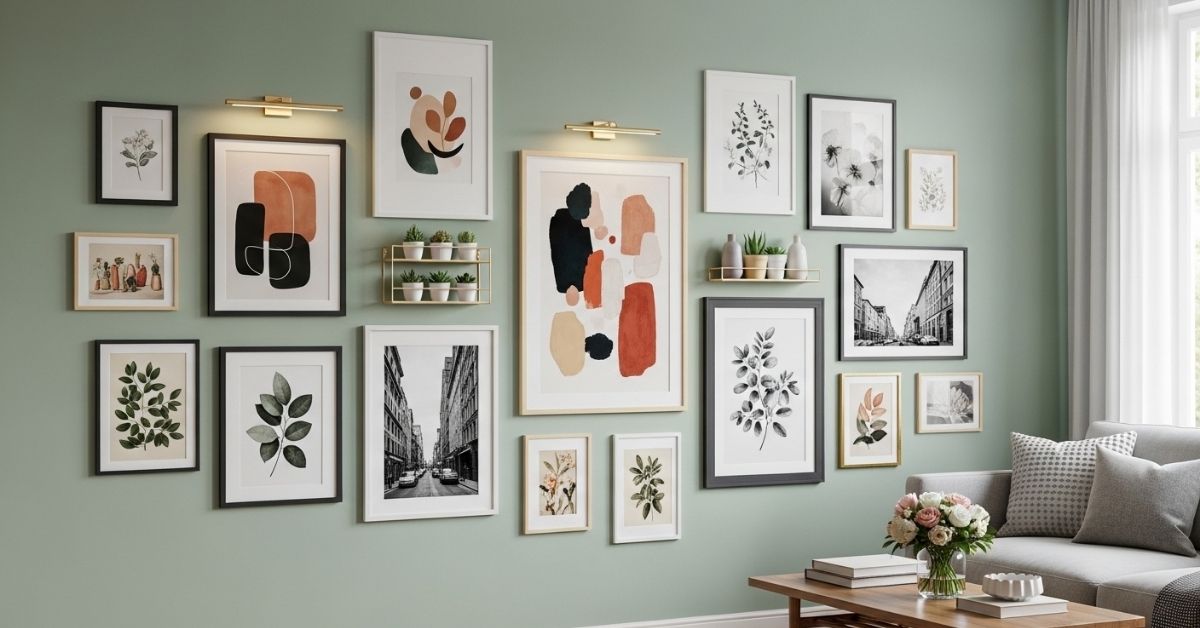
Gallery walls work because they let you fill vertical space with personality without committing to one oversized piece of art. But the difference between a curated wall and a cluttered one comes down to a few practical decisions: frame spacing, scale variation, and how the arrangement relates to your furniture below. In 2026, the trend is shifting away from the “more is more” Gallery Wall Ideas Your Living Room approach toward intentional, edited arrangements, fewer pieces, more breathing room, stronger visual anchors.
If you’re working with a living room that feels unfinished, too minimal, or just lacking a focal point, a well-planned gallery wall is one of the most flexible solutions available especially for renters who can’t paint or make permanent changes.
Symmetrical Grid of Black Frames on a White Wall
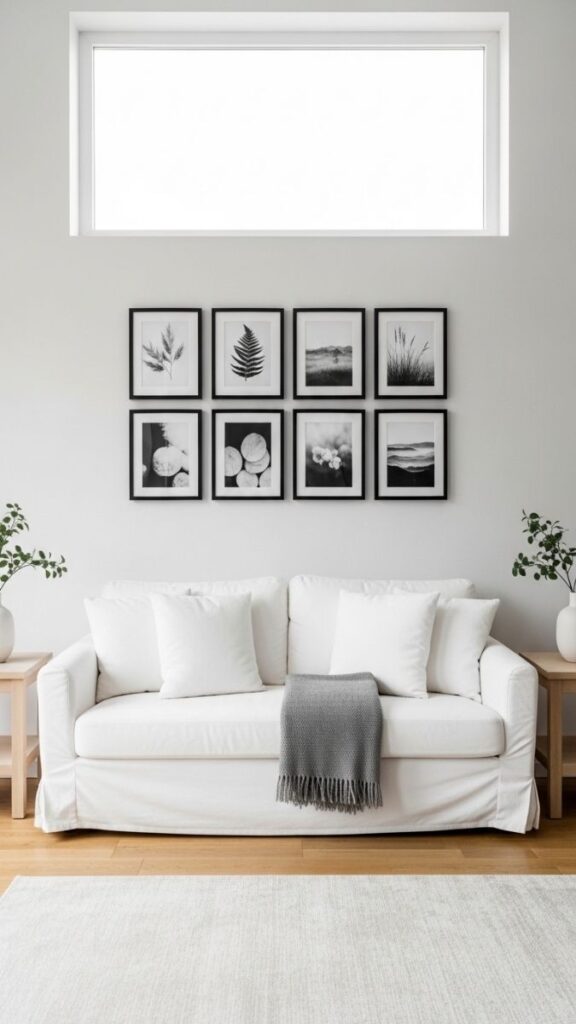
A grid layout works because the human eye reads repetition as order. Nine matching black frames, evenly spaced at about two inches apart, create a strong geometric anchor above your sofa without demanding a lot of visual decision-making. The frames do the heavy lifting; what’s inside them matters less than the consistency of the arrangement. This setup works especially well in living rooms with low ceilings because the tight horizontal spread emphasizes width rather than height. It’s also one of the easiest layouts to execute without a professional tape, a level, and a measuring tape are all you need. Go for matte black over glossy for a finish that reads modern without feeling cold.
Mixed-Size Frames in a Centered Salon-Style Arrangement
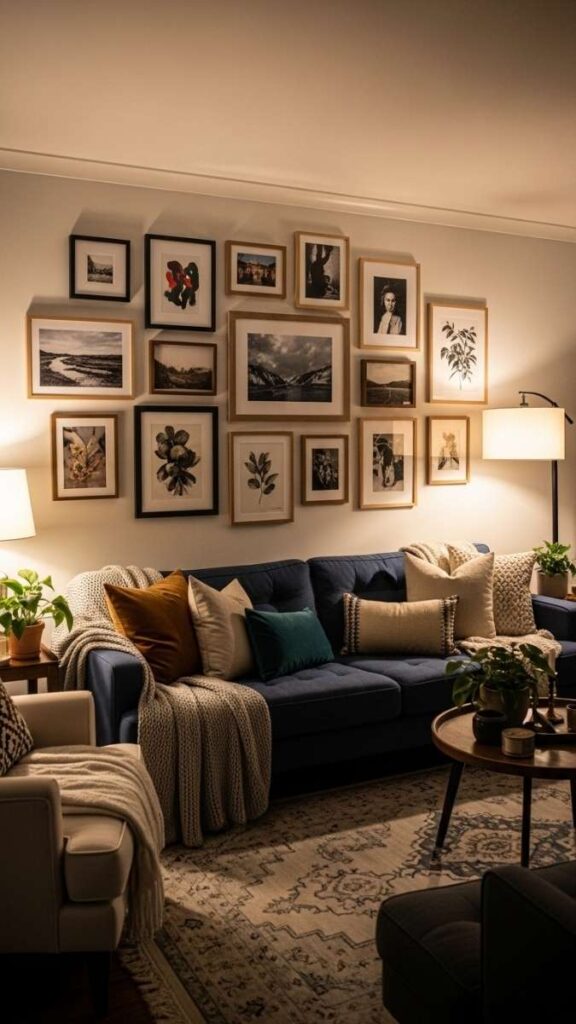
The salon wall style frames of varying sizes arranged around a central large piece creates the kind of layered, collected look that suggests the space evolved over time rather than being assembled in an afternoon. Anchor it with one large piece (at least 16×20) at eye level, then build outward with smaller frames. The key is keeping consistent spacing (two to three inches between frames) so the variety in size doesn’t tip into chaos. In my experience, this works best when you stick to two or three frame finishes, mixing too many metals or wood tones makes the arrangement feel unfocused rather than eclectic. Great for larger living rooms where a single piece of art would feel underwhelming against an expansive wall.
Floating Shelves with Leaned Art and Small Objects
Instead of nailing everything to the wall, floating shelves give you a gallery wall that’s completely reconfigurable. Lean prints and framed photos against the wall rather than hanging them, and fill in with small objects: a ceramic vase, a candle, a small plant. This setup is ideal for renters who want visual impact without permanent holes, and it’s one I’d actually recommend trying first if you’re new to gallery walls because you can adjust everything freely before committing. The layered depth (frames behind objects) adds dimension that a flat hung arrangement can’t replicate. Works in narrow living rooms where you want the wall to feel filled without the visual weight of a dense frame cluster.
Oversized Single-Print Flanked by Smaller Pieces
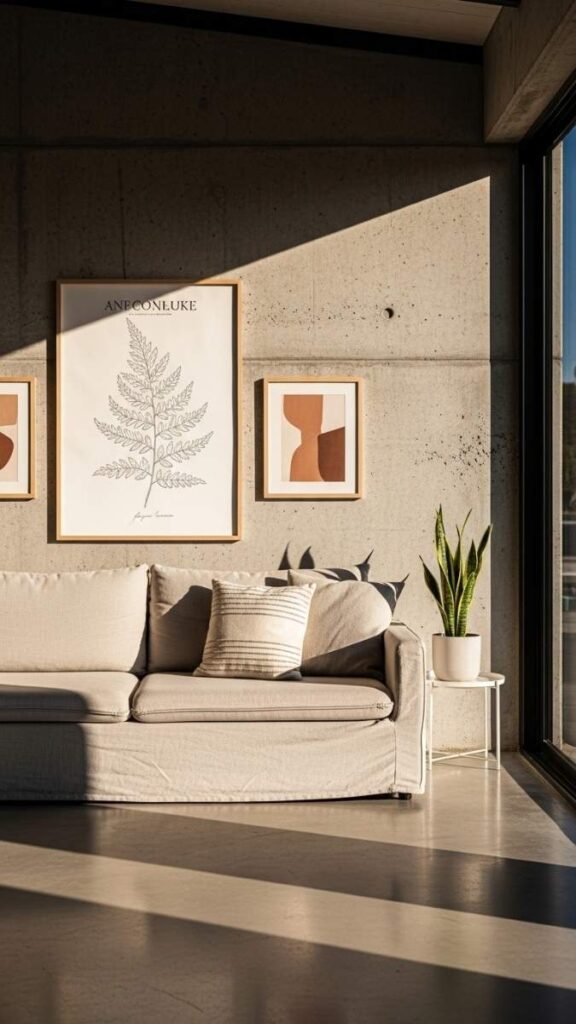
Not every gallery wall needs to be dense. A large statement print 24×36 or bigger flanked by two smaller pieces at varying heights creates an asymmetrical trio that feels intentional and modern. The spacing matters here: the smaller pieces should sit close enough to read as a group but not so tight that they compete with the main print. This format is especially useful in living rooms where you want a focal point without the commitment of a full-wall arrangement. It also photographs well and reads cleanly on smaller walls where a full grid would feel overwhelming.
Read More About: 33+Spring Home Decor Ideas That Actually Make Your Space Feel Different
All-White Frames with Black-and-White Photography
The tonal consistency of white frames and monochrome photography creates a gallery wall that feels cohesive even when the image subjects vary widely; portraits, landscapes, architectural shots, and abstract images all coexist without friction. This works because color is the usual source of visual tension in mixed-image arrangements, and removing it eliminates that problem entirely. The result is calm and orderly. Works particularly well in living rooms with white or off-white walls where you want the arrangement to feel airy rather than heavy. A good budget option too black and white prints are widely available and easy to source.
Vertical Column of Frames on a Narrow Wall
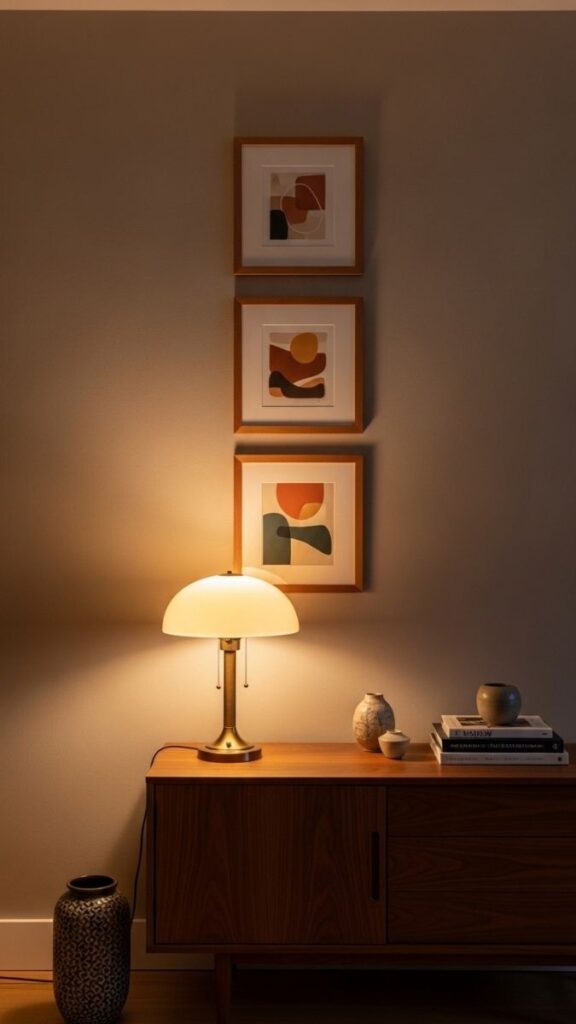
Narrow walls, the kind between two doorways or beside a fireplace are awkward to decorate because most layouts assume horizontal space. A clean vertical column of three frames, stacked with consistent spacing, turns that constraint into a design feature. The vertical line draws the eye upward, which makes the ceiling feel higher. Choose a slightly larger frame at the center and smaller ones above and below for a subtle hierarchy that keeps it from looking like a checklist. This is a particularly useful format in apartments where the living room wall space is broken up by doors, windows, or built-ins.
Eclectic Mix of Art, Mirrors, and Wall Objects
Introducing a mirror into a gallery wall does two things: it breaks the predictable frame-only pattern and it reflects light back into the room. Add in a woven textile or wall hanging and the arrangement picks up texture alongside the visual variety. The practical rule here is to keep the mirror as one of the larger pieces; it anchors the composition and prevents the non-frame objects from feeling like afterthoughts. This eclectic format is flexible enough to evolve: you can swap pieces in and out as your taste shifts without dismantling the whole arrangement. Best in living rooms with warm lighting where the mixed materials can catch the light at different angles.
Large-Scale Art Prints in a Horizontal Row
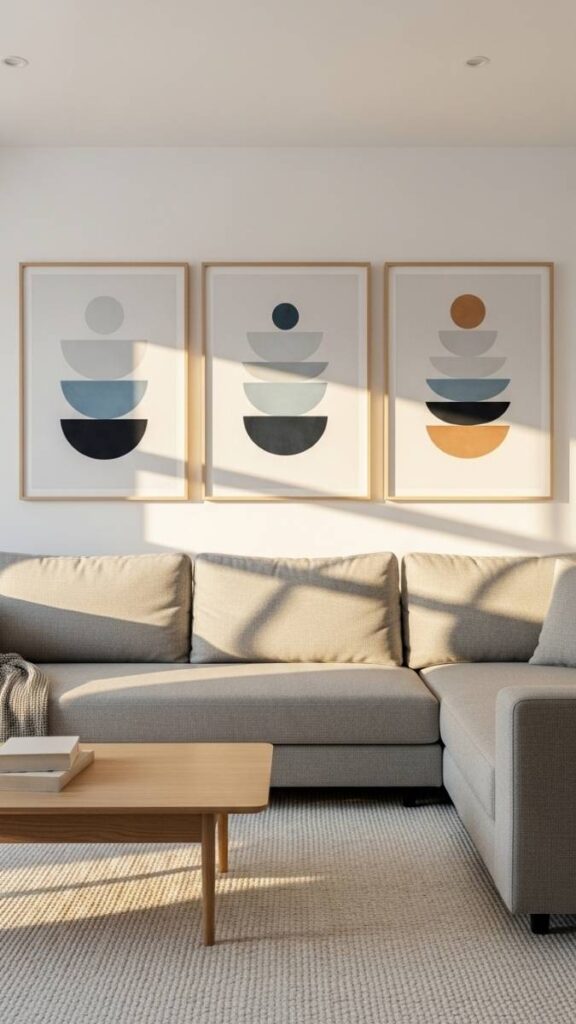
Three large prints of identical size, hung in a horizontal row at the same height, create a wide panoramic effect that suits long, low sofas well. The visual logic here is simple: it mirrors the horizontal line of the furniture below, creating a balanced relationship between the wall and the seating. This layout is clean and easy to execute, but it requires enough wall width to breathe crowding three large frames on a short wall reads as claustrophobic. Ideal in open-plan living rooms where the gallery wall needs to define the seating zone without closing it off.
Kids’ Artwork Gallery with Uniform Clip Frames
Displaying kids’ artwork in clip-style frames (the kind where you just swap the print) creates a practical gallery wall that can rotate seasonally. The frames do the design work keeping the size and style consistent and makes even the most colorful, varied artwork look intentional on the wall. This is more functional than it looks: it gives children ownership over a section of the home without sacrificing the overall feel of the room. Works in family living rooms where the wall near the sofa needs to feel personal but not chaotic. Budget-friendly and completely renter-safe with removable hooks.
Read More About: 26+DIY Bedroom Decor Ideas That Actually Work in Real Homes
Dark Wall Gallery with Gold and Brass Frames
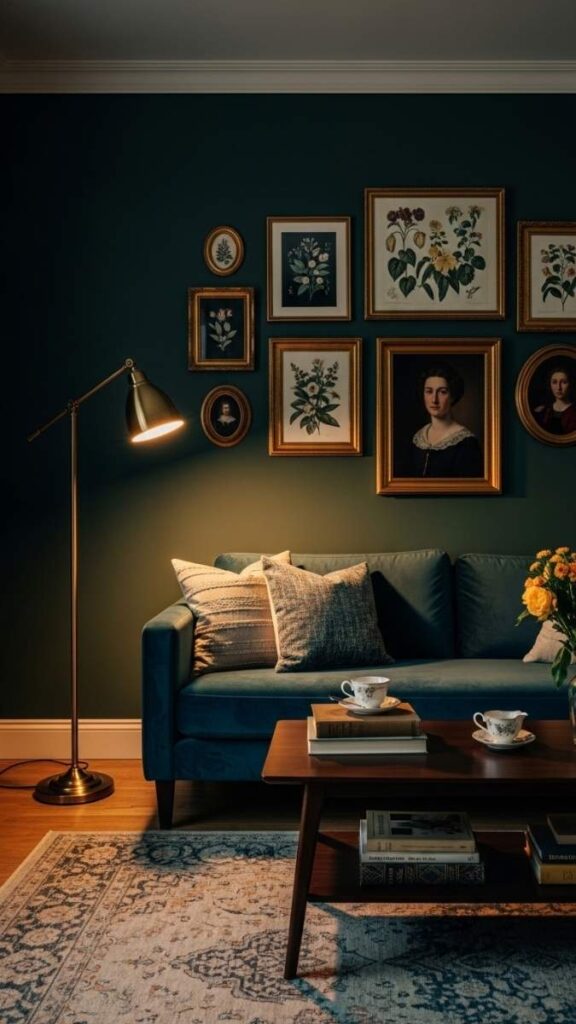
A dark-painted wall flips the usual logic instead of frames standing out against a light background, the wall itself becomes part of the composition. Gold or brass frames against a deep green, navy, or charcoal wall create a rich, layered effect. The arrangement doesn’t need to be as precise as a white-wall grid because the dark background naturally blends the spacing between frames. This is worth considering if your living room lacks natural light and you’ve been resisting dark paint because it might feel heavy. A gallery wall on the dark surface actually makes the wall feel more deliberate and less dark by giving the eye multiple points to land on.
Travel Photo Gallery in Natural Wood Frames
A travel gallery wall is personal by definition, and that’s its strength it tells a story that a curated art collection can’t. The practical move is to use consistent natural wood frames (light oak or walnut) and print your photos in a uniform size so the variety of the images doesn’t compete with inconsistent framing. Arrange them in a loose grid with slightly more spacing than usual three to four inches to give the arrangement an unhurried feel. This format works well in casual living rooms where the overall tone is relaxed and personal rather than formal or minimal.
Botanical Print Collection in Thin Metal Frames
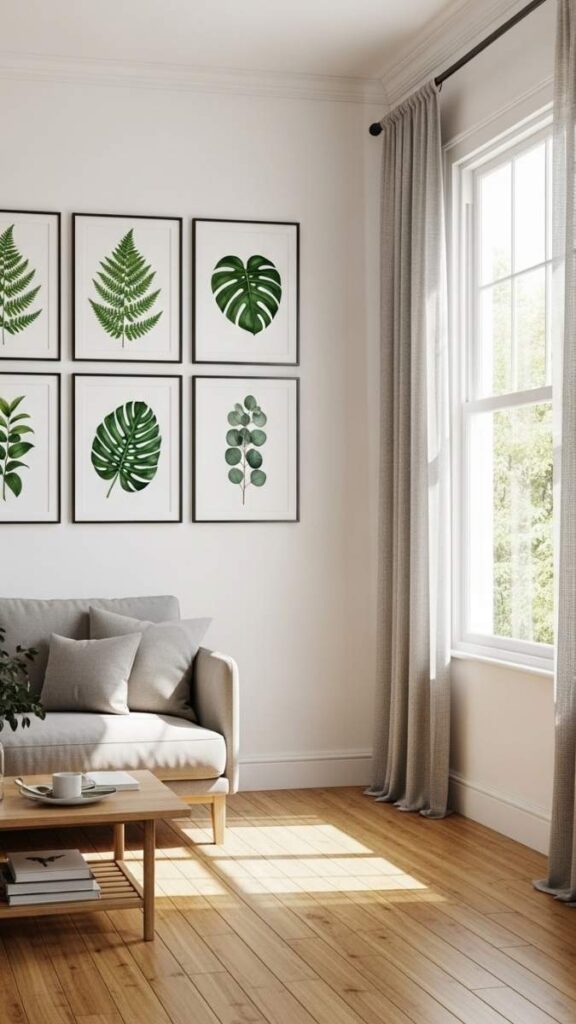
Botanical prints are having a sustained moment in 2026 not because they’re trendy, but because they bring organic shape into a room without the upkeep of actual plants. A set of six matching botanical prints in thin black or brass metal frames, arranged in two rows of three, creates a cohesive gallery that works across most living room styles minimal, Scandinavian, boho, or transitional. The thin frame profile keeps the arrangement light visually, which is useful if you’re working with a smaller wall or don’t want the frames to dominate. Source from printable art sites and print locally to keep costs low.
Abstract Art Cluster in a Loose, Organic Layout
A loose cluster frame arranged without strict alignment works when the art itself has enough visual cohesion to hold the composition together. Abstract prints in a shared color palette (earth tones, moody blues, muted greens) allow for an asymmetrical layout that still reads as a deliberate arrangement rather than random placement. The layout should feel like it grew outward from a central piece, not like frames were placed randomly. Honestly, this is one of the harder formats to execute well. It rewards more planning time on paper or a digital mockup before you put a single nail in the wall.
Black and Terracotta Frames with Warm-Toned Art
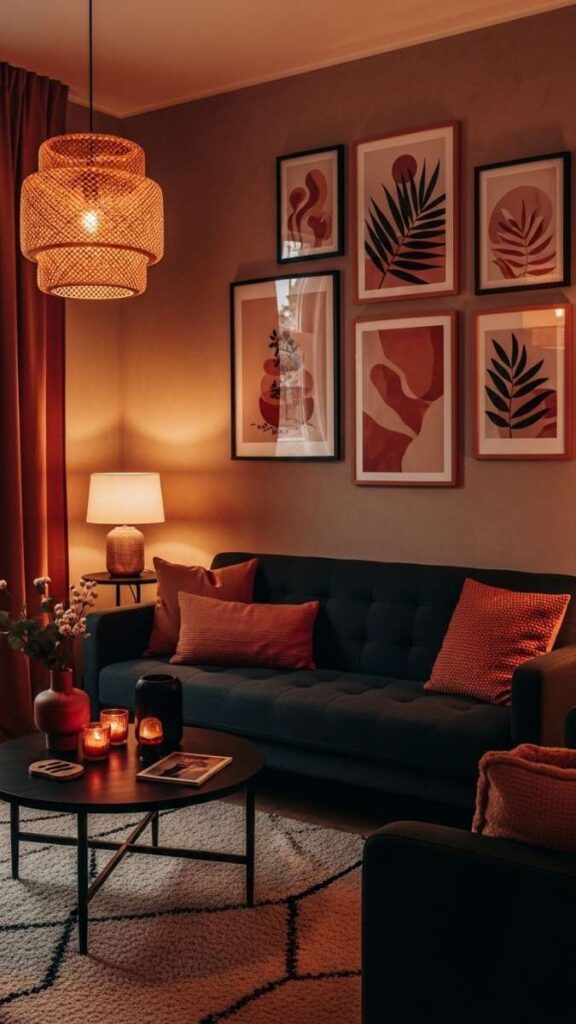
Frame color is an underused tool in gallery wall design. Mixing black and terracotta frames sounds risky but creates a warm, grounded arrangement when the art inside shares a similar warm palette of ochre, rust, blush, or cream tones. The terracotta frames in particular pick up on the broader 2026 trend toward warm, earthy interiors without requiring you to repaint or refurnish. This setup works best on a warm white or textured plaster wall where the frame tones can complement the background rather than contrast with it.
Staircase-Style Diagonal Gallery Wall
The staircase layout frames arranged in a diagonal line rising from lower left to upper right follows natural visual movement patterns, which makes it feel dynamic without being chaotic. It’s particularly well suited to living rooms with high or vaulted ceilings where a flat horizontal arrangement would leave too much empty space above. Space each frame so the top corners of consecutive frames align diagonally. Keep the frames consistent in size or alternate between two sizes for rhythm. This layout also works along actual staircases, but in a living room, it creates a subtle sense of upward movement that makes the space feel taller.
Read More About: 22+Apartment Storage Ideas That Actually Work in Small, Cluttered Spaces
Monochromatic Frame Gallery in Beige and Cream
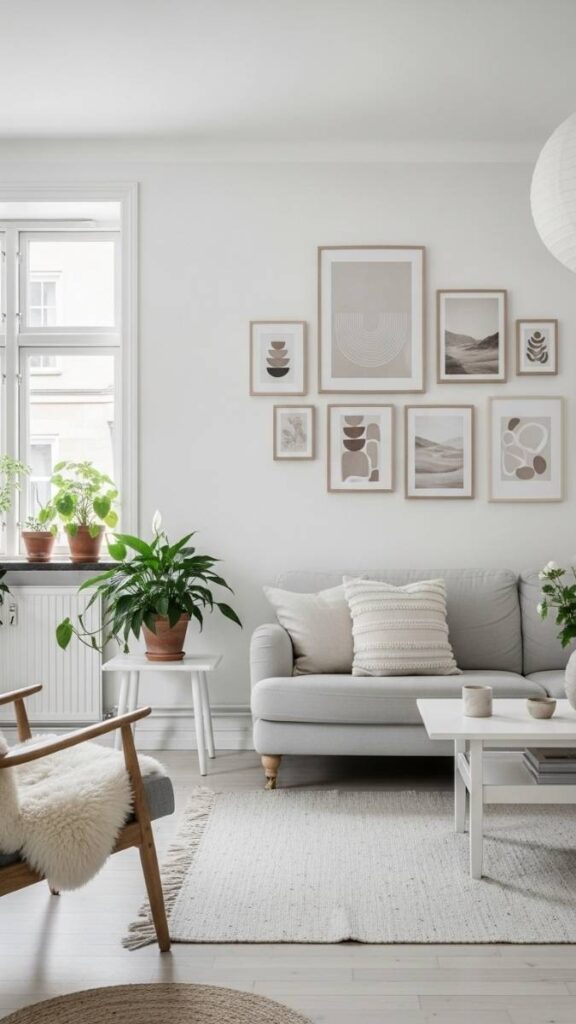
A monochromatic gallery wall where the frames, the art, and the wall all share the same tonal family creates a quiet, layered look that’s almost textural rather than graphic. Beige frames on a warm white wall with cream and sand-toned prints produce depth without contrast. This is a useful approach if your living room already has a lot going on (patterned rug, layered textiles, statement furniture) and you want the gallery wall to add warmth without competing. I’ve noticed this style tends to work better with matte finishes throughout glossy frames or high-contrast prints that break the soft, cohesive effect.
Oversized Poster in a Simple Clip Frame
A single oversized poster in a large clip frame is one of the most underrated approaches to gallery wall-adjacent decorating. A1 or A0 size, hung centered at eye level, makes an immediate visual impact with almost no complexity. Clip frames (glass front, metal clips, no traditional frame border) keep the focus entirely on the image. This works for anyone who wants a strong wall presence without committing to a full gallery arrangement; it’s also the fastest to execute and easiest to change. Best in minimal living rooms where one strong piece is more effective than many smaller ones.
Mix of Framed Quotes and Art Prints
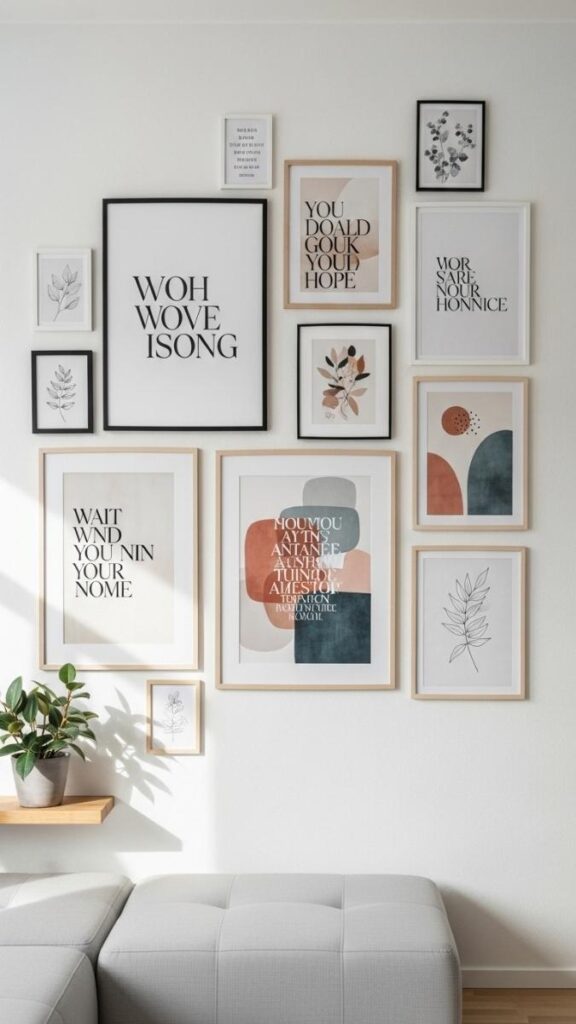
Typography on a gallery wall works when it’s specific rather than generic: a meaningful quote, a word in an interesting typeface, a short line of poetry you actually connect with. Mixed with art prints, typographic frames add an element of storytelling to the arrangement. The practical rule is to keep the type legible: avoid overly ornate fonts and ensure the print size is large enough to read from across the room. This format is especially popular in living rooms that double as work-from-home spaces, where the words on the wall can contribute to the overall atmosphere of the room.
Vintage Map and Print Gallery Wall
Vintage maps and illustrations bring a studied, layered quality to a gallery wall that feels collected rather than curated. The aged paper tones of cream, ochre, sepia naturally harmonize across different images, making it easier to mix map types (city plans, topographic maps, old botanical charts) without clashing. Frame them in thin brass or antique gold for consistency. This setup works well in living rooms with traditional or transitional furniture wood tones, leather, darker textiles where the vintage feel of the prints complements the overall direction of the space.
Photo Ledge System with Rotating Prints
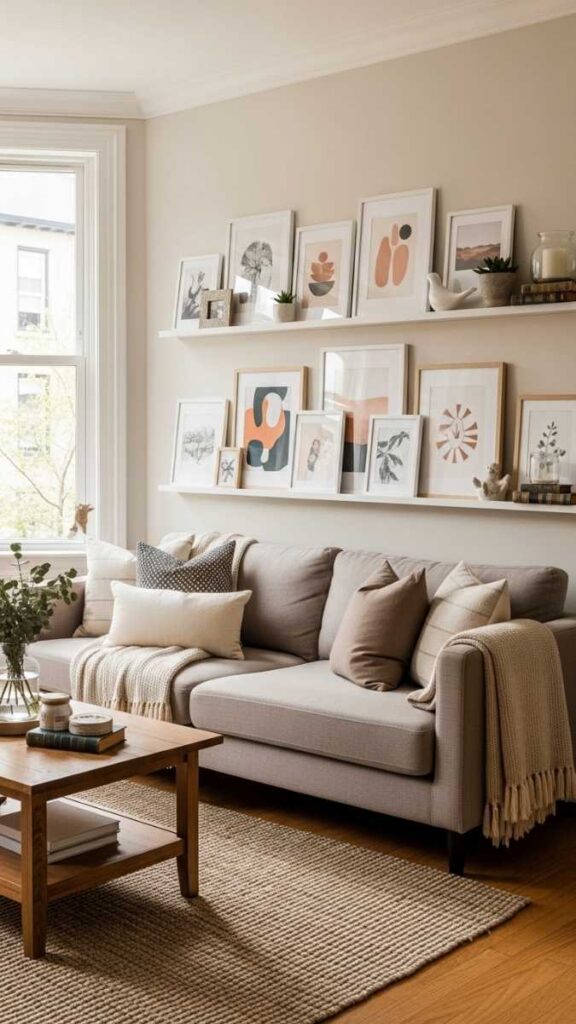
Photo ledges shallow shelves designed specifically for leaning frames are the most flexible gallery wall format available. You can rearrange, swap, and add prints without touching a single wall anchor. Two ledges stacked horizontally, filled with a loose mix of frames and small objects (a small plant, a candle, a ceramic piece), create a gallery wall that can evolve monthly without any effort. This is particularly useful for people who haven’t settled on a permanent aesthetic, or for rented spaces where reducing wall damage is a priority. The depth of the ledge also creates a shadow line that adds architectural interest to an otherwise flat wall.
Maximalist Wall-to-Wall Gallery Arrangement
A full wall-to-wall, floor-to-ceiling gallery arrangement is the maximalist version of this format and it works when the rest of the room is deliberately restrained. If every surface is competing, the full wall becomes noise; if the furniture below is clean and low-profile, the wall becomes the room’s defining statement. The practical approach is to plan this on paper first, mapping out the general zones before you hang anything. Include frames of at least three different sizes, keep a consistent spacing of two to three inches, and ensure no area becomes too frame-dense or too sparse. This format suits large living rooms with high ceilings where smaller arrangements would feel lost.
Nature-Themed Gallery with Pressed Botanicals
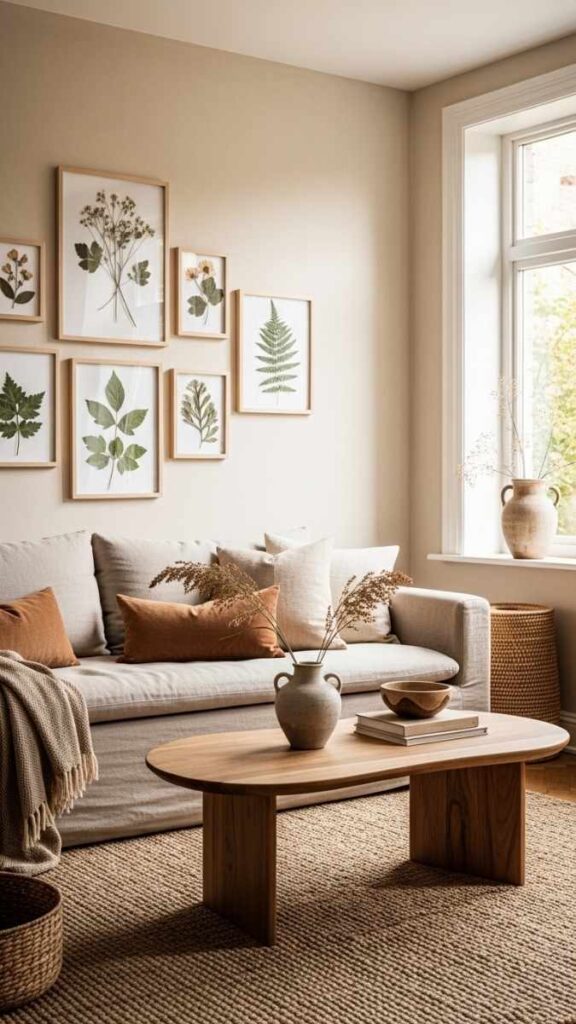
Pressed botanical frames, real or high-quality printed, bring organic texture to a gallery wall in a way that no printed art can fully replicate. The natural variation in the specimens means no two frames are identical, which creates an effortlessly eclectic arrangement even when the frames are all identical. Shadow box frames work best here to give depth to the specimens. Arrange in a loose grid with slightly more space between frames than you might think the organic shapes need room to breathe. This works especially well in living rooms with a natural, earthy material palette: linen, wood, rattan, natural fiber rugs.
Colorful Art Gallery for a Neutral Living Room
If your living room has entirely neutral white walls, beige sofa, wood tones, a gallery wall is one of the few places where you can introduce color without it feeling like a commitment. A set of colorful abstract or illustrated prints in white frames lets the color come from the art rather than the architecture or furniture, which means it’s changeable. The white frames create visual separation that prevents the colors from bleeding into each other. Go for a palette with two to three colors that repeat across at least half the prints; it’s what stops a colorful gallery wall from reading as random.
Minimalist Two-Frame Arrangement with Wide Spacing
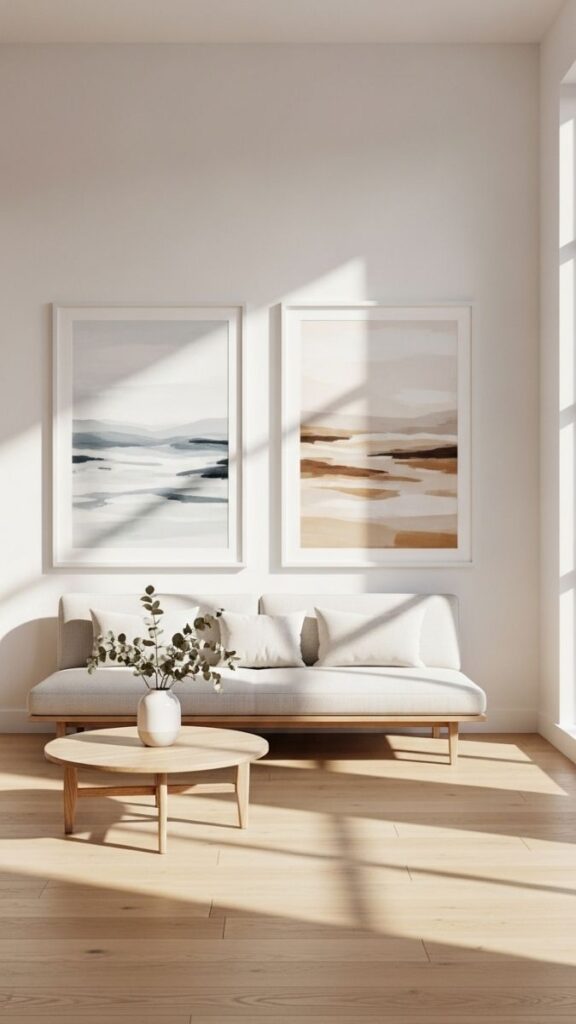
Two frames, hung with deliberate spacing not trying to fill the wall but choosing to leave space is a minimalist approach that reads as confident rather than incomplete. The key is that each frame has to be large enough to hold its own: two small frames hung far apart just look lonely. Go for at least 18×24 each, keep the frames identical, and align them at the same height. This format suits living rooms where the furniture and textiles are doing significant decorative work and the wall just needs a grounded, quiet presence rather than a dominant focal point.
Arched Frame Gallery with Curved-Top Prints
Arched frames with a curved top rather than a rectangular profile add architectural reference to a gallery wall without anything structural. They echo the curved furniture trend that’s defined a significant portion of interior design in recent years, and they pair well with round mirrors, curved sofas, and oval coffee tables. A grouping of three arched frames in varying heights, arranged in a gentle arc themselves, creates a visually soft arrangement that reads as modern without being stark. Works well in living rooms leaning toward organic modern or warm boho aesthetics.
Kids’ Room-Inspired Pastel Gallery in the Living Room
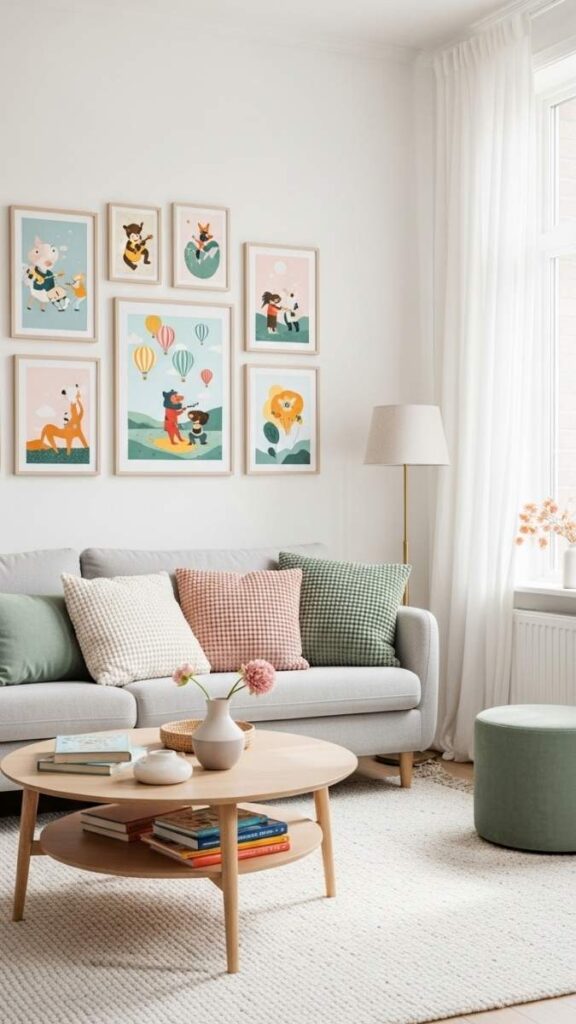
Pastel gallery walls aren’t limited to children’s rooms; a carefully executed pastel arrangement in a family living room can be both playful and cohesive. The trick is to choose illustrated or graphic prints rather than photography, and to keep the palette tight: two or three muted pastels that share the same saturation level. Dusty rose, sage green, and pale yellow work together without competing. This is a format that works particularly well for family living rooms where you want personality and warmth without the space feeling too formal or too child-oriented.
Gallery Wall as Room Divider in Open-Plan Living
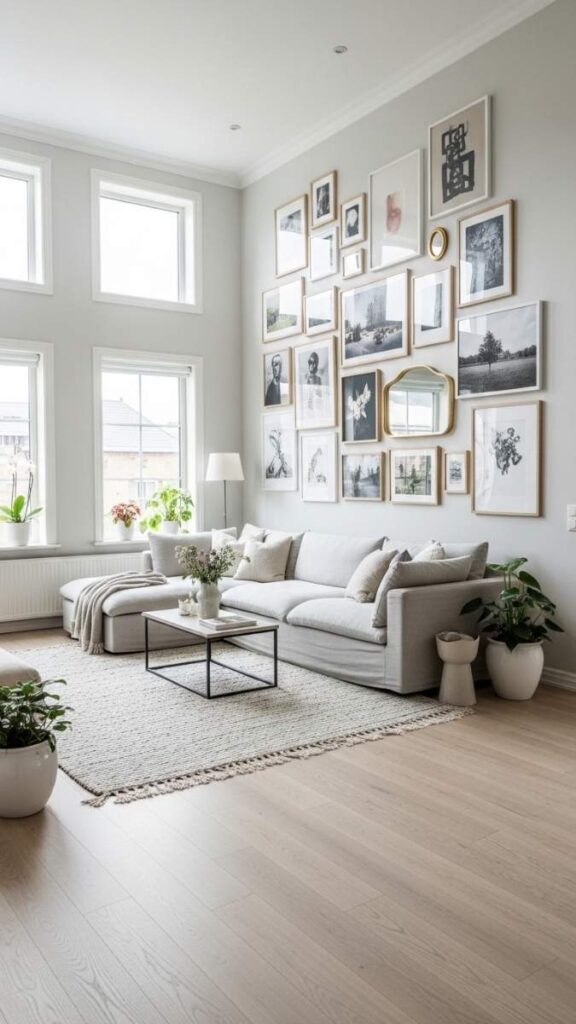
In open-plan spaces where the living area flows into a dining room or kitchen without walls to define it, a gallery wall can function as a soft room divider by anchoring the seating zone visually. A tall, vertically oriented arrangement on the wall behind the sofa tells the room where the living space begins. The gallery wall essentially does the work that a physical partition would do, but without blocking light or movement. For this to work, the arrangement needs vertical emphasis, taller frames, or a layout that extends closer to the ceiling than a typical arrangement would.
What Actually Makes Gallery Walls Work in Real Homes
The ideas above cover a lot of ground, but there are a few underlying principles that separate gallery walls that hold up from ones that feel off after a few weeks.
Spacing is the most underestimated variable.
Most people hang frames too close together (under an inch) or too far apart (over six inches). Two to three inches of consistent spacing between frames is the range that reads as curated in most living rooms. When in doubt, cut paper templates of each frame and tape them to the wall before committing.
The relationship to furniture below matters as much as the arrangement itself.
A gallery wall that starts too high above a sofa with more than eight to ten inches of gap looks disconnected. One that starts too low looks like it’s pressing down on the furniture. The standard guidance is to leave six to eight inches between the top of your sofa and the bottom of the lowest frame, but the real measure is visual balance, which you can judge with paper templates.
Mixing too many frame finishes is the most common issue.
Black, brass, silver, white, and natural wood together in one arrangement rarely resolve into a cohesive look. Limit yourself to two finishes or three if one of them is used minimally as an accent.
Print scale relative to frame matters.
A small image floating in a large mat inside a large frame reads as elegant. A small image in a small frame on a large wall reads as underwhelming. If you’re working with smaller prints, either use them in a dense cluster or mat them generously inside larger frames
Gallery Wall Ideas Quick Reference Guide
| Setup Style | Best For | Space Type | Problem It Solves | Effort Level |
| Symmetrical Grid | Clean, modern look | Any size room | Blank walls, no focal point | Low |
| Salon/Eclectic Mix | Collected, personal feel | Large walls | Empty, impersonal walls | Medium |
| Photo Ledges | Renters, flexibility | Any | Commitment to hanging | Low |
| Vertical Column | Narrow walls | Small or awkward spaces | Limited horizontal space | Low |
| Full Wall Maximalist | Bold statement | Large rooms, high ceilings | Oversized blank wall | High |
| Two-Frame Minimal | Understated look | Already-decorated rooms | Over-cluttered feel | Very Low |
| Shelf + Object Combo | Texture + depth | Apartments, renters | Flat, one-dimensional wall | Low–Medium |
| Dark Wall + Gold Frames | Moody, rich aesthetic | Rooms with low natural light | Wall feels flat or dull | Medium |
How to Arrange a Gallery Wall Without Getting It Wrong
The planning stage is where most gallery walls succeed or fail before a single nail goes in.
Start by mapping your wall. Measure the width of the wall section you’re working with and the height from the top of the furniture (or the floor, if it’s a freestanding arrangement) to where you want the top of the arrangement to reach. This gives you a defined canvas to work within.
Cut paper templates of every frame you plan to use and tape them to the wall with painter’s tape. Step back. This is the most useful step you can take. It lets you see scale, spacing, and overall proportion before any holes are made. Adjust until the layout feels balanced both vertically and horizontally.
For a centered arrangement, find the horizontal center of your wall and work outward from there. For a left-anchored or asymmetrical layout, start from the largest or most visually dominant piece and build around it.
Hang the largest piece first, then work outward. Using a level for every frame isn’t optional even small tilts compound across a multi-frame arrangement and are obvious once you step back.
The final check: stand across the room and look at the wall in the context of the entire space, not just the wall in isolation. The gallery should relate to the furniture, the room proportions, and the overall light not just look good as a flat composition.
FAQ’s
How far apart should frames be in a gallery wall?
Two to three inches of consistent spacing between frames is the standard for most living room gallery walls. Closer than one inch tends to look crowded; farther than five to six inches breaks the visual connection between frames and makes the arrangement feel scattered rather than cohesive.
How high should a gallery wall be hung above a sofa?
The bottom of the lowest frame should sit six to eight inches above the top of the sofa back. This keeps the arrangement visually connected to the furniture. If the gap is too large, the gallery wall and the sofa read as separate elements rather than a composed vignette.
How many frames should a gallery wall have?
There’s no fixed number; it depends on wall size and the visual density you’re aiming for. Three to five frames works for small walls or minimal arrangements. Nine to fifteen is typical for a full salon-style wall. What matters more than the count is that the arrangement fills the intended space proportionally without overcrowding.
Can you do a gallery wall in a rented apartment?
Yes. Photo ledges require only a few anchor points. Removable adhesive hooks work for lighter frames (up to a few pounds each). Floating shelves with leaned art are another solid option. None of these approaches require significant wall work, and most remove cleanly.
What types of art work best in a living room gallery wall?
The content matters less than the cohesion. Mixed subjects photography, illustration, abstract art, typography coexist well when the palette and frame finish are consistent. A shared color story across the prints is more important than matching image subjects.
Is it better to use matching frames or mixed frames?
Matching frames are easier to execute and read more cleanly. Mixed frames create a more collected, eclectic feel but require more planning to avoid looking random. If you’re new to gallery walls, start with matching frames in one finish; you can always introduce a second finish once the basic arrangement is in place.
What’s the easiest gallery wall setup for beginners?
A symmetrical grid of identical frames is the most forgiving starting point. Even spacing, same frame size, consistent finish and repetition makes the arrangement feel intentional with minimal planning effort. Start with a 2×2 or 3×3 grid and expand from there if you want more coverage.
Conclusion
A gallery wall doesn’t require a large budget or a perfectly proportioned room; it requires a bit of planning and a clear sense of what you want the wall to do. Whether that’s creating a focal point, adding warmth, filling an awkward space, or making a blank wall feel personal, the right format exists for your specific room and constraints.
Start with one or two ideas from this list that fit your wall size, your current frame situation, and your tolerance for commitment. Photo ledges and paper template planning cost almost nothing and tell you most of what you need to know before you invest further. Building from their gallery walls are one of the few things in home design you can genuinely evolve over time without starting over.