82+ Japandi Bathroom Design Ideas That Make Small Spaces Feel Calm and Intentional
There’s a shift happening in how people think about bathrooms. Less spa-marketing fantasy, more genuine calm. Japandi, the blend of Japanese minimalism and Scandinavian warmth has moved from mood board to mainstream precisely because it solves something real: how to make a utilitarian room feel like a place you actually want to be in.
If your bathroom feels cluttered, cold, or just disconnected from the rest of your home, Japandi design gives you a clear design language to work with. It’s built on restraint natural materials, a quiet palette, and layouts that prioritize breathing room over decoration.
For anyone working with a small bathroom, a rental, or a tight renovation budget, this aesthetic is genuinely practical. The principles translate well to compact spaces, and most of the ideas below can be executed without structural changes.
A Floating Vanity with Open Shelving Below
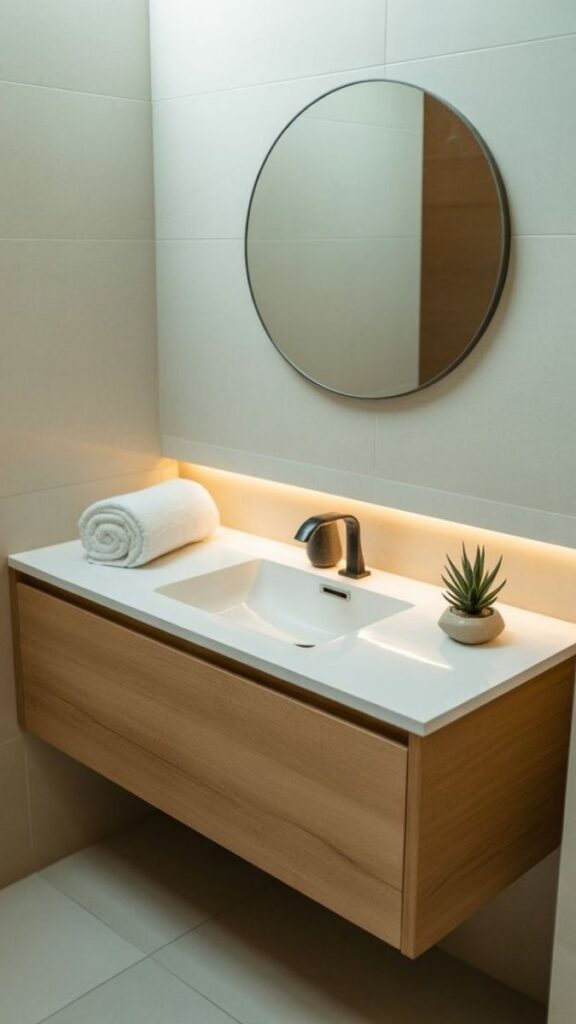
Mounting the vanity off the floor does something concrete to a small bathroom; it visually extends the floor plane, making the room read as larger even when the square footage hasn’t changed. Pair a walnut or light oak cabinet face with a matte stone or concrete countertop, and the shelf below becomes functional without being visually noisy.
In my experience, this setup works best when the open shelf holds just two or three items: stacked towels, a small plant, and nothing else. The moment it becomes a catch-all, the whole look collapses. Best for: small bathrooms where the floor-to-ceiling visual matters, apartments, renters who can install floating units without permanent damage.
Limewash or Textured Wall Finish Behind the Mirror
A smooth, painted wall is fine. A limewash or clay-plaster finish in a warm greige or pale terracotta does something completely different: it catches light unevenly, which gives the room depth without adding visual weight.
Japandi bathroom design leans heavily on surface texture as a substitute for decoration, and this is the easiest place to introduce it. One wall is enough; doing all four reads as heavy. This works especially well behind a mirror or vanity, where the texture gets framed and reads like a deliberate design decision rather than an incomplete renovation.
A Wet Room Layout with a Linear Drain
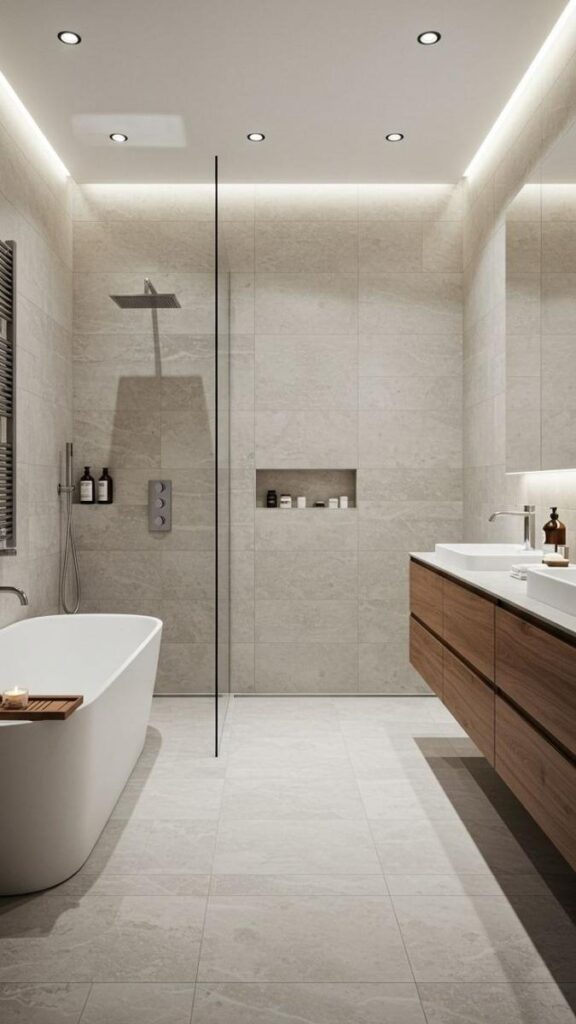
Removing the shower enclosure entirely changes the spatial logic of a bathroom. A wet room layout where the shower exists as a zone defined by floor gradient and drain placement rather than glass keeps the visual field open across the full room.
Large-format matte tile running floor to ceiling with minimal grout lines is the standard Japandi execution here. The teak bath mat sitting on a stone-look floor adds the warmth the palette needs without cluttering the line of sight. This layout genuinely works in narrow bathrooms because there are no enclosure edges breaking the space.
A Deep Soaking Tub Positioned as a Focal Point
The Japanese o-furo bathing tradition is at the core of Japandi bathroom design and the deep soaking tub is its physical expression. Unlike a standard Western tub positioned against a wall as an afterthought, this setup treats the tub as the room’s organizing element.
Placement matters: center of the room, or under a window where natural light can frame it. Frosted glass preserves privacy without blocking daylight, which gives the tub a quiet, luminous quality even in a small footprint. Skip the hardware, a simple bamboo tray and one candle is the upper limit.
Vertical Wood Slat Wall Panel Behind the Toilet or Tub
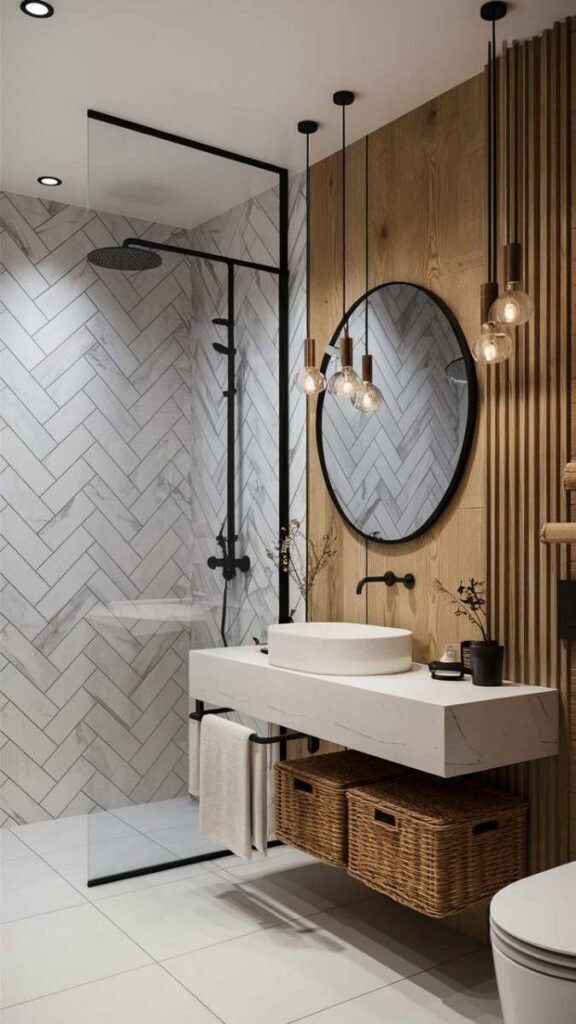
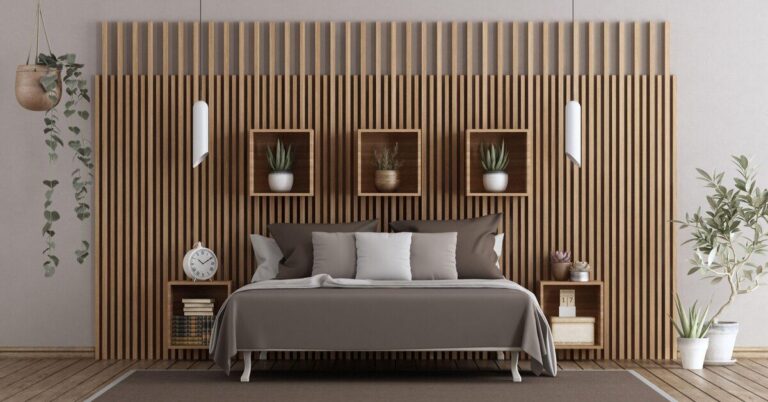
Wood slat panels are doing a lot of design work. In 2026 they’ve become one of the clearest markers of Japandi interior design because they add warmth and rhythm without pattern. Behind a toilet or tub, a vertical slat panel creates a defined zone that reads like deliberate architecture rather than wallpaper. Use moisture-resistant teak, bamboo, or engineered wood panels with a sealed finish. The slat spacing matters: closer together reads more formal and Japanese, wider gaps lean Scandinavian. Either works, but pick one direction and commit.
Read More About: 81+ Japandi Color Palette Ideas That Make Any Room Feel Calm, Collected
Built-In Wall Niche Instead of Open Shelving
The niche solves the Japandi bathroom’s core tension: how to have storage without visual noise. Recessed into the shower wall, it holds soap, shampoo, and one or two objects flush with the surface, no edges, no brackets, no clutter reading across the space.
A contrasting tile liner (often matte black, dark terracotta, or a mosaic cut from the main tile) turns the niche into a quiet design moment. This works best planned during renovation, but retrofit niches are possible in many stud-framed walls. Problem solved: the shower caddy, which is the single fastest way to undermine a minimal bathroom aesthetic.
A Round or Oval Mirror with Concealed Lighting
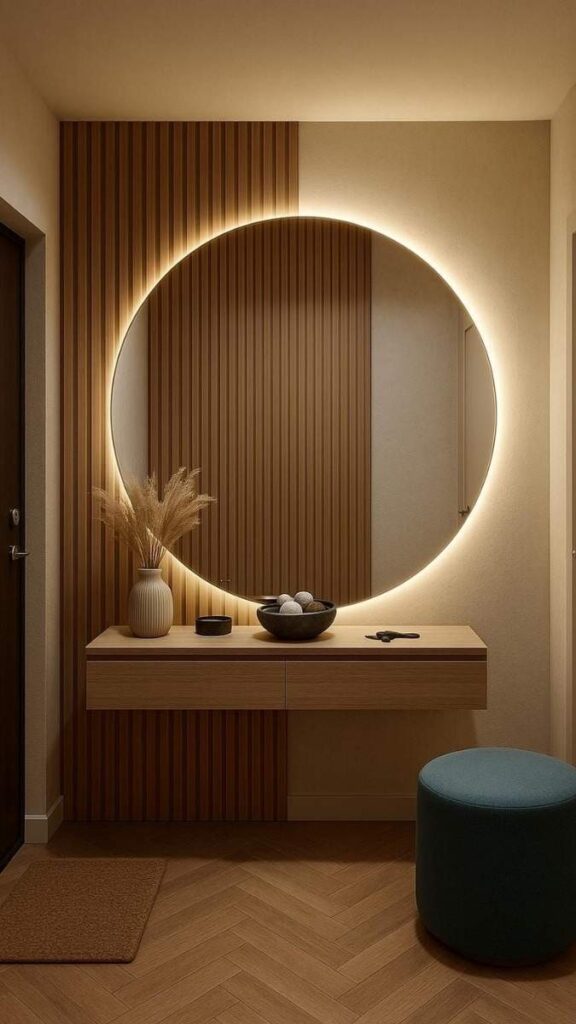
Japandi bathroom design uses lighting as atmosphere, not utility. A backlit mirror warm LED strip behind an oval or round frameless mirror removes the shadow problem you get with side sconces while keeping the light quality soft and even.
The round shape matters here: rectangular mirrors push the bathroom toward either modern or traditional depending on the frame, while an oval sits neutrally between Japanese and Scandinavian aesthetics without committing to either. For renters: plug-in versions with concealed cords are widely available now and photograph identically to hardwired options.
Large-Format Matte Stone-Look Tile, Floor to Ceiling
The grout line is doing more visual work than most people realize. Standard tile with frequent grout joints fragments a small bathroom into dozens of pieces. Large-format tile 60x120cm or larger with minimal grout, especially floor to ceiling, creates a surface that recedes rather than advances. In a Japandi context, the finish matters: polished is too glam, matte limestone or concrete-look sits exactly right. The room feels quieter because there’s less visual interruption. Honestly, this single change has more visual impact than most decorative decisions combined.
A Wooden Stool or Bath Tray as a Functional Accent
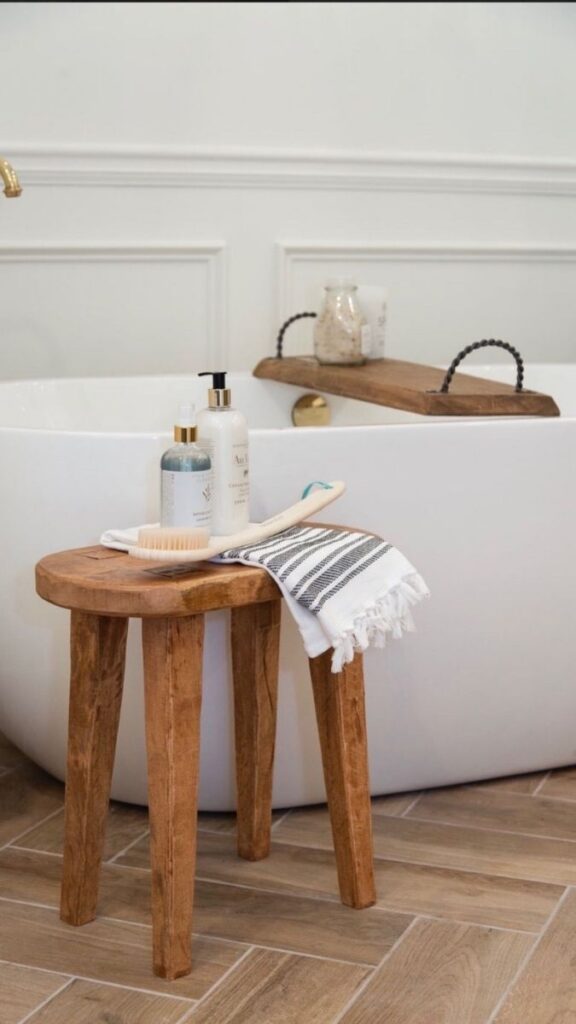
A well-placed wooden stool does three things at once in a Japandi bathroom: it adds natural material texture, provides functional surface space, and signals intentionality. This is the kind of detail that distinguishes a designed space from a decorated one.
Teak is the standard choice for moisture resistance, but hinoki (Japanese cypress) is worth the cost if you can find it the scent alone earns its place. Keep it spare: one folded towel, a bar of soap. The stool isn’t storage; it’s punctuation.
Read More About: 80+ Bedroom Lighting Ideas That Actually Change How Your Room
A Vessel Sink with a Low-Profile Stone or Concrete Basin
Vessel sinks polarize people because the bad versions look dated fast. The Japandi version works because it leans on material honesty rather than shape novelty: a hammered stone basin, a raw concrete pour, or a matte ceramic vessel that looks like it was made by hand.
The visual logic is that the basin becomes an object in its own right, like a bowl you’d have on a dining table. Pair it with a wall-mounted faucet to keep the counter completely clear. Where it works best: floating vanities with clean counter edges where a drop-in sink would lose the visual of the surface material.
Indoor Plants Used Sparingly and Purposefully
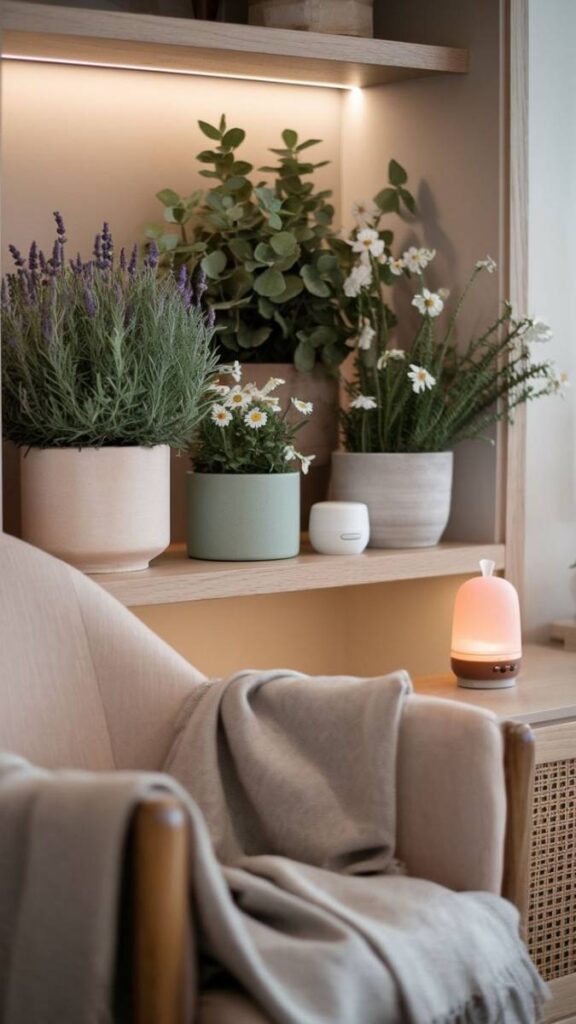
One plant, placed deliberately, works better than three plants arranged decoratively. Japandi design borrows directly from the Japanese concept of the intentional use of empty space which means greenery is meant to punctuate, not fill.
A monster in the corner near a window, a trailing pothos above the toilet tank, or a single fern on the vanity in a matte ceramic pot. What to avoid: multiple plants in coordinating pots that look like a styled shoot rather than a lived-in home. The plant earns its place by being the only plant.
A Linen or Waffle-Weave Towel as a Texture Layer
Towels are underused as design elements. In a Japandi bathroom, the texture and weight of the towel becomes part of the room’s sensory register. Waffle-weave or linen towels undyed or in oat, sage, or soft clay tones have a flatness and lightness that terry cloth doesn’t.
They also dry faster, which matters practically. Fold them once and hang them so they don’t artfully scrunch or layer. The visual should read as casual confidence, not a hotel styling moment.
Matte Black Hardware as a Grounding Element
In a neutral, warm Japandi palette, hardware is the thing that keeps the room from floating away visually. Matte black not chrome, not brushed nickel has enough weight to anchor a pale stone and wood bathroom without introducing contrast that pulls attention.
The key is consistency: faucet, towel bar, mirror frame (if any), toilet paper holder, door handle. Mixed metals undermine the quiet coherence the whole palette is working toward. This is a detail people notice in person more than in photos, which is exactly where it should land.
A Concealed Storage Cabinet Behind the Mirror
The Japandi principle of functional minimalism doesn’t mean no storage, it means storage that disappears. A recessed medicine cabinet behind the mirror keeps the counter completely clear, hides toiletries without a vanity drawer, and from the outside reads as a flat mirror.
In small bathrooms especially, this resolves the tension between needing storage and maintaining visual openness. Pair it with a floating vanity that has one shallow drawer, and most bathrooms’ daily-use items are covered without any visible storage at all.
Warm Indirect Lighting from Wall Mounted Sconces
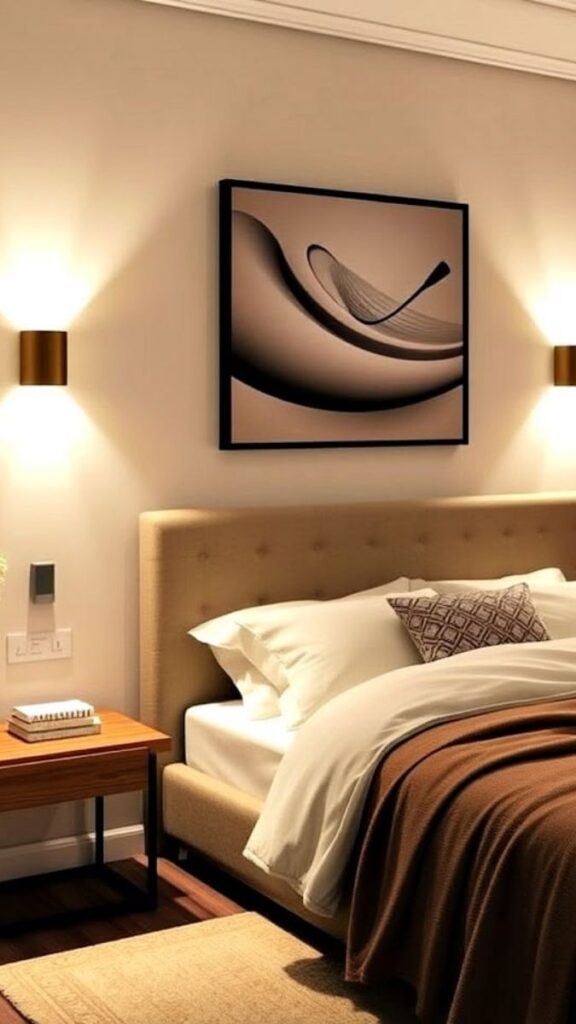
Overhead lighting in a bathroom is functional and nothing more. Wall sconces flanking the mirror warm bulb, simple linen or matte metal shade, positioned at face height give even, shadow-free illumination for practical tasks while keeping the atmosphere soft.
In a Japandi context, the shade material matters: avoid glass globes that read as mid-century, and skip anything with a decorative silhouette. A simple cylinder in linen, paper, or brushed metal sits neutrally. 2700K is the right color temperature; anything cooler pushes the room toward clinical.
Read More About: 79+ Japandi Kitchen Design Ideas That Make Small Spaces
A Bench Seat in the Shower or at the Tub Edge
A built-in bench in the shower has practical utility: a place to sit, to rest a foot, to hold a product without introducing a caddy but it also changes the architectural feel of the space.
In a Japandi bathroom, a teak bench built into the shower wall or positioned beside the tub signals a considered approach to comfort that goes beyond aesthetics. The bench doesn’t need to be large; 40cm deep is enough. What matters is that it’s flush with the wall and reads as part of the room rather than something added to it.
A Bamboo or Hinoki Wood Bath Mat
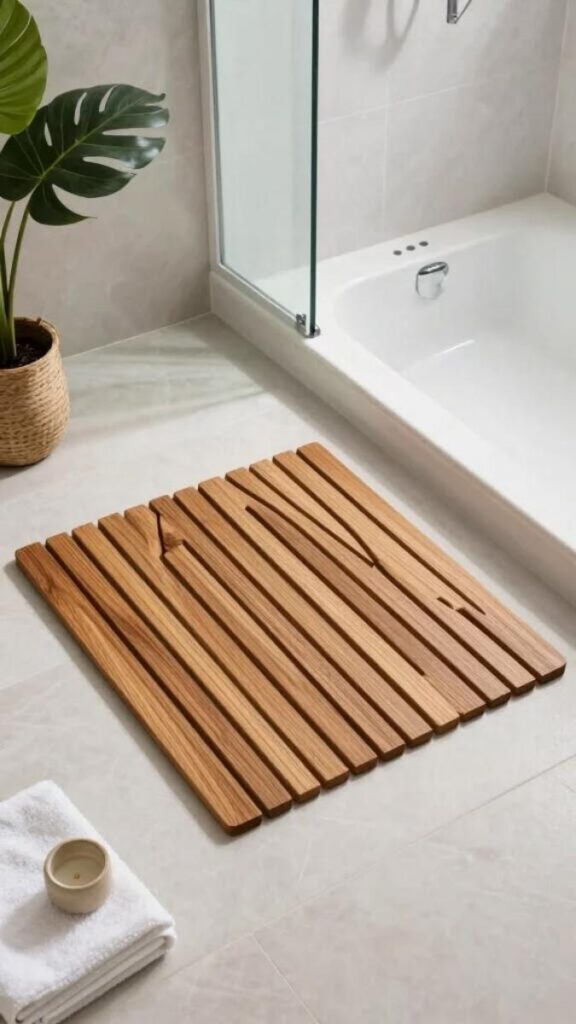
The standard bath mat is one of the easiest things to swap and one of the most visually impactful. A hinoki or bamboo slat bath mat introduces natural material and slight elevation without adding visual complexity. The wood drains fast, dries quickly, and ages gracefully all properties that suit a bathroom.
More practically, it keeps the floor tile fully visible, which matters in a small bathroom where the floor is doing design work. Where it works best: beside a freestanding tub or in a wet room where the floor texture is a feature, not just a functional surface.
A Single Floating Shelf for Display, Not Storage
The difference between a display shelf and a storage shelf is restraint. In a Japandi bathroom, one floating shelf with a thin profile, natural wood holds two or three objects: a bud vase, a small stone object, and a candle.
That’s it. The shelf isn’t solving a storage problem; it’s providing one visual resting point that gives the eye somewhere to land. I’ve noticed this works best when positioned above the toilet, where it fills a vertical space that would otherwise read as an empty wall without competing with the vanity area.
Neutral Zellige or Handmade Tile as an Accent Surface
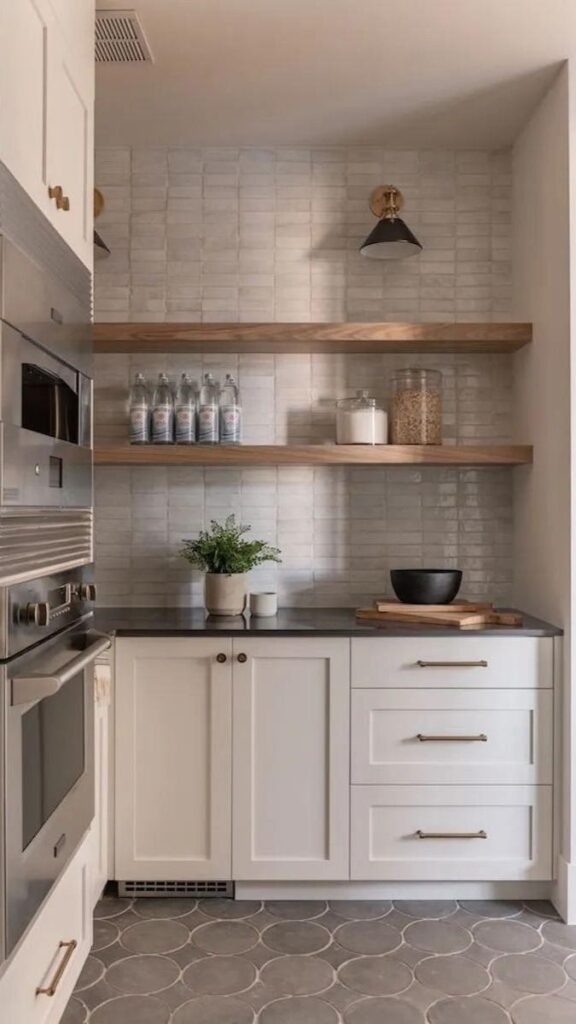
Zellige tile, the Moroccan handmade ceramic with slight surface variation and irregular glaze, reads differently from mass-produced tile in person. The imperfection is the point: each tile catches light slightly differently, which gives the surface a warmth and liveliness that a perfect glaze doesn’t have.
In a Japandi bathroom, this aligns with the Japanese wabi-sabi appreciation for the beauty of imperfection. Use it on one wall, behind the vanity or in the shower recess. The color should stay in the neutral range of putty, warm white, pale clay rather than anything saturated.
A Rainfall Showerhead Centered Above the Drain
Positioning the shower head directly overhead changes the physical experience of the shower but in a Japandi bathroom, it also changes the visual logic of the room. A ceiling-mounted rainfall head with concealed pipe work, centered above the drain, reads as a clean architectural element rather than plumbing.
The experience of showering under its water falling straight down rather than at an angle connects to the Japanese bathing practice of rinsing completely before soaking. Pair with a floor drain, not a tray, for the cleanest floor line.
A Monochromatic Color Palette Anchored by One Natural Material
Monochromatic doesn’t mean boring, it means the room’s visual energy comes from texture and material rather than color contrast. A Japandi bathroom built entirely in warm whites, oats, and pale stones, with a single walnut or teak element introducing warmth, achieves a cohesion that feels considered rather than sterile.
This is the approach that photographs beautifully but also lives well because there’s nothing competing for visual attention, the space feels genuinely calm. The one natural material anchor wood, stone, bamboo is the thing that keeps the palette from reading as a hospital.
What Actually Makes Japandi Bathroom Design Work
It helps to understand the underlying logic, not just the look. Japandi isn’t a checklist of materials, it’s a design approach built on two related ideas: functional restraint from Japanese minimalism, and sensory warmth from Scandinavian design. When those two things are in tension (storage vs. openness, warmth vs. simplicity), the right answer is almost always the one that serves the room’s calm quality first.
Scale and proportion matter more than specific materials.
A bathroom that gets the proportions wrong, a vanity that’s too large, fixtures that compete visually, a mirror that doesn’t relate to the vanity below it won’t feel Japandi regardless of the tile. Start with the largest elements and get those relationships right before choosing finishes.
Lighting is the easiest thing to get wrong.
Cool overhead lighting undoes everything else. If your bathroom has only overhead recessed lights and you can’t change them, dimmer control and warm bulbs (2700K) go a long way. Add a plug-in sconce if you can.
Restraint extends to scent.
Japanese bathing culture treats the bath as a multi-sensory experience. A hinoki soap, a simple candle, or a single dried eucalyptus branch hung near the showerhead participates in the aesthetic without adding visual clutter.
Japandi Bathroom Design Quick Setup Guide
| Idea | Best Space Type | Core Benefit | Problem Solved | Difficulty |
| Floating vanity | Small/narrow bathroom | Visual floor extension | Cramped feel | Low |
| Wet room layout | Medium–large bathroom | Openness, no enclosure edges | Dark or boxed-in shower | High |
| Limewash wall finish | Any size | Depth without pattern | Flat, cold walls | Low |
| Built-in niche | Shower wall | Flush storage | Shower caddy clutter | Medium |
| Rainfall showerhead | Walk-in showers | Architectural clean line | Exposed plumbing look | Medium |
| Large-format tile | Small/medium | Fewer grout lines, less visual noise | Fragmented space feel | High |
| Vessel sink + wall faucet | Floating vanity setups | Clear counter surface | Cluttered sink area | Medium |
| Wood slat panel | Feature wall behind tub or toilet | Warmth + rhythm | Cold, bare wall | Low–Medium |
| Zellige accent tile | One feature wall | Texture, wabi-sabi quality | Sterile, flat surfaces | Low |
| Monochromatic palette | Any size | Cohesion, calm atmosphere | Competing visual elements | Low |
How to Avoid the Most Common Japandi Bathroom Mistakes
Buying the look without logic.
The most common mistake is assembling Japandi elements, a wood vanity, some matte tile, and a round mirror without applying the underlying restraint principle. If every surface has a “Japandi item” on it, the room reads as a theme bathroom, not a designed one. Edit harder than feels comfortable.
Ignoring scale.
A floating vanity that’s too deep for the room, or a soaking tub that leaves no clear movement path, breaks the spatial logic regardless of finish quality. Walk the room with tape measure before purchasing anything fixed.
Mixing too many natural materials.
Wood, stone, bamboo, linen, concrete each of these works individually. Three or four in the same room compete with each other and undermine the calm quality the palette is working toward. Pick two, maximum three, and let them repeat.
Over-planting.
One well-placed plant participates in the design. Multiple plants in matching pots is styling, not design, and it works against the main principle of intentional empty space.
Getting the lighting temperature wrong.
2700K warm white is the target. Anything cooler pulls the room toward clinical. Anything warmer pushes it toward amber-heavy, which fights the neutral palette.
Frequently Asked Questions
What is Japandi bathroom design?
Japandi is a design style that blends Japanese minimalism, clean lines, natural materials, intentional restraint with Scandinavian warmth and functionality. In a bathroom context, it typically means a neutral palette of warm whites and natural wood tones, matte natural materials like stone and teak, and a layout that prioritizes openness and calm over decoration.
Does Japandi bathroom design work in small bathrooms?
Yes and arguably better than in large ones. The principles of visual restraint, floating furniture, large-format tile, and concealed storage are all tools for making compact spaces feel more open. The absence of heavy decoration is an asset when square footage is limited.
What colors belong in a Japandi bathroom?
Warm neutrals: white, off-white, oat, warm greige, pale stone, and soft sage. Accents tend to be matte black hardware or natural wood tones rather than color. Avoid anything saturated or cool-toned blues, grays, and cool whites push the palette away from the Japandi warmth register.
Japandi vs. minimalist bathroom, what’s the difference?
Minimalism is primarily about reduction: fewer objects, less color, clean surfaces. Japandi includes minimalism but adds deliberate warmth through material choice: wood, linen, stone and a wabi-sabi acceptance of imperfection and texture. A minimalist bathroom can feel cold; a Japandi bathroom is designed not to.
What flooring works best in a Japandi bathroom?
Large-format matte stone-look tile (60x120cm or larger) is the standard. Concrete tile, honed travertine, and pale limestone all work. The floor should be warm-toned and matte rather than reflective. A wooden bath mat (teak or hinoki) adds natural texture at the point of use without replacing the tile.
Is Japandi design expensive to achieve?
Not inherently. The palette is neutral, which means materials are available at most price points. The highest-cost elements a freestanding soaking tub, a wet room layout, zellige tile can be substituted: a standard deep tub for the o-furo, a standard shower with a frameless door, ceramic tile with a hand-finished glaze instead of zellige. The design logic holds regardless of budget; restraint costs nothing.
Can renters achieve a Japandi bathroom aesthetic?
Yes. Focus on what you can change without fixtures: warm lighting, wood bath mat, linen towels, a single plant, a round plug-in mirror with warm backlight, and an edited counter surface. Removing non-essential items from the counter and shower has more visual impact than adding anything new.
Conclusion
A Japandi bathroom works because it starts from function and moves toward calm, rather than starting from aesthetic and hoping it lands. The ideas above are practical: they solve specific problems around storage, lighting, space, and layout and most of them translate across different bathroom sizes and budgets.
Start with two or three ideas that align with what your bathroom actually needs. If it feels cluttered, focus on concealed storage and counter editing. If it feels cold or flat, start with lighting temperature and a natural material addition. The design logic is cumulative; each element reinforces the others and small adjustments in the right direction build quickly into a room that reads as intentional.