27+ Wall Decor Ideas That Actually Work in Real Homes Not Just on Pinterest
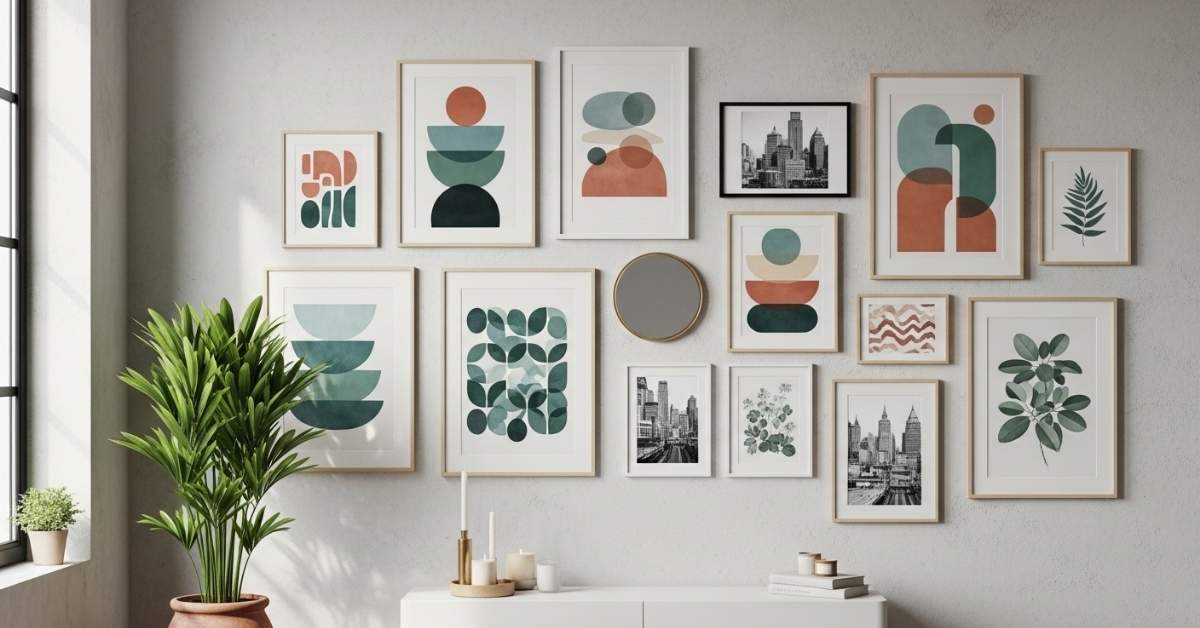
This list is for anyone who wants their walls to feel intentional without hiring an interior designer. Whether you’re renting, working with a small space, or just trying to make a room feel more like yours Wall Decor these ideas are grounded in how real rooms actually look and function. Not just how they photograph.
In 2026, the shift is away from matching sets and gallery walls that look like they came straight from a showroom. What’s working now is layered, personal, and specific walls that look like they happened over time rather than all at once.
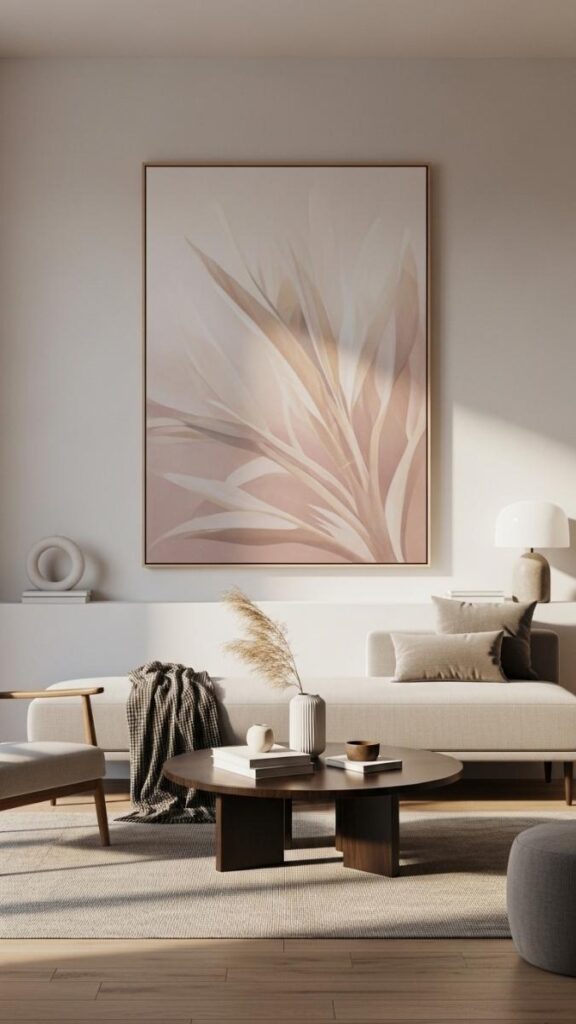
A Single Oversized Art Print That Anchors the Room
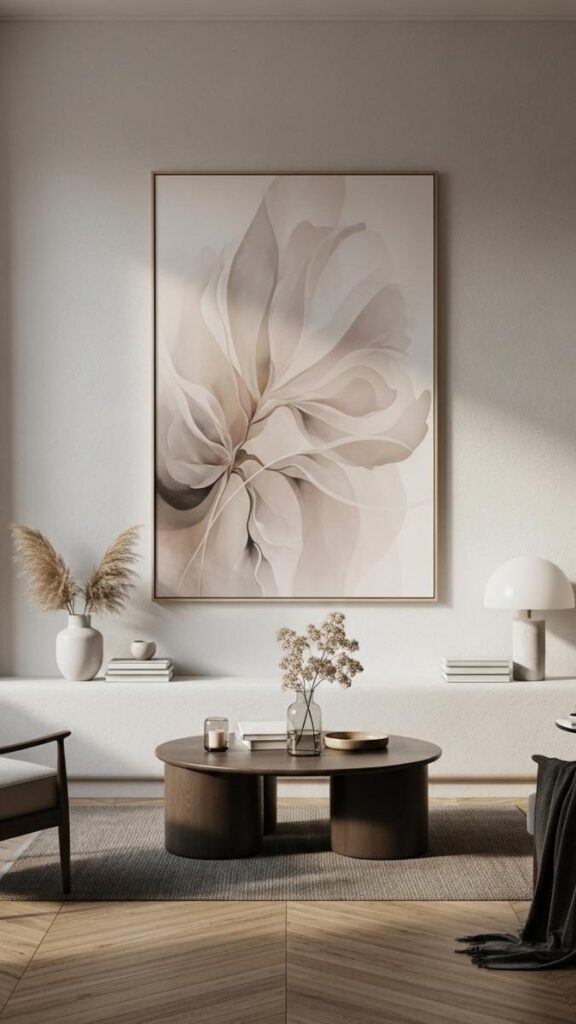
When a room has too many small pieces, the eye bounces around and nothing lands. One large print something that takes up 60–70% of the wall width above a sofa or console creates a clear visual anchor.
Think of it as giving the room a focal point it can settle on. This works especially well in living rooms and bedrooms where the furniture is low and horizontal.
A single 24×36 or 30×40 framed piece (even a poster in a simple frame) does more for the room than three smaller prints scattered around. The trick is scale: most people hang art too small.
A Floating Shelf Gallery With Objects and Small Frames
Shelves give you flexibility that hanging art doesn’t. You can rearrange, swap out, and update without touching the wall. Line two or three slim shelves horizontally and layer in a mix of small framed prints, a trailing plant, and one or two ceramic pieces.
The visual rhythm of mixing flat and dimensional objects is what makes this feel curated rather than cluttered. Works particularly well in entryways, hallways, and home offices where the wall space is narrow but you still want something to look at.
A Grid Gallery Wall With Matching Frames and Consistent Spacing
The grid gallery wall, equal-sized frames, equal spacing, aligned edges is one of the most forgiving setups for people who don’t have a natural eye for arrangement. It removes the guesswork. Use 4×6 or 5×7 prints in identical frames (black or natural wood tend to read the cleanest) and space them 3–4 inches apart.
The consistency is the point: it gives the wall structure without demanding that every single piece be interesting on its own. Great for renters who want impact without overwhelming commitment.
A Large Mirror to Expand a Narrow or Dark Room
A mirror placed opposite or perpendicular to a window doesn’t just reflect, it redistributes light across a room. In narrow bedrooms or dark living areas, a large round or arch-shaped mirror can make the space feel substantially wider and brighter without any renovation.
The frame matters: an ornate gold frame adds warmth, a thin black frame keeps it modern and subtle. This is one of the highest-return wall additions you can make in a small or north-facing space.
Woven Wall Hangings for Texture in Minimal Rooms
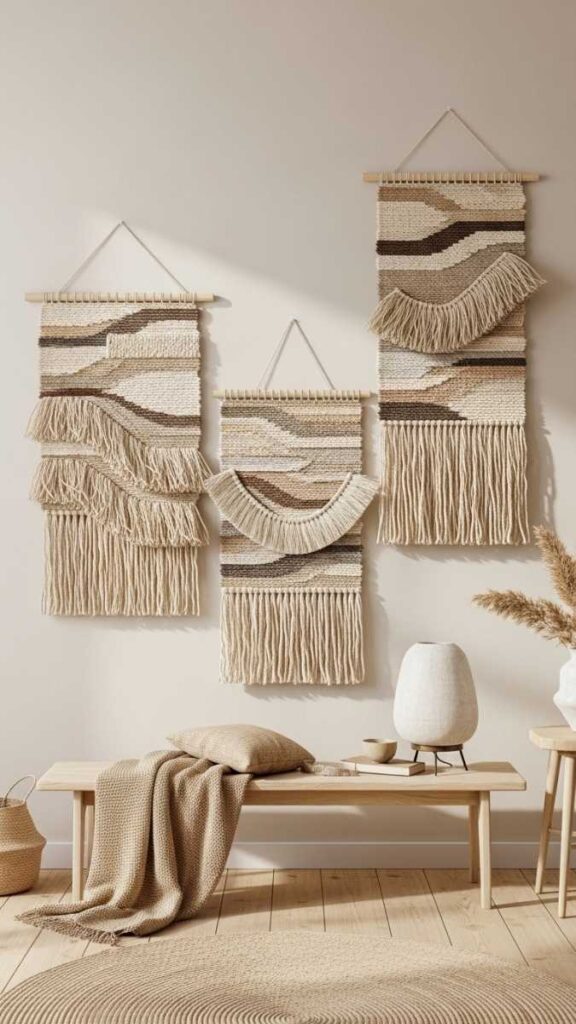
In a room that’s already minimal white walls, clean furniture lines, a woven or macramé wall hanging introduces the texture the space is missing without adding visual clutter.
Hung above a bed or sofa, it functions like art but with a tactile dimension that changes how the room feels physically, not just visually. The loose, organic quality of woven pieces also softens spaces that can feel overly cold or stark. A good option for renters since most require just one or two hooks.
Read More About: 70+ Seasonal Decor Ideas That Actually Work in Real Homes Without the Clutter
A Statement Clock as Functional Wall Decor
A well-designed clock does something most wall art can’t: it justifies its presence every day. In kitchens, home offices, and living rooms, a large-format clock (24 inches or more) reads as a design object rather than a utility purchase.
The best ones are simple: no numerals, thin hands, minimal face. This approach works in rooms where you want something on the wall but don’t want to commit to art. It also gives smaller rooms a sense of proportional scale when sized correctly.
Vertical Wall Panels for Rooms With High Ceilings
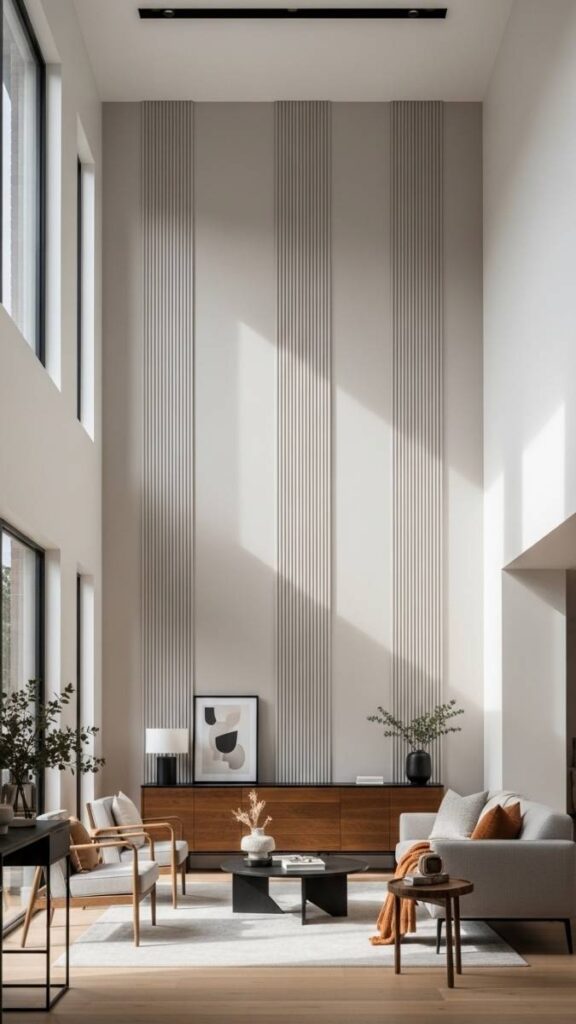
High-ceilinged rooms often have an awkward proportion problem: the furniture sits low while the walls loom. Narrow vertical panels (painted MDF, wood veneer, or even reclaimed boards) draw the eye upward intentionally and give the wall a structured rhythm.
This works differently from art: it’s about the wall itself becoming a design element. Space the panels evenly and keep them the same width. The vertical orientation amplifies the sense of ceiling height in a controlled, deliberate way.
A Framed Fabric or Textile as Affordable Wall Art
Fabric in a deep frame reads as art and it’s one of the most budget-friendly ways to get large-scale wall coverage.
A piece of printed cotton, linen, or vintage fabric stretched inside a shadow box or over a canvas gives you color, pattern, and texture in one object. This is particularly useful for large walls that would require an expensive painting or print to fill.
It also opens up interesting options: market textiles, vintage scarves, or fabric from a culture meaningful to you. The framing is what elevates it.
Ledge Shelves for a Flexible, Renter Friendly Art Display
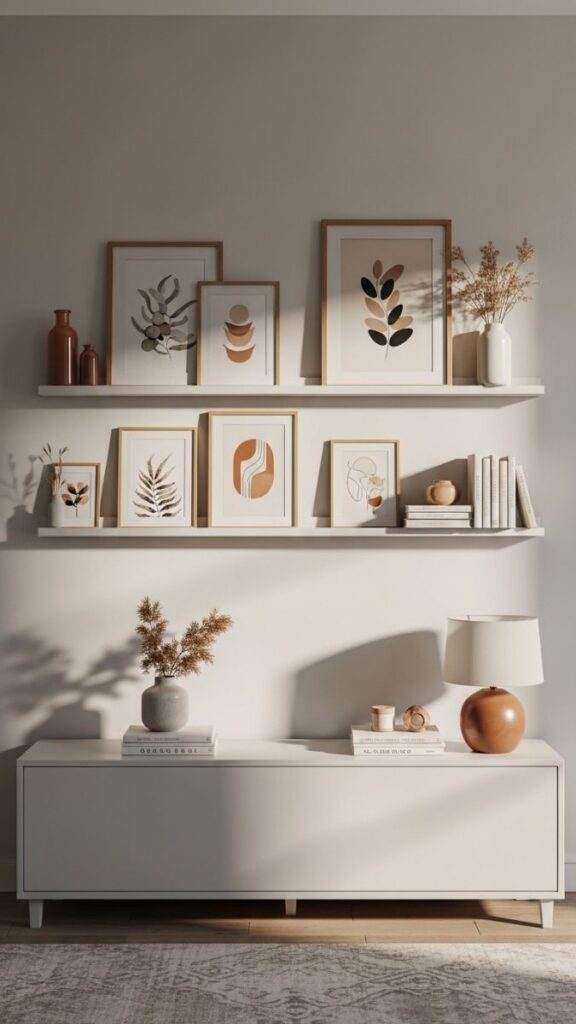
Picture ledges shallow shelves typically 3–4 inches deep let you lean frames at varying depths to create a layered look. Unlike gallery walls, you can rearrange without touching a single nail hole.
This is a genuinely useful setup for people who rotate art seasonally or for renters who want to minimize wall damage.
The layering creates a sense of depth that flat-hung pieces don’t achieve. Use frames of similar finish but different sizes for a collected-over-time feel.
Read More About: 69+ Rental Friendly Decor Ideas That Make Your Space Feel Like You Actually Own It
Painted Geometric Shapes as a DIY Accent Wall
Painted directly on the wall, a simple geometric shape, an arch, a wide vertical stripe, and a curved panel does what a traditional accent wall can’t: it reads as intentional art rather than just a color choice.
This is low-cost and high-impact for renters willing to paint back to white before leaving. The arch shape in particular has become one of the strongest wall decor trends of 2025–2026 because it frames furniture below it like a built-in backdrop. Pair with a desk or side table to ground it.
Botanicals and Pressed Flowers in Matching Frames
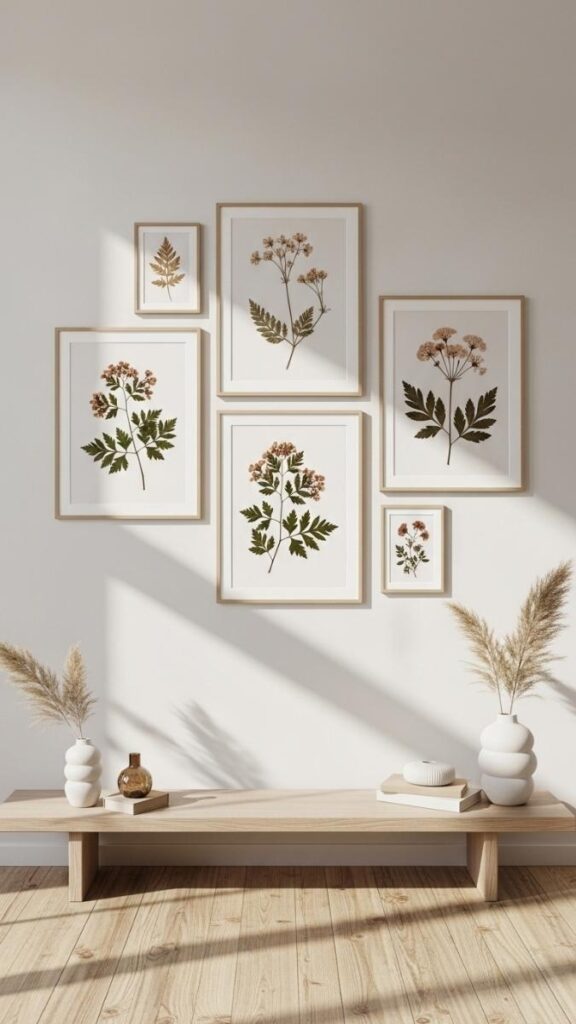
Pressed botanicals in identical white or gold frames give bathrooms and hallways the kind of quiet detail that feels elevated without being expensive.
The key is using the same frame size across all pieces and arranging them symmetrically either in a line or a balanced cluster. Botanicals work particularly well in rooms that get high moisture or aren’t used for long stretches (bathrooms, powder rooms, hallways) where you want something decorative but not precious.
A Wall-Mounted Pegboard for Functional Decor
Pegboards are the rare category where storage and decor overlap completely. In kitchens, they keep frequently used tools within reach while adding visual interest to a blank wall. In home offices, they hold supplies, notes, small plants, and chargers, a genuinely functional setup that also looks good from across the room.
The natural wood versions are especially versatile; painted versions in black or white read as more intentional. This is a particularly strong option for small apartments where counter and drawer space is limited.
A Horizontal Art Pair Above a Long Console
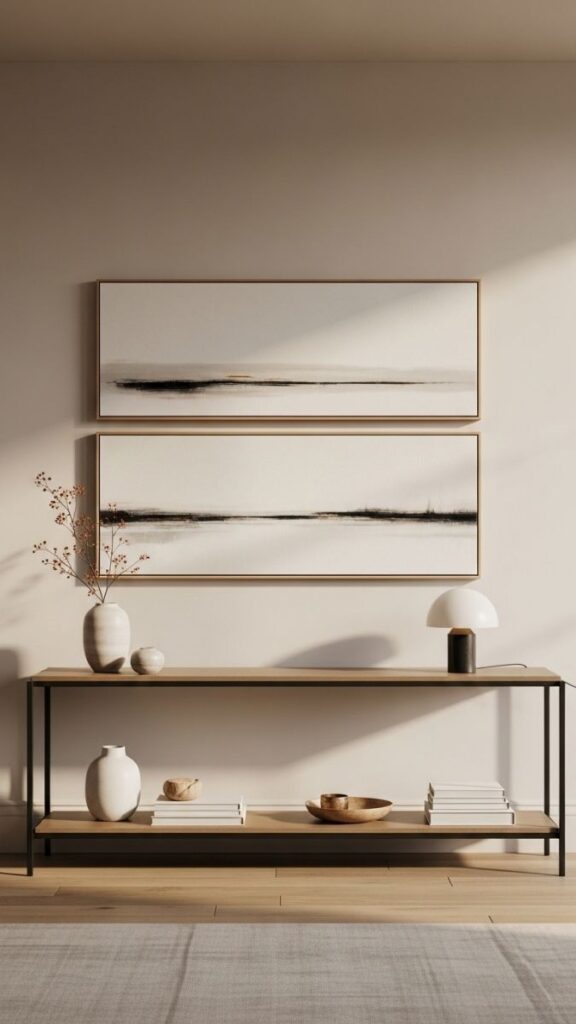
Two horizontal prints hung side by side create a wide, low composition that mirrors the proportions of a long console or sideboard below. This is a more interesting alternative to a single large print because the gap between the two creates visual rhythm but the matching frames keep it cohesive.
This works best when the combined width of both prints is close to (but slightly narrower than) the furniture below. A classic proportion rule that makes the arrangement feel intentional rather than accidental.
Architectural Wall Molding for a Built-In Look
This one I’d actually recommend trying first because the materials cost almost nothing just MDF strips and paint but the result looks like a genuine renovation. Frame molding applied directly to the wall and painted the same color creates a panel effect that reads as architectural rather than decorative.
It adds depth and shadow to a flat wall and makes a room feel more finished and considered. This works in both traditional and modern spaces depending on the strip profile you choose.
A Floating Bench With Art Above in Entryways
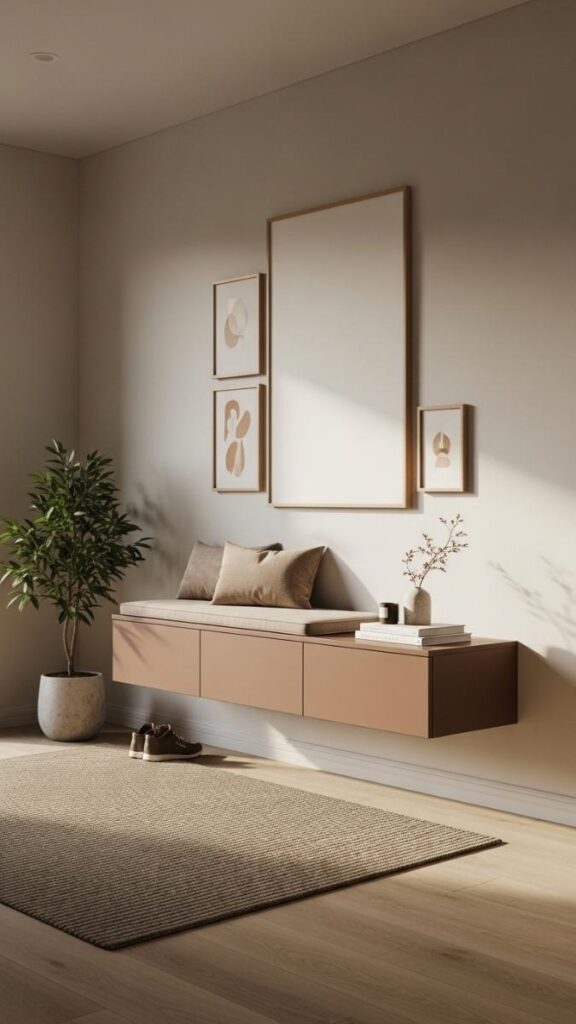
Narrow entryways often get ignored decoratively because function takes priority. But combining a floating bench, a few wall hooks, and one piece of art creates a layered setup that solves storage and makes the entry feel like a room, not just a corridor. The bench frees up floor space, the hooks handle daily items, and the art gives you something to look at from the door. Size the art to match the width of the bench makes the two objects feel like a composed unit.
Framed Maps or City Prints for a Personal Connection
Maps and city prints carry specific personal meaning in a way that most generic art doesn’t. A map of your hometown, the city you got married in, or a place you’ve traveled works as wall decor because it’s visually interesting and has a story behind it.
Large-format versions (24×36 or bigger) work best above a bed or sofa where they have room to be appreciated. The vintage or topographic styles age the best and fit most color palettes.
A Floating Corner Shelf for Awkward Wall Spaces
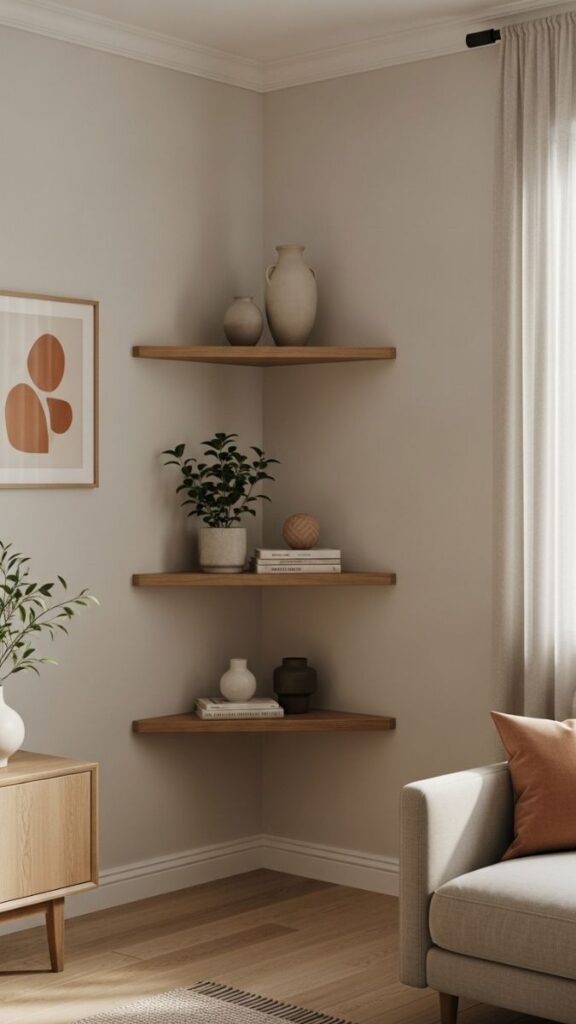
Corners are the most underused surfaces in most homes. A single floating corner shelf, usually triangular or curved, gives you a place to sit a plant, a candle, or a small object in a spot that would otherwise be empty.
It’s especially useful in bedrooms and living rooms where every other wall has something but the corners feel like dead space. The shelf itself becomes the decor; what sits on it is secondary.
Read More About: 68+ Budget Decor Ideas That Make Your Home Look Intentional Not Cheap
A Corkboard or Linen-Covered Pinboard as Living Wall Art
Pinboards are functional, yes but a large one in a proper frame becomes a living piece of wall art that changes over time. In a home office, pin a mix of reference images, postcards, a few art prints, and things you’re working on.
The evolving nature of it means it never looks stale. The key is the frame: a pinboard without a frame just looks like an office supply. A linen-covered version in a wide natural wood frame reads as intentional and designed.
Vertical Garden or Mounted Planters for Living Walls
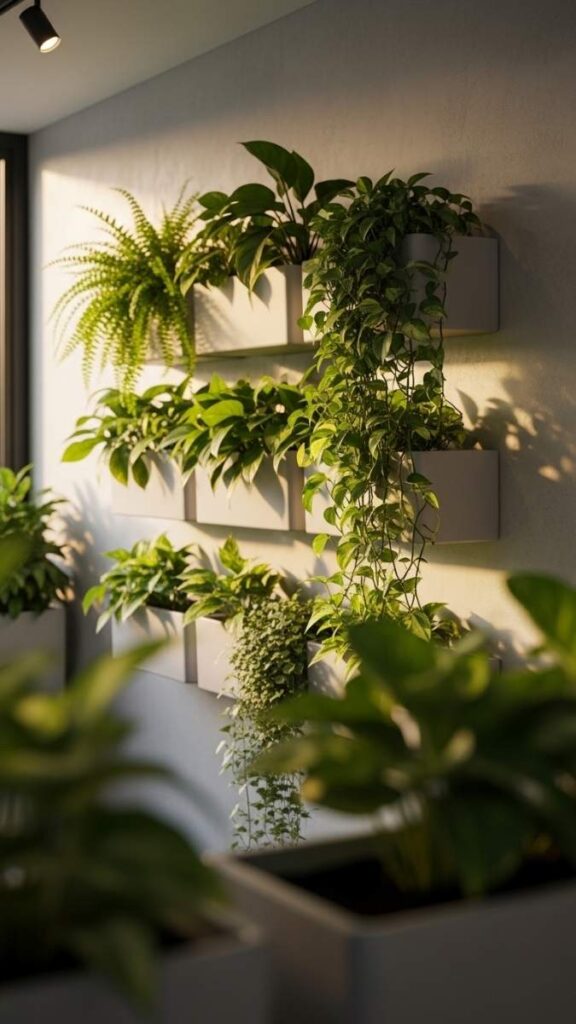
Living plants on the wall, even just two or three mounted ceramic planters, do something no art piece can: they introduce life, movement, and natural variation.
Trailing plants like pothos or string of hearts work best because they naturally spill down and draw the eye.
This is most practical in rooms with consistent natural or grow-light exposure. The mounted planter style (as opposed to a full living wall system) is manageable for most renters and doesn’t require professional installation.
A Floating TV Wall Unit That Makes the TV Part of the Design
Most TVs are hung on the wall as an afterthought centered, isolated, and surrounded by empty space. Integrating the TV into a wider floating shelf system transforms it from an eyesore into a considered feature.
Flank it with shelves at the same height (or just above and below) holding books, plants, and small objects. Hide cables in the wall or a cable channel. The goal is for the TV to be one element in a composed arrangement rather than the only thing on the wall.
An Oversized Clock With Roman Numerals for Transitional Spaces
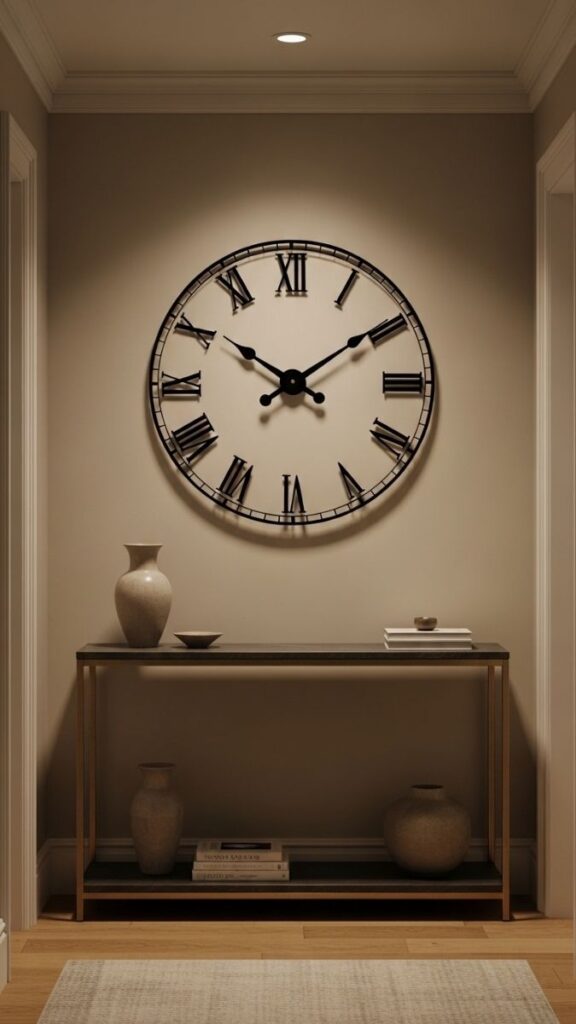
In spaces that lean traditional or transitional dining rooms with wood furniture, hallways in older homes a large clock with Roman numerals and an aged metal finish works as both a functional object and a vintage centerpiece.
Proportionally, these clocks tend to be 30–36 inches across, which gives them the presence they need to hold a wall independently. Honest answer: this reads dated in ultra-modern rooms, but in the right context it’s one of those pieces that gets asked about every time someone visits.
Black and White Photography in a Curated Wall Cluster
Monochrome photography is one of the most cohesive ways to create a gallery wall that feels deliberate rather than random. Because the color palette is unified, you can use different frame styles, sizes, and subjects without it looking chaotic.
Mismatching frames in different finishes (matte black, brass, dark wood) actually helps in this case it gives the cluster a collected quality. The subjects can range from portraits to landscapes to architecture as long as the black-and-white treatment ties them together.
A Neon or LED Sign for Entertainment Rooms and Studios
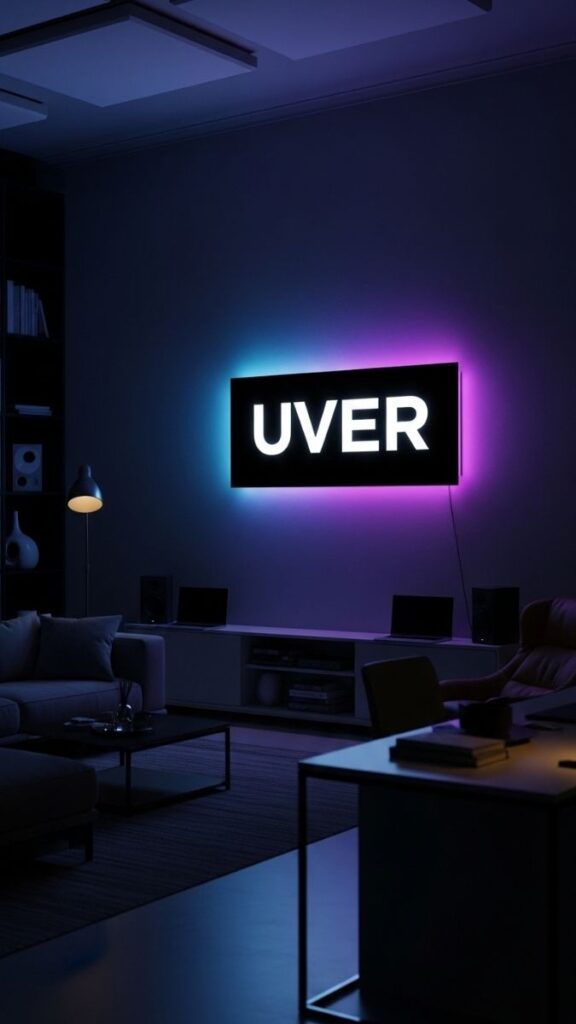
Neon signs used to feel gimmicky. The newer LED flex-neon versions are a different category: they produce softer, warmer light and can be designed custom or sourced in cleaner, more graphic styles. In entertainment rooms, podcast studios, or home bars, they serve as ambient light and wall decor simultaneously two functions in one.
The trick is choosing a color temperature that matches the room. Cool white feels clinical; warm amber or blush reads more atmospheric.
Framed Vintage Posters for a Curated Collected Feel
In my experience, vintage posters are underrated as serious wall decor. A well-chosen vintage travel, botanical, or exhibition print properly framed with a mat holds its own next to much more expensive art.
The graphic quality of mid-century design in particular reads very well at scale. Source them from markets, estate sales, or digital archives that offer printable files. The frame and mat do a lot of the work: the same poster in a cheap plastic frame and in a deep wooden frame with a white mat look like completely different objects.
A Wall Mural or Wallpaper Panel as the Room’s Signature Feature
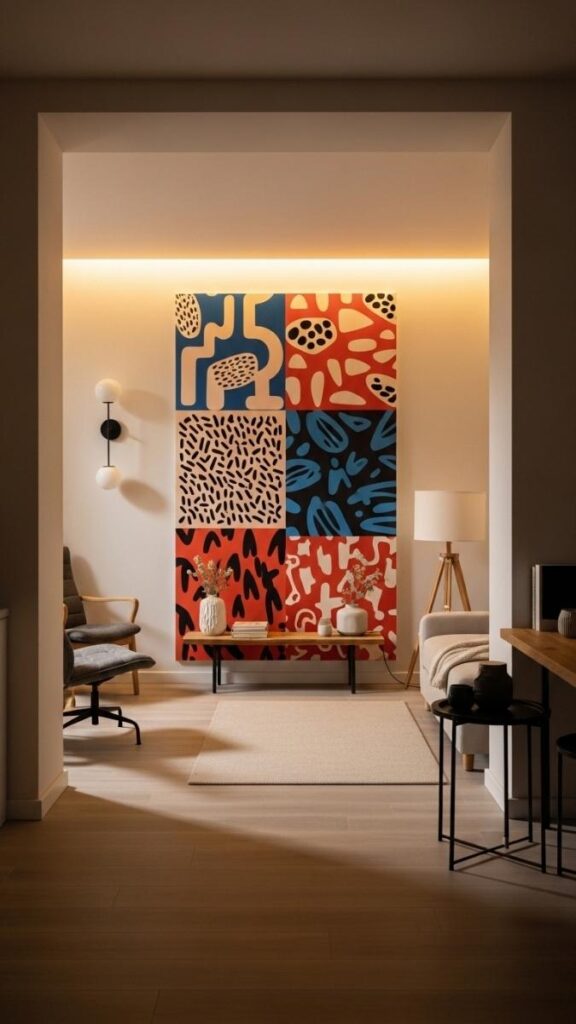
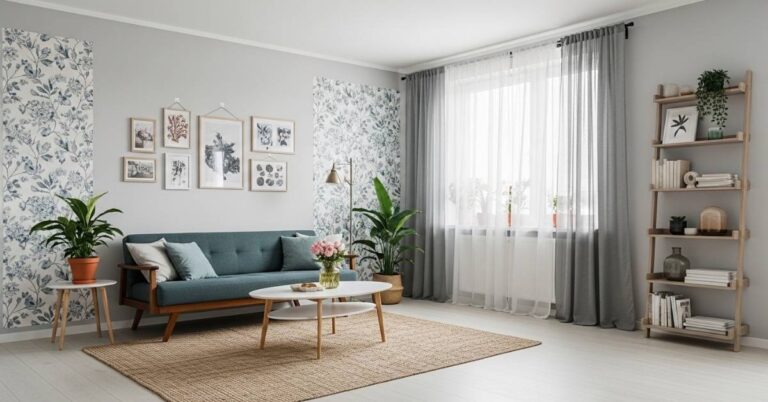
One peel-and-stick wallpaper panel applied to a single wall behind a bed or sofa creates the effect of a custom mural without permanent commitment. The market for peel-and-stick options has expanded significantly in the last few years, with designs that include botanicals, abstract patterns, and geometric prints in realistic scales.
Because the rest of the room stays neutral, one patterned wall becomes the room’s signature feature rather than a visual competition. Strong option for renters.
Shelving With Books as Visual Texture on a Feature Wall
A wall of books works differently from other wall decor because the spines create natural color blocking and visual texture without requiring you to curate anything specifically for display.
Arrange books loosely by color or size for a more structured look, or leave them in reading order for a more honest, lived-in feel. Either way, bookshelves that cover a significant portion of a wall give a room substance and warmth that’s hard to achieve with art alone.
Hanging Ceramic or Sculptural Wall Plates for a Layered Look
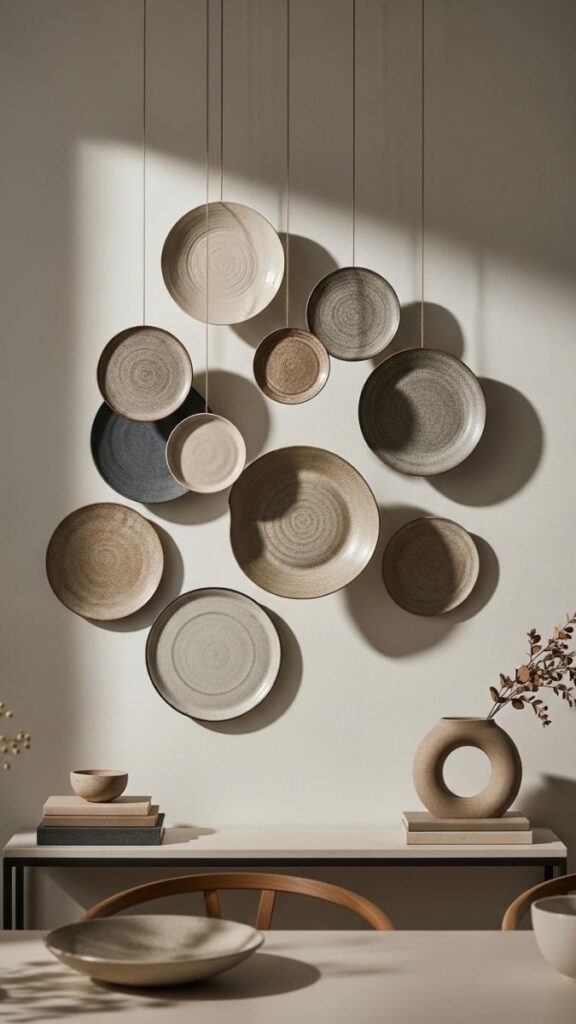
Decorative plates hung on a wall are having a clear moment in 2026 partly as a reaction against the ultra-flat, two-dimensional quality of print-heavy walls. Ceramic plates introduce physical depth, and the variation in glaze texture means they catch light differently throughout the day.
Arrange them asymmetrically in a cluster, mixing sizes but keeping the glaze tones within a coherent range (all earthy, all neutral, all bright). They work particularly well in dining rooms and kitchens where there’s already a connection to material objects.
What Actually Makes These Wall Decor Ideas Work
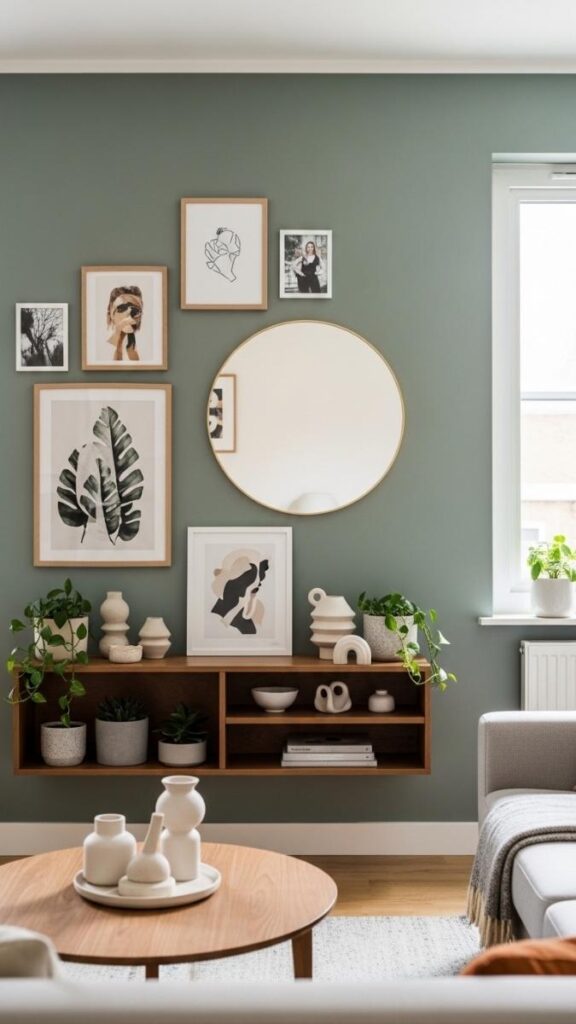
Most wall decor fails for three reasons: the wrong scale, the wrong height, and too much fragmentation.
Scale: The single most common mistake is hanging art that’s too small for the wall it’s on. A piece that looks adequate online often disappears in a real room. As a general rule, art above a sofa should span at least two-thirds of the sofa’s width. A single piece above a bed should be 24 inches wide at minimum ideally wider.
Height: Art hung too high is extremely common, especially in rooms with tall ceilings. The standard guidance is to hang the center of the piece at eye level approximately 57–60 inches from the floor regardless of ceiling height. In rooms with ceilings above 10 feet, resist the temptation to hang art higher just because there’s room. It disconnects the art from the furniture below.
Fragmentation: Too many small pieces spread across a wall create visual noise rather than presence. Grouping pieces together even if it’s just pulling two pieces closer than feels instinctive creates a single cohesive unit the eye can land on rather than a scattering it has to work to process.
Wall Decor Setup Comparison Guide
| Setup | Best Space Type | Problem It Solves | Budget Level | Renter-Friendly |
| Single large print | Living room, bedroom | Empty wall, no focal point | Low–mid | Yes |
| Grid gallery wall | Dining room, office | Blank large wall, indecision | Low | Yes |
| Floating shelves + objects | Entryway, hallway | Narrow walls, need flexibility | Low–mid | Yes |
| Large mirror | Small or dark room | Poor light, cramped feel | Mid | Yes |
| Architectural molding | Living room, dining room | Flat, plain walls | Low | No |
| Woven wall hanging | Bedroom, studio | Lacks texture, feels cold | Low–mid | Yes |
| Peel-and-stick mural | Bedroom accent wall | Needs personality fast | Mid | Yes |
| Pegboard | Kitchen, home office | No storage + no decor | Low | Yes |
| Mounted ceramic plates | Dining room, kitchen | Two-dimensional, flat walls | Mid | Yes |
| Floating TV unit | Living room | TV looks isolated, cables visible | Mid–high | Depends |
Common Wall Decor Mistakes That Make Rooms Feel Smaller or Unfinished
Hanging too many pieces at different heights.
When art is hung at inconsistent heights across a wall one piece at 62 inches, another at 70 the eye reads it as disorder. Establish one center line for all pieces or align tops, then stick to it.
Using frames that are too thin for large prints.
A large print in a very thin or flimsy frame looks unresolved. The frame width should scale with the print. A 30×40 print generally needs a frame that’s at least 1.5–2 inches wide to hold its own on the wall.
Treating every wall as needing decor.
Not every wall in a room needs to have something on it. One or two well-considered walls are more effective than four walls that are all trying to do something. A negative space plain wall gives the decorated surfaces room to breathe.
Ignoring the furniture below.
Wall decor doesn’t exist in isolation. The size, position, and finish of what’s directly below a piece of art should influence what goes above it. Art should relate to the furniture it sits above, not just fill the available wall space.
Choosing art based on trend rather than scale.
In 2026, abstract and organic-shaped art is everywhere but an abstract print that works beautifully at 12×16 can look weak and out of place at that size on a full wall. Buy for scale first, then style.
FAQ’s
What is the rule for hanging wall decor?
Hang the center of each piece at approximately 57–60 inches from the floor roughly eye level for a standing adult. This applies regardless of ceiling height. For art hung above furniture, leave 6–10 inches of space between the top of the furniture and the bottom of the frame.
How do I make a small room look bigger with wall decor?
Using one large piece rather than several small ones large-scale art expands the perceived size of a wall. A mirror placed opposite a window doubles the light in the room and makes it feel more open. Avoid cluttering walls with too many pieces, which closes a space in rather than opening it.
Is it better to have one large piece or a gallery wall?
It depends on the wall and the room. A single large piece creates calm and focus good for bedrooms and small rooms. A gallery wall adds energy and personality better suited to dining rooms, hallways, and living rooms with longer walls. The issue with gallery walls is execution: they look intentional when planned, and chaotic when improvised.
What wall decor works best for renters?
Peel-and-stick wallpaper panels, floating ledge shelves with leaning frames, picture ledges, large mirrors, and woven wall hangings all require minimal wall damage. Most can be done with three or fewer holes per piece. Command strips work for lighter pieces, check the weight limit carefully before using them on heavier frames.
How do I choose wall decor that won’t look dated in two years?
Avoid art that’s trend-specific (specific colors or motifs that are peak-trend right now) and invest in pieces with longevity: black and white photography, botanicals, abstract line drawings, typography in neutral tones, and maps. The frame matters more than people think a classic frame in natural wood or matte black will outlast almost any trend the art inside it goes through.
Does wall decor need to match furniture?
No but it should relate to it in scale, tone, and proportion. A dark-framed piece above a light-wood console creates contrast that works well. Art that matches furniture exactly tends to read as a set, which can feel less personal. The relationship between the two matters more than matching.
How do I fill a very large wall without spending a lot?
Large-format printing (many print shops offer poster-size prints for under $30), fabric stretched over a canvas frame, peel-and-stick murals, or architectural molding painted the same color as the wall are all budget-conscious approaches for large surfaces. The molding option is particularly effective because it adds architectural interest without requiring expensive art.
Conclusion
Bare walls are one of the easiest things to fix in a home and one of the most overlooked. The ideas in this list run the range from a $15 poster in a proper frame to a full floating shelf system, but they share the same underlying logic: relate the decor to the room’s proportions, solve a real spatial problem, and let the wall work with the furniture rather than against it.
Start with one or two ideas that fit your actual space, your ceiling height, your furniture, your light situation. Don’t try to address every wall at once. A single well-chosen, well-placed piece does more for a room than five pieces hung without a clear relationship to the space around them. Pick one, get the scale right, and build from there.