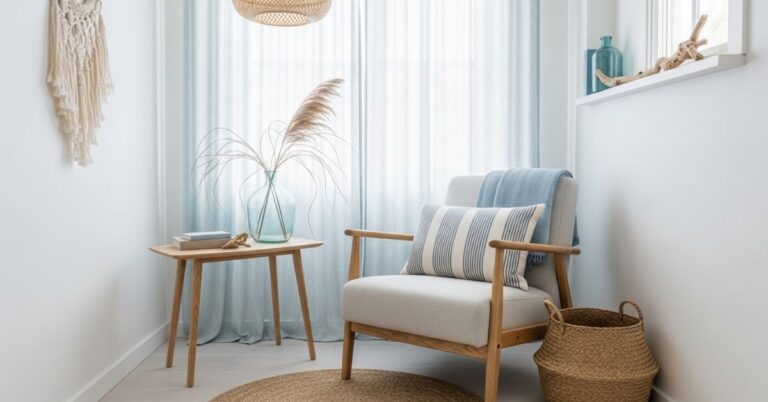
11+ Lighting Ideas That Actually Change How Your Home Feels Not Just How It Looks
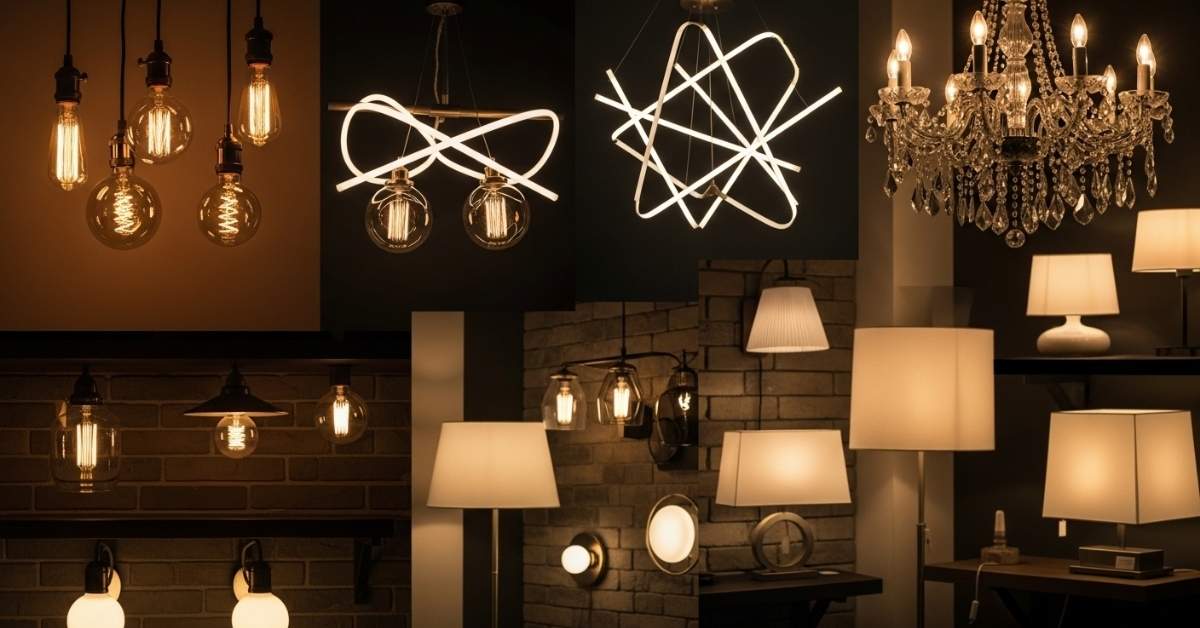
Lighting is one of those things you don’t think about until it’s wrong. The room feels flat. The overhead light is too harsh. You’ve got great furniture and still the space doesn’t feel warm or finished. Lighting Ideas In 2026, more homeowners are ditching the single-ceiling-fixture setup and building layered lighting from the ground up and the difference isn’t subtle.
If your space needs to function for both work and relaxation, or if you’re trying to make a small room feel larger and less clinical, the ideas below are specifically chosen for real floor plans, real budgets, and real results. These aren’t magazine setups, they’re practical lighting arrangements you can actually pull off.
Layer Three Light Sources in the Living Room Instead of Relying on One Overhead
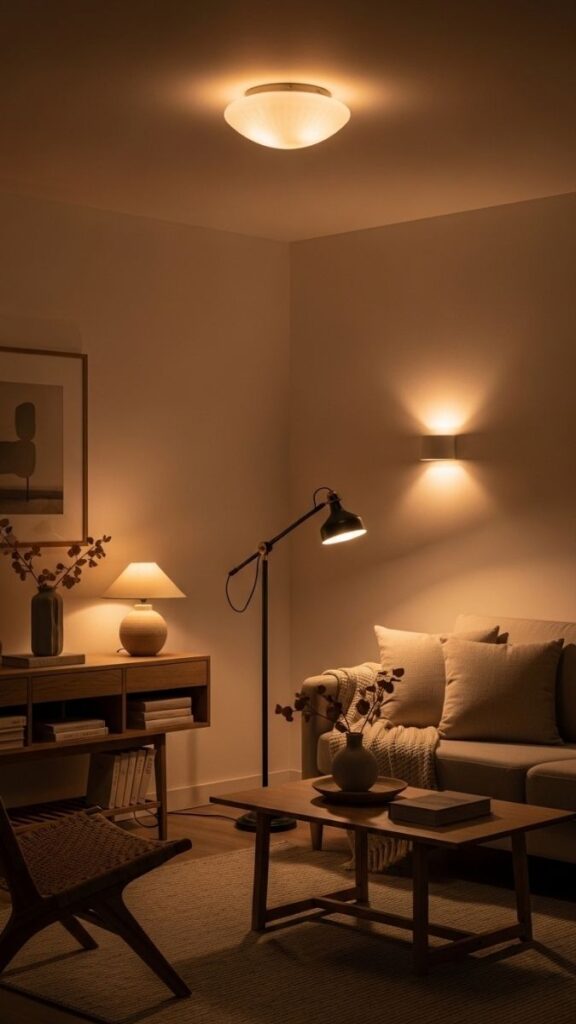
The single overhead light problem is incredibly common, and the fix is surprisingly simple: add two more sources at different heights. A floor lamp tucked behind a sofa, a table lamp on a side table, and a dimmed overhead or recessed fixture creates a triangulated glow that fills the room evenly without any harsh shadows.
The reason it works spatially is that light coming from multiple angles eliminates the flat, institutional feel that a single ceiling fixture creates. This setup works especially well in living rooms under 300 sq ft. It makes the ceiling feel higher and the room feel less boxy. It also lets you shift the mood: full brightness for work, just the floor lamp for evening wind-down.
Use a Plug-In Pendant Light Over a Dining Table Without Rewiring
Renters, this one’s for you. A pendant light doesn’t have to mean an electrician and a ceiling medallion. Plug-in pendant kits where the cord runs discreetly along the ceiling toward an outlet are one of the smartest workarounds in home decor right now. Position it 28–34 inches above the tabletop so the light pools on the surface without blinding anyone seated. A wide-shade pendant over a round dining table creates a cozy, almost restaurant-like feel that keeps the conversation close.
This solves the problem of dining areas that sit directly under a general-purpose ceiling light which tends to light the ceiling more than the table.
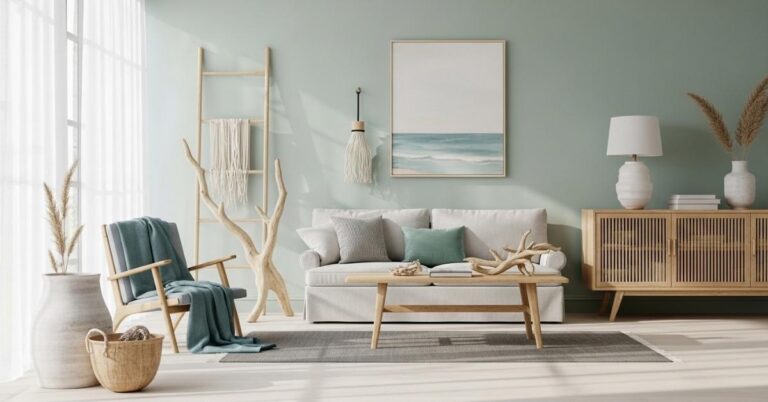
Place a Table Lamp on the Floor to Create Indirect Uplight in a Corner
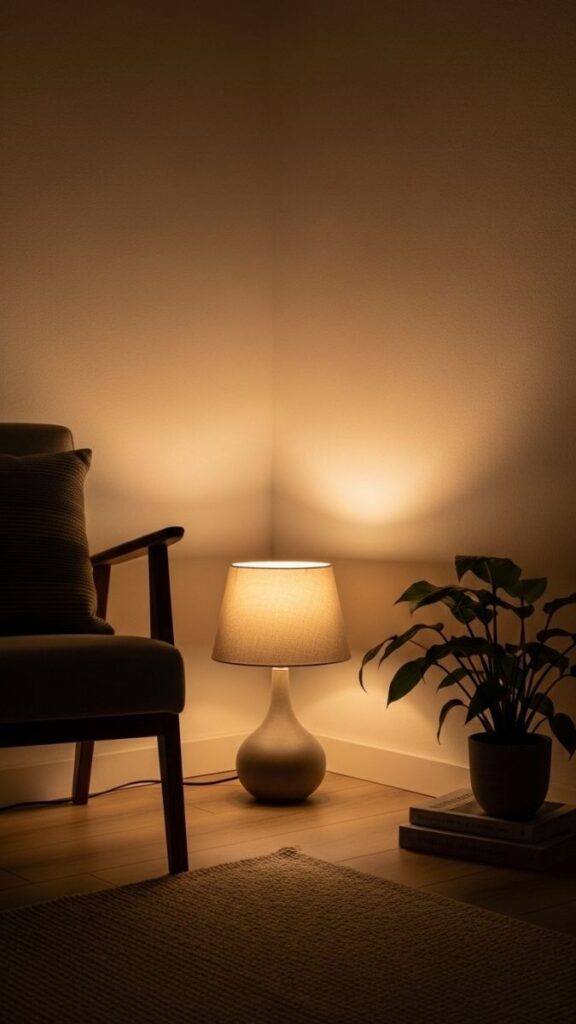
This is one I’d actually recommend trying first because it costs nothing and the effect is surprisingly good. Take a table lamp, ideally one with a fabric or translucent shade, set it directly on the floor in a corner, and aim it toward the wall.
The upward wash of light adds warmth and perceived height without any installation. It’s not a trick, it works because corner light creates soft shadows that make a room feel more dimensional than flat, overhead-only setups.
Best for: living rooms and bedrooms where you want a relaxed, low-key atmosphere after dark. Great for renters because it’s fully removable.
Install LED Strip Lights Under a Floating TV Unit for Ambient Bias Lighting
Bias lighting the soft glow behind or around a screen isn’t just aesthetic. It reduces eye strain when watching TV in a dark room by creating a middle ground of light that helps your eyes adjust. Warm white (2700–3000K) strips mounted underneath a floating unit create a clean, modern glow that pools on the floor beneath.
The visual effect makes the unit appear to float even more dramatically. This works in nearly any size living room, but it’s especially effective in apartments where the TV unit is the room’s focal point. Avoid cool-white or daylight strips they clash with the warm evening atmosphere.
Use Clip-On Reading Lights to Free Up Surface Space in Small Bedrooms
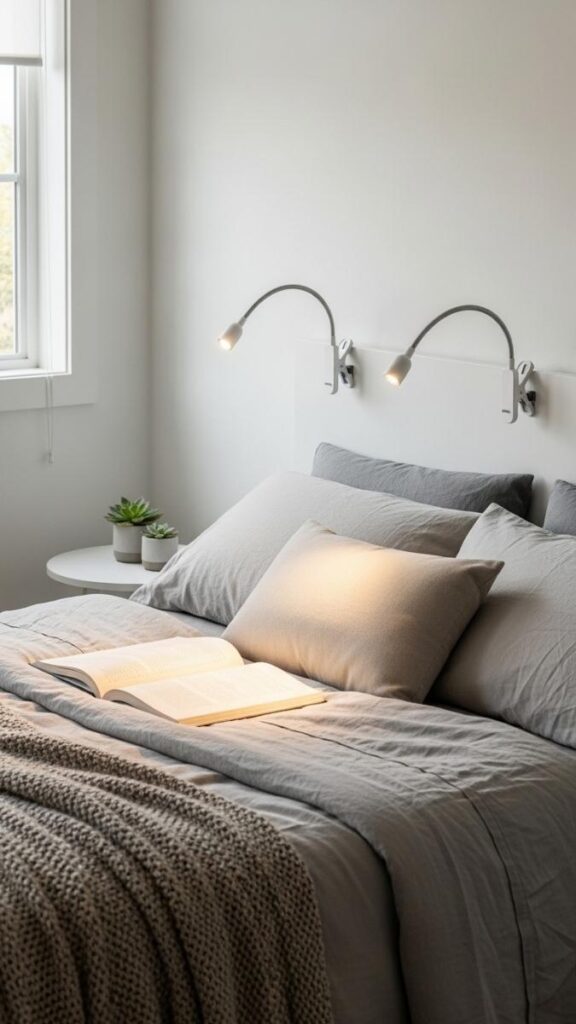
Nightstands in small bedrooms are already doing a lot of work: phone, water, book, maybe a charger. Adding a traditional table lamp often means something gets knocked over. Clip-on reading lights are the cleaner solution: they mount directly to the headboard, direct light exactly where you need it, and leave the surface completely free.
In my experience, this works best when you choose a light with a flexible gooseneck arm rather than a fixed one; it gives you directional control without repositioning the whole fixture. The setup is ideal for rooms where the nightstand is under 18 inches wide.
Read More About: 27+ Wall Decor Ideas That Actually Work in Real Homes Not Just on Pinterest
Hang String Lights Horizontally Across a Bedroom Wall for Texture, Not Just Ambiance
Strung vertically, fairy lights look like a dorm room. Stretched horizontally behind the bed at ceiling height using small adhesive hooks they create a long, even band of warm light that mimics the effect of a wall sconce without the installation.
The horizontal plane draws the eye across the wall rather than up and down, which widens the visual perception of the room. This is especially useful in narrow bedrooms where the walls feel close. It’s also one of the easiest swaps to make before moving into a rental with no overhead lighting in the bedroom.
Use a Statement Floor Lamp With a Wide Shade to Light a Reading Nook
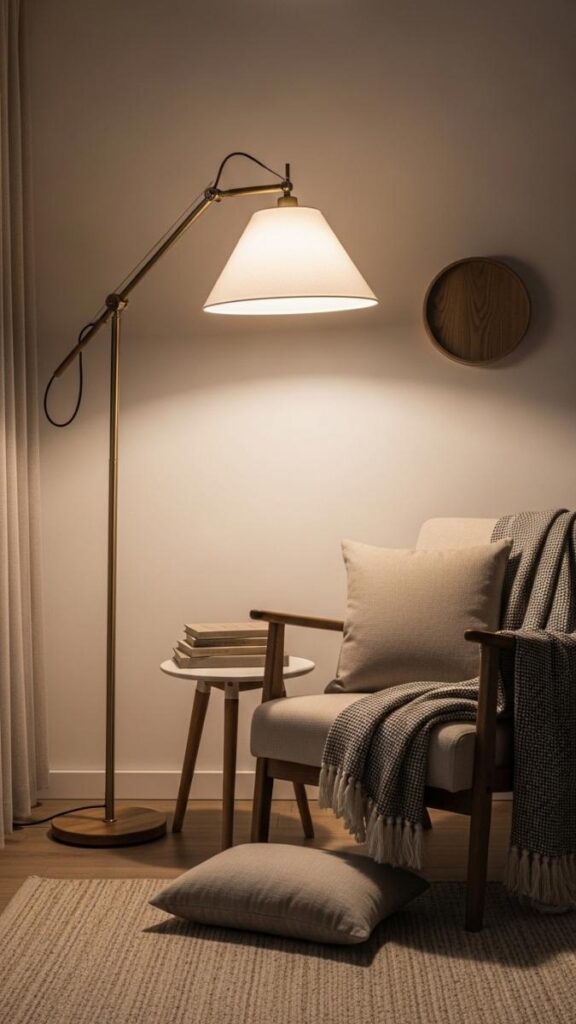
A good reading nook isn’t just about the chair, it’s about having the right light at the right angle. A floor lamp with a wide, downward-facing drum shade placed slightly behind and to the side of the chair lights the lap and book without creating glare.
Arc floor lamps are particularly useful here because the arm can extend over the seating without needing the lamp base to be directly next to it, keeping the floor area clean. This kind of setup also works beautifully in larger living rooms where you want to visually define a “reading corner” without using a physical divider.
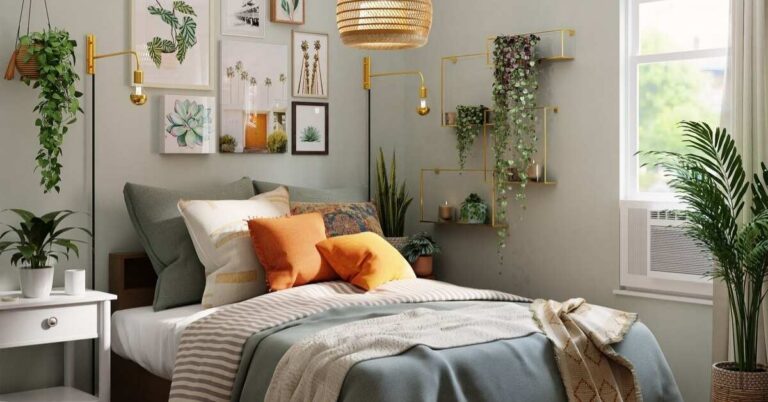
Swap Overhead Lighting for a Rattan Pendant in a Small Bedroom or Nursery
Rattan pendants are one of the most practical swaps you can make in a smaller room and they’re having a serious moment in 2026 interiors. The woven material filters light into a dappled, textured pattern on the walls and ceiling that feels far warmer than bare bulbs or frosted glass fixtures.
The overhead light becomes a design element rather than just a utility. In a small bedroom, this subtle patterning makes the walls feel active and interesting without adding any furniture or wall art. Use a warm Edison or globe bulb 2200–2700K to maximize the effect.
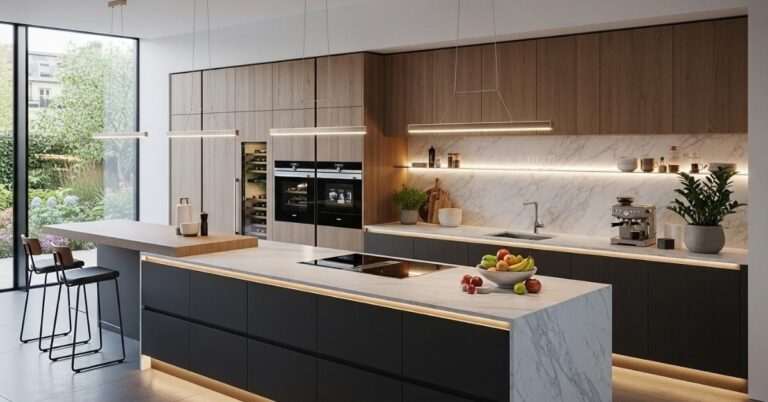
Use Under-Cabinet Lighting in the Kitchen to Solve the Shadow Problem
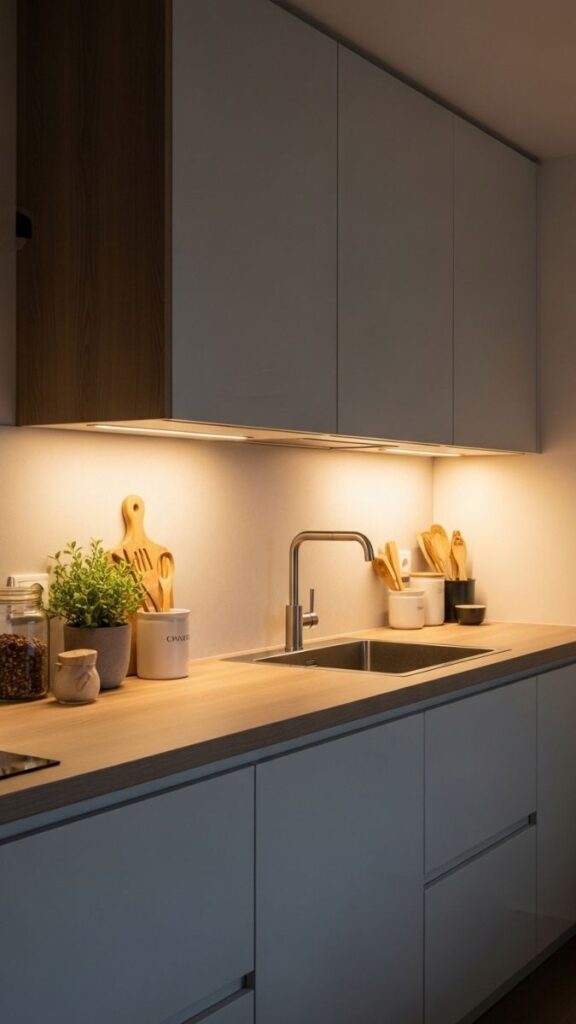
When you’re working at a kitchen counter and the light source is above and behind you like most ceiling-mounted fixtures you’re essentially standing in your own shadow. Under-cabinet lighting solves this completely by placing the light source directly above the task area.
Adhesive LED tape strips or plug-in puck lights both work well; the former gives more even coverage across longer counter runs. Warm white is the better choice here over cool white it makes food prep feel more inviting and ties the kitchen into the warmer atmosphere of adjacent rooms. This is one of the most underrated, practical lighting upgrades in any home.
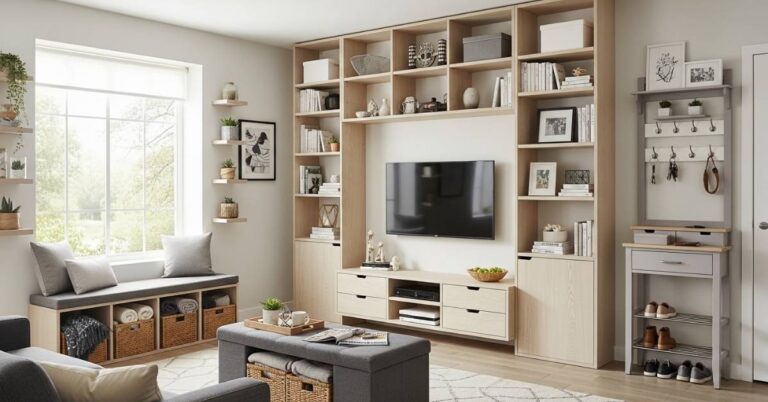
Add a Table Lamp to a Bookshelf for a Built-In Library Effect
Books on a shelf look completely different when they’re backlit or side-lit from close range. A small table lamp ideally with a fabric or opaque shade so it doesn’t glare placed on one of the middle shelves creates a warm focal glow that makes the whole bookcase feel intentional.
The light illuminates the spines of books at that level and casts a soft upward light on the shelves above it. This works in living rooms and home offices. If the shelf is deep enough, you can push the lamp toward the back and stack objects in front of it to create a layered, vignette-style arrangement.
Read More About: 70+ Seasonal Decor Ideas That Actually Work in Real Homes Without the Clutter
Use Warm Bulbs Throughout to Create Visual Consistency Between Rooms
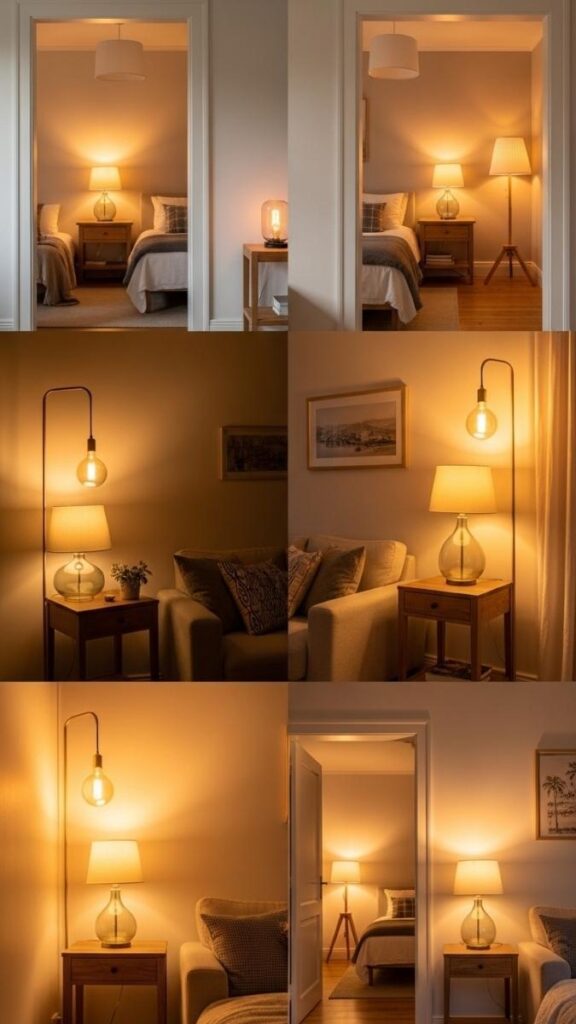
Honestly, this is one of the most overlooked fixes. When different rooms have bulbs at different color temperatures 3000K in the kitchen, 2700K in the living room, 4000K in the bathroom the home feels visually fragmented.
Switching everything to the same warm white temperature (2700K is a reliable standard for most residential spaces) creates cohesion between rooms, especially in open-plan apartments where the kitchen, dining area, and living room are visible simultaneously.
The cost is minimal; the impact on perceived warmth and continuity is significant.
Hang a Pendant Light Cluster Over a Kitchen Island at Staggered Heights
A single pendant over a long kitchen island works, but three small pendants hung at slightly staggered heights, 2–4 inches apart create a dynamic overhead composition that feels designed rather than default.
The stagger draws the eye along the length of the island rather than up and down, which emphasizes its horizontal presence. This is especially effective in kitchens with higher ceilings (9ft+) where a single pendant can look lost.
Use matching fixtures in different sizes or the same fixture at different cord lengths for a cohesive look.
Use a Dimmer Switch to Control the Mood Without Changing Any Fixtures
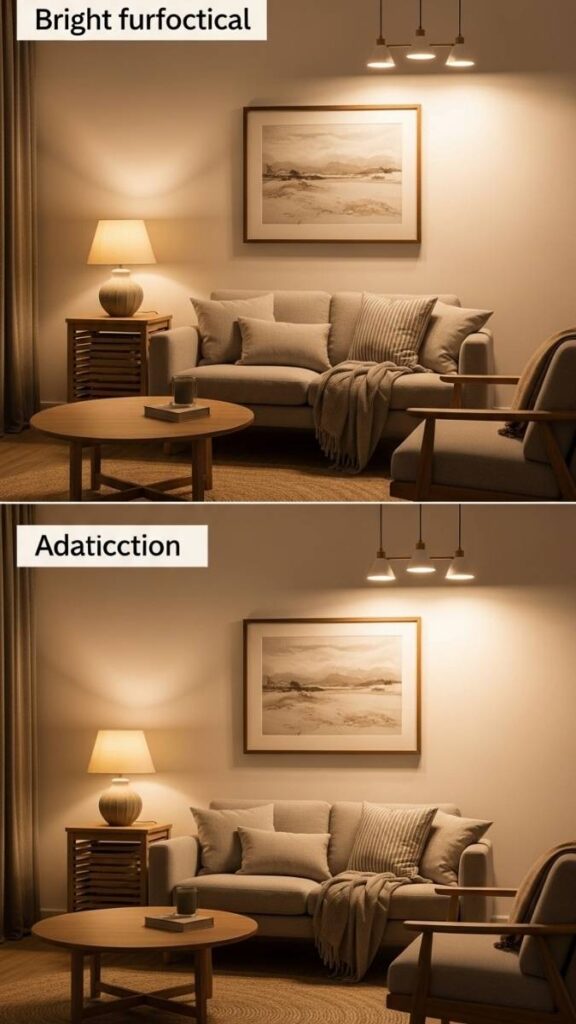
A dimmer switch is one of the least-discussed, most-effective lighting upgrades in any home. The same fixture that feels too harsh at full brightness can feel warm and intimate at 40%. Most modern LED bulbs are dimmable (check the packaging) and most dimmer switches are straightforward to install.
This is particularly useful in multipurpose rooms, a living room that doubles as a workspace, or a kitchen with a dining area attached. Full brightness for cooking or working, low for eating, lower still for evening. The room doesn’t change, but how it feels does.
Raed More About: 69+ Rental Friendly Decor Ideas That Make Your Space Feel Like You Actually Own It
Place Candles or Flameless LED Candles at Varying Heights on a Coffee Table
Grouping candles at different heights on a coffee table is one of the simplest forms of layered lighting and it’s completely free if you already own them.
The varying heights create a micro-landscape of light that’s more visually interesting than a single plane of glow. For everyday use, flameless LED candles are a practical alternative.
The better brands flicker in a way that’s genuinely convincing, and they work in spaces where real flames aren’t safe (families with young kids, tight shelving). Use an odd number of candles and cluster them toward one end of the table rather than centering them; it looks less formal.
. Light a Bathroom Vanity From the Sides, Not Just Above
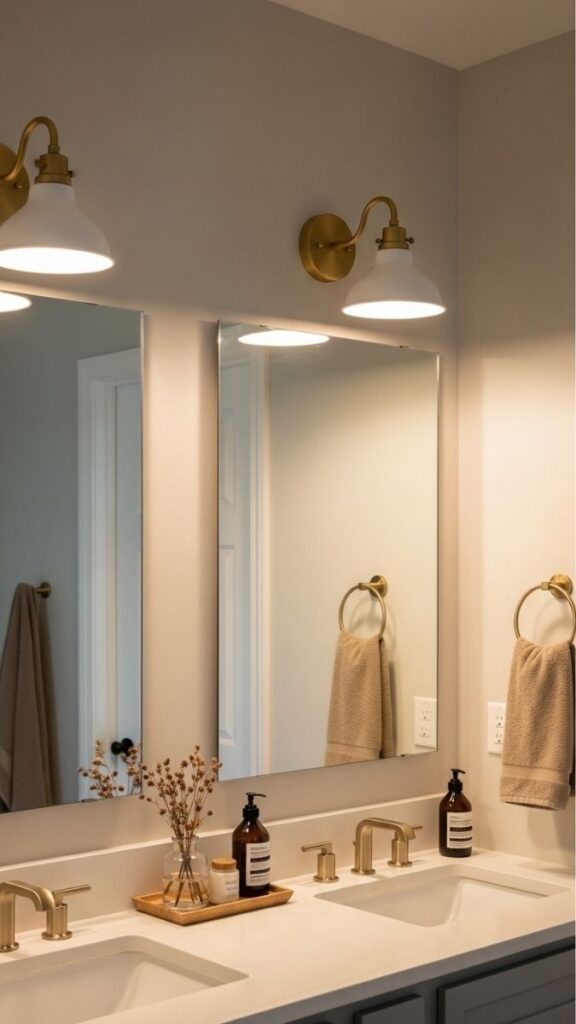
The single light bar above a bathroom mirror is functional but creates unflattering shadows under the chin and eyes. It’s why bathroom selfies rarely look great. Side-mounted sconces at approximately face height (around 60–65 inches from the floor) distribute light evenly across the face without the shadow issue.
If you’re in a rental and can’t rewire, there are adhesive, battery-operated sconce options that deliver a convincing effect. This setup works in bathrooms of any size, but it’s particularly impactful in small bathrooms where the mirror and vanity take up a large proportion of the visible wall space.
Use Outdoor String Lights on a Balcony or Patio to Define the Space
A balcony without overhead lighting just doesn’t get used after dark. String lights strung in a grid or draped along the railing create an immediate sense of enclosure and warmth that makes even a tiny balcony feel like a usable room.
The overhead plane of light is what does the work: it draws a ceiling where there isn’t one, which is why the space suddenly feels finished. This is especially true in urban apartments where balconies are small and high-ceilinged; the lights bring the visual “roof” down to a human scale.
Add a Bedside Sconce on a Wall Bracket to Free Up the Entire Nightstand
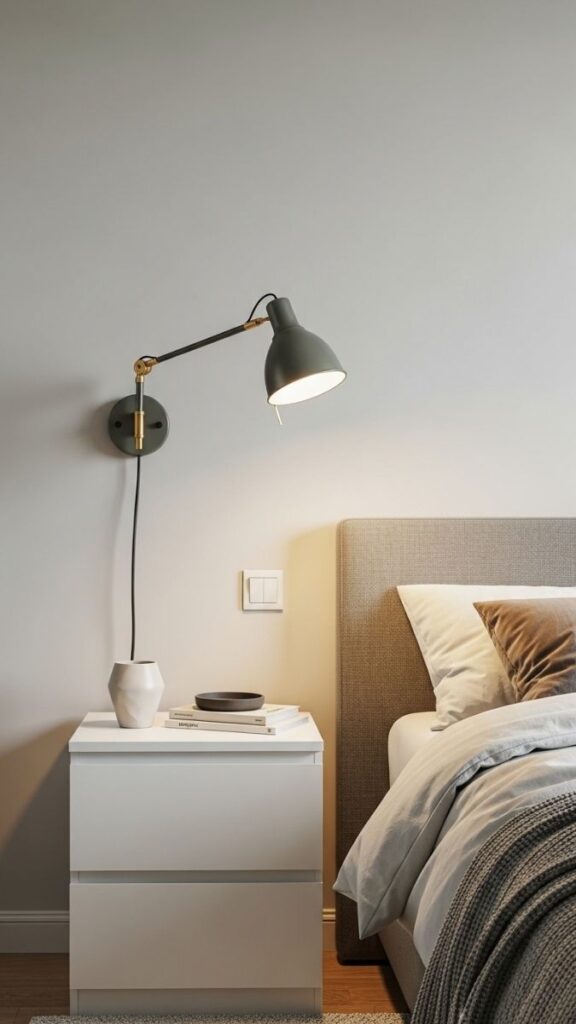
Swing-arm wall sconces, the plug-in variety, which don’t require hardwiring are one of the most underrated bedroom upgrades. They mount on a wall bracket, plug into a standard outlet, and give you fully adjustable, directional light right where you read.
The main advantage over a floor or table lamp is that the nightstand is freed entirely: no base, no cord running to the surface. In smaller bedrooms or those with narrow nightstands, this is a functional gain, not just an aesthetic one. Look for sconces with a fabric shade rather than a bare bulb. The filtered light is much easier on the eyes for bedtime reading.
Use a Task Lamp With a Focused Beam in a Home Office to Separate Work From Ambient Light
In a home office, having only one light source usually means the overhead means your desk, screen, and background are all at the same brightness level, which makes it harder to mentally “close” the workday.
A dedicated task lamp with a focused, adjustable beam keeps the work surface well-lit while allowing the ambient light to stay lower. This separation helps with both focus during work hours and with the transition out of work mode.
A lamp with a built-in USB port and brightness control is worth the extra investment if you’re at a desk for long hours.
Light a Staircase With Step Lights for Safety and Visual Interest
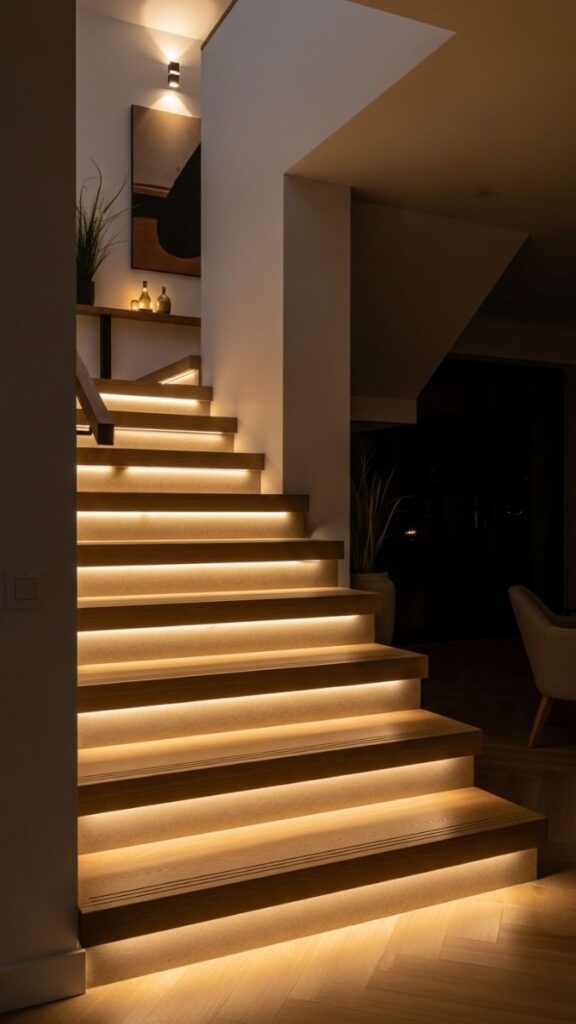
Staircase lighting is almost always an afterthought which is why so many staircases are lit only by whatever light spills from the floor above. Recessed step lights (installed into the riser or the wall beside the tread) add both safety and a very architectural quality to what is otherwise a purely functional space.
They also consume very little energy when set to low brightness. This works in both modern and traditional homes; the fixture style can be swapped to match. If recessed installation isn’t an option, adhesive motion-activated step lights offer a similar effect for renters.
Use a Long Linear Pendant Over a Rectangular Dining Table for Scale
Round pendants work over round tables. But over a rectangular table, especially one that seats six or more, a single round pendant looks proportionally wrong and creates a dark zone at both ends.
A linear pendant or island light, hung along the length of the table, distributes light evenly from end to end and creates a more formal, finished arrangement. Position it 30–36 inches above the tabletop and centered over the table’s length, not just its center point. This setup also signals the dining area as a defined zone in open-plan spaces, which helps with room flow.
Use Wall Sconces in a Hallway to Replace the Standard Ceiling Fixture
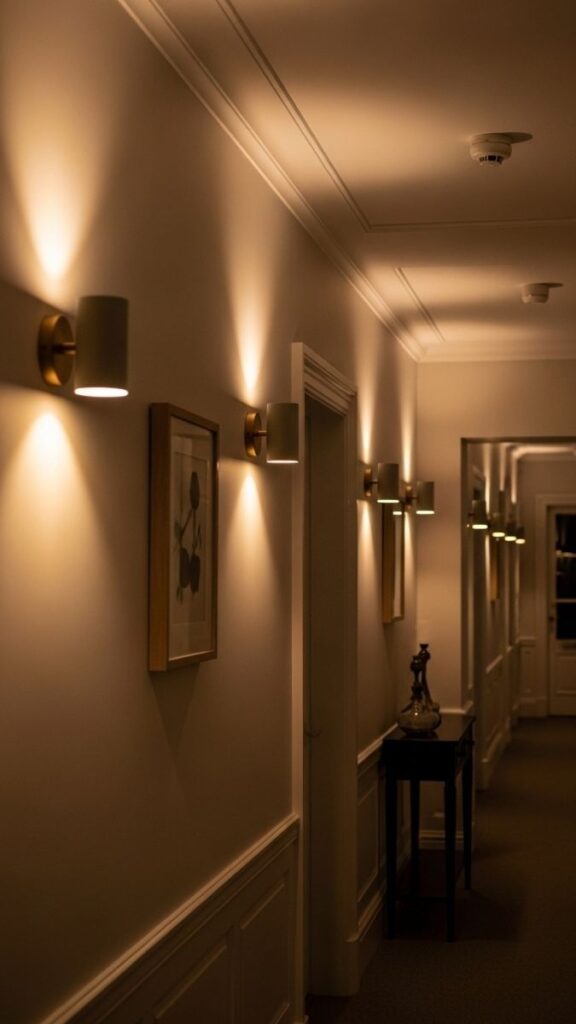
Hallways are typically lit by a single recessed light or a plain flush-mount which gives off a flat, utilitarian glow that does nothing for the transition from entrance to living space.
Replacing or supplementing that ceiling fixture with two flanking wall sconces (mounted at around 60 inches) creates a more architectural quality to the space.
The light washes upward and downward along the wall, adding texture and perceived depth. This is particularly effective in hallways with an interesting wall finish, artwork, or a console table at the end the sconces draw attention toward it.
Light Artwork With a Picture Light or Adjustable Spotlight
I’ve noticed this style tends to make a room feel significantly more considered not in a way that needs explaining, but in the way that people notice the art without knowing why. A picture light mounted directly on the frame or a small adjustable spotlight aimed at art from a nearby ceiling track creates a museum-quality presentation that elevates the entire wall.
It works best with a warm, incandescent-spectrum bulb so colors in the artwork look rich rather than cool. For renters, plug-in track lighting which attaches to the ceiling with a canopy plate and plugs into an existing outlet offers a no-commitment version of this.
Create a Cozy Corner With a Tall Arc Lamp and Layered Textiles
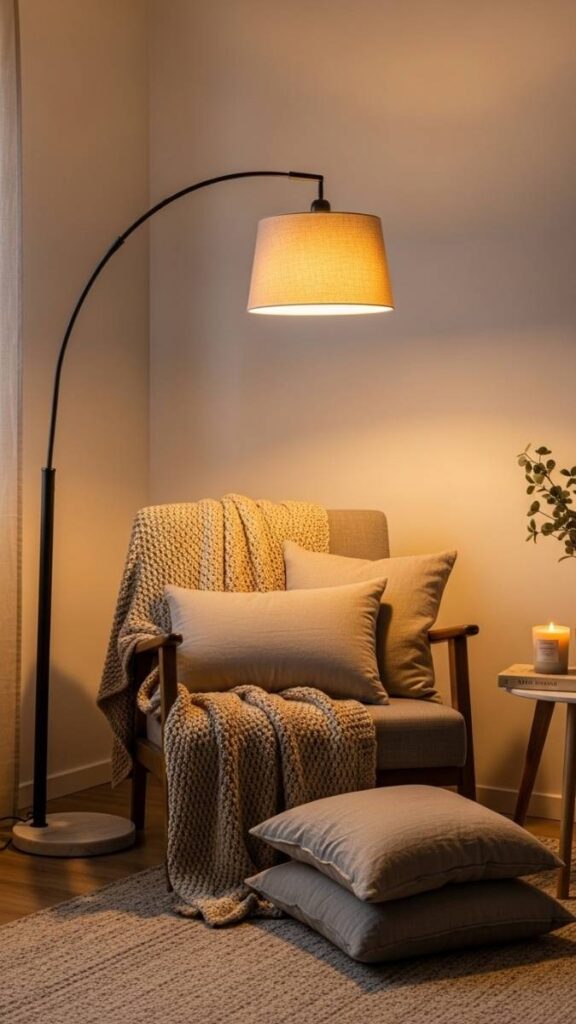
An arc floor lamp does something no ceiling light can: it creates a personal pool of downward light that makes a corner feel like its own contained space within a larger room. Pair it with a rounded side table and a single chair throw blanket optional but effective and the corner becomes a visually complete vignette.
The key is the arc itself; the lamp base should sit well outside the seating area so there’s no visual clutter at foot level. This setup works in living rooms of almost any size but is particularly valuable in large, open rooms that feel sparse in the corners.
Swap Fluorescent Kitchen Lighting for Warm Flush Mounts
Fluorescent tube lighting in kitchens isn’t just an aesthetic problem, it’s a functional one. Cool, flat light at high brightness makes food prep look clinical and makes colors in the room look washed out. Swapping to a flush-mount with a warm-white LED (2700K, high CRI) changes both how the room looks and how comfortable it is to spend time in.
High CRI (Color Rendering Index) bulbs 90+ are worth looking for specifically in kitchens because they make ingredients look more vibrant and accurate. This is a straightforward swap that most homeowners can handle themselves.
Use Battery-Operated Puck Lights Inside Cabinets for a Functional and Subtle Upgrade
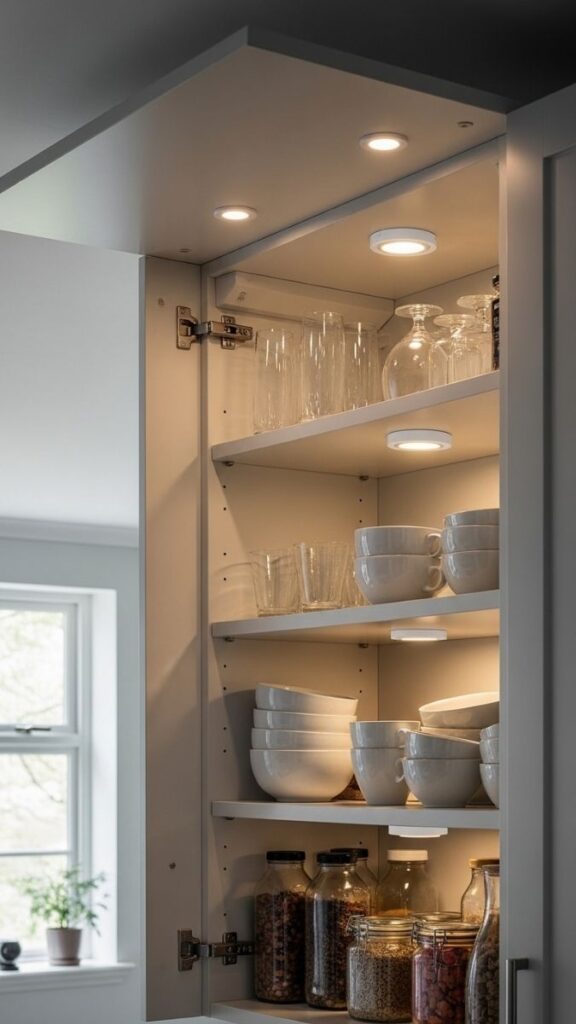
Interior cabinet lighting is one of those ideas that seems purely decorative until you’re trying to find the right pan in a dark cabinet at 7am. Adhesive battery-operated puck lights placed at the front inside corner of a shelf cast enough light to make the interior navigable without any wiring.
For open-shelving displays, they also add a quiet warmth that makes kitchenware and dishes look more deliberate. This setup takes about 10 minutes to install and costs almost nothing. The only maintenance is occasional battery replacement rechargeable puck lights, which are now widely available, eliminating even that inconvenience.
Use a Torchière Floor Lamp to Bounce Light Off the Ceiling in Low-Ceilinged Rooms
In rooms where the ceiling is 8 feet or lower, overhead lights can feel pressing if the fixture is simply too close to the living space. A torchière lamp with its upward-facing bowl redirects the light to the ceiling, which then reflects it down diffusely across the whole room. The result is a much softer, more even illumination without any direct glare.
This is one of the most cost-effective solutions for small apartments with low ceilings that feel uncomfortable under harsh overhead lighting. Use a warm white bulb (2700K) and position the lamp in a corner where the ceiling bounce covers the maximum area.
Use Smart Bulbs With Tunable Color Temperature for All-Day Adaptability
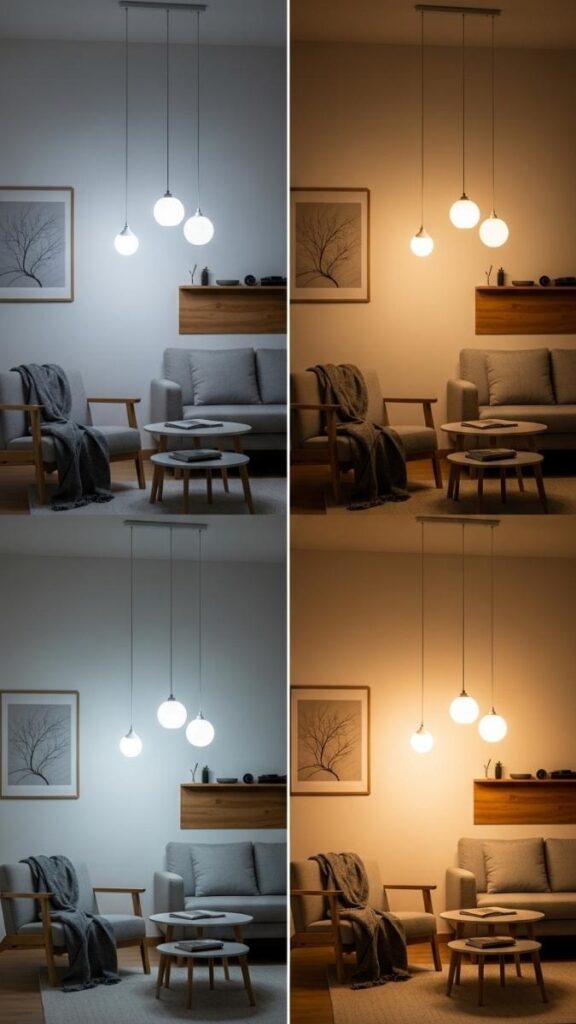
Smart bulbs with tunable color temperature aren’t just a convenience feature, they solve a genuine problem that fixed-bulb homes have all day long. In the morning, a cooler light (3000–4000K) is more energizing and works well for kitchen tasks and getting ready.
By evening, a warmer setting (2200–2700K) is easier on the eyes and helps signal the body to wind down. A single bulb can cover both ends of that range and every point between.
For those working from home in a room that doubles as a living space, this flexibility is especially valuable; the room’s atmosphere can shift with the time of day without touching a single physical fixture.
What Actually Makes These Lighting Ideas Work
The ideas above aren’t individually complicated; most involve placing or replacing a single fixture. What makes them effective collectively is the logic behind each one:
where the light source sits determines what the room feels like,
Not just how bright it is.
Three principles are worth keeping in mind:
Height variety changes perceived room size.
Light sources at different heights floor, table, ceiling create a sense of vertical depth that one overhead fixture simply can’t. In small rooms, this is more effective than adding mirrors or light paint colors at making the space feel larger.
Color temperature consistency matters more than brightness.
Mixing warm and cool bulbs in the same visual field (especially in open-plan spaces) creates a fragmented, slightly uncomfortable atmosphere that’s hard to diagnose. Standardizing on 2700K throughout is the single easiest fix with the widest impact.
Task lighting and ambient lighting aren’t the same thing.
Ambient light fills the room; task light serves a specific function. The rooms that feel most thought-through are the ones where both are accounted for a general background glow and a focused, well-placed source for whatever you’re actually doing.
Quick Lighting Setup Guide by Room and Goal
| Room | Best Setup | Space Type | Problem Solved | Difficulty |
| Living Room | Layered: overhead + floor lamp + table lamp | Any size | Flat, clinical feel | Easy |
| Bedroom | Wall sconce + dimmable overhead | Small/medium | Surface clutter, harsh light | Easy-Med |
| Kitchen | Under-cabinet + warm flush-mount | Any size | Counter shadows, cold atmosphere | Easy |
| Dining Room | Pendant centered over table | Any size | Disconnected, un-anchored table | Easy-Med |
| Home Office | Task lamp + ambient source | Small/medium | Screen glare, no mood shift | Easy |
| Hallway | Wall sconces at 60″ | Narrow | Flat, uninviting entry | Easy-Med |
| Bathroom | Side sconces at face height | Any size | Unflattering overhead shadows | Medium |
| Balcony/Patio | Overhead string lights | Small | Unusable space after dark | Easy |
Common Lighting Mistakes That Make Rooms Feel Smaller or Colder
Relying solely on overhead lighting.
This is the most common mistake in residential spaces. A single ceiling fixture lights the center of the room and leaves the perimeter in shadow which makes a room feel smaller because the eye can’t travel to the edges.
Using daylight-temperature bulbs throughout the home.
Cool white and daylight bulbs (4000K+) are useful in specific contexts: workshop lighting, a makeup vanity, a study but used throughout a home they create an office-like atmosphere that’s hard to relax in. Most living spaces benefit from 2700K as the baseline.
Ignoring scale.
A tiny pendant over a large dining table, or a massive arc lamp in a small room, throws off the proportions visually. Fixtures should be sized to the space they’re lighting not just aesthetically, but functionally.
Placing lamps too high.
Table lamps that sit too tall above the sofa or armchair create glare at eye level rather than soft ambient light. The bottom of the shade should be roughly at seated eye level approximately 38–42 inches from the floor for standard seating heights.
Forgetting the transition spaces.
Hallways, entryways, and staircases tend to get the cheapest, most basic lighting which sets the tone for the entire home before anyone reaches the living room. Upgrading these spaces to warmer, more intentional fixtures changes how the whole home feels to walk through.
Frequently Asked Questions
What is layered lighting and why does it matter in home design?
Layered lighting means using multiple light sources at different heights and with different functions ambient (general fill), task (specific areas), and accent (highlight or mood). It matters because a single overhead fixture creates flat, even illumination that doesn’t allow for mood variation or visual depth. Three sources at different heights makes the same room feel larger, warmer, and more finished.
How do I make a small room feel brighter without adding more overhead lights?
Use light sources at multiple heights rather than just one ceiling fixture. A floor lamp in a corner, a table lamp at mid-height, and a dimmed overhead creates the perception of a brighter, more open room because light is coming from multiple angles. Mirrors positioned to reflect existing light also extend the reach of what you already have.
What’s the best light bulb color temperature for a cozy living room?
2700K is the most reliable starting point for living rooms. It reads as warm white similar to incandescent lighting without being so yellow it distorts colors. Anything above 3000K starts to shift toward cooler, more clinical territory that’s harder to relax in.
Do plug-in pendant lights actually look good, or do the cords ruin the effect?
They can look very good if the cord is routed cleanly. The key is running the cord flat along the ceiling (using adhesive cable clips) toward the wall and down to the outlet, rather than letting it drop straight down. A fabric or twisted cord adds to the aesthetic rather than detracting from it. For renters, it’s one of the most convincing “real fixture” substitutes available.
Wall sconce vs. table lamp for bedside lighting which is better?
It depends on nightstand size and personal preference. Wall sconces (plug-in swing-arm versions especially) free up the entire nightstand surface and give you directional light without any base or cord on the furniture. Table lamps are easier to add and remove without any wall involvement. For small bedrooms or narrow nightstands, the sconce is almost always the more practical choice.
Is it worth investing in smart bulbs for the whole house?
For a single room, particularly one that serves multiple purposes throughout the day, yes, smart bulbs with tunable color temperature are worth it. For the whole house at once, it depends on budget and lifestyle. Start with the room you spend the most time in and assess whether the flexibility changes how you use the space before committing to every fixture.
How high should a pendant light hang over a dining table?
The general rule is 30–36 inches above the tabletop for standard ceiling heights (8–9 feet). If the ceiling is higher, you can drop it slightly further to maintain visual proportion. The goal is for the light to pool on the table surface without shining directly into seated diners’ eyes.
Conclusion
Most rooms feel off not because of what’s in them, but because of how they’re lit and that’s actually good news. Lighting is one of the most adjustable, reversible, and budget-flexible things you can change in a home. Even two or three of the ideas above, applied to the rooms you use most, can shift the atmosphere in a way that’s genuinely noticeable.
Start with one idea that fits your current setup whether that’s adding a floor lamp behind the sofa, swapping to warm bulbs throughout, or finally fixing the shadow problem on your kitchen counter. Small changes done consistently tend to compound: once one room feels right, you notice the others more. The key is finding what works for your space and building from there, one fixture at a time.