29+ Entryway Decor Ideas That Make Your Home Feel Intentional the Moment You Walk In
Your entryway does something that no other room in your home can set the tone before you even take off your shoes. If that first impression is a pile of bags, a bare wall, Entryway Decor Ideas and nowhere to put anything, the rest of the house already feels like an uphill battle. The good news is that a well-designed entryway doesn’t require a dedicated foyer or a big budget. It requires intention.
Whether you’re working with a narrow apartment hallway, a cramped side entrance, or just a small corner of an open-plan living room, these entryway decor ideas are built for real homes, the kind where coats actually land on hooks, keys actually get put somewhere, and guests actually feel welcomed. For anyone trying to make their space feel more organized and pulled-together from the second they walk in, this list is for you.
A Narrow Console Table With a Mirror Above It
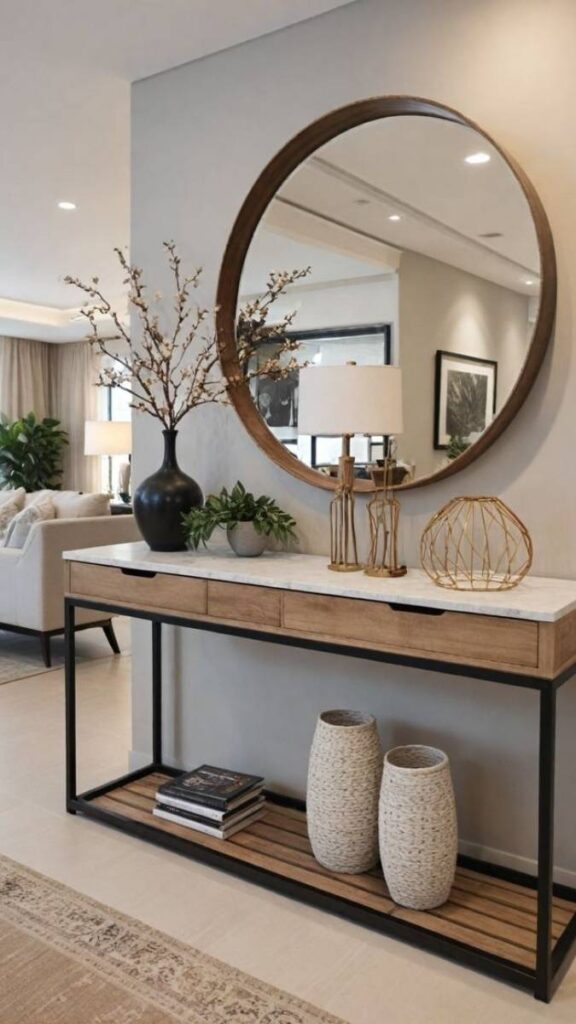
A console table with a mirror above it is one of the most functional pairings you can put in an entryway and it works in spaces as narrow as 12 inches deep. The mirror doubles the perceived width of a tight hallway and creates a visual endpoint that makes the space feel designed rather than just functional.
Choose a console with a lower shelf for baskets or bins so bags and shoes have somewhere to live. In small apartments or rental homes, a wall-mounted console keeps the floor clear, which makes the space feel less crowded. This setup solves the problem of the entry feeling like a pass-through with no sense of arrival.
Layered Hooks With a Floating Shelf Above
Most entryways have exactly one rail of hooks and it gets overwhelmed within a week. Staggering two or three hooks at different heights (one at adult shoulder level, one lower for bags and kids’ coats) distributes the visual load and actually gets used. Add a floating shelf just above the top hooks for sunglasses, mail, or a small plant, and the setup starts to feel intentional rather than improvised.
This works especially well in apartments where you can’t add furniture but do have vertical wall space. It removes the accumulation on counters and chairs that makes entries feel chaotic.
A Rattan or Woven Bench With Hidden Storage
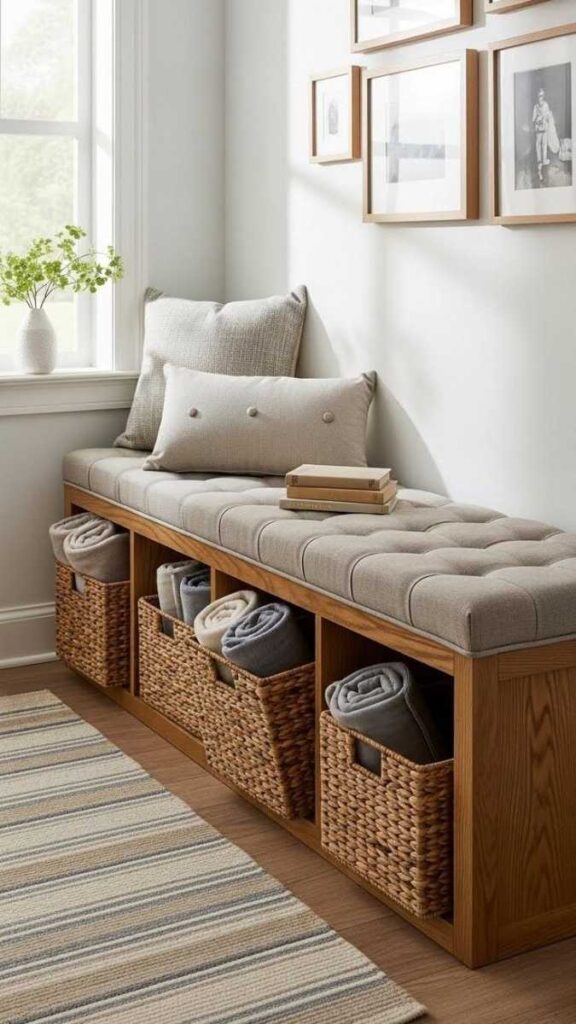
A bench that opens up for storage is one of the more quietly useful pieces you can put near a door. It handles the shoe problem, gives you somewhere to sit while you tie your laces, and adds texture without visual weight. In 2026, there was a clear move toward natural materials rattan, seagrass, and woven cane replacing the darker, heavier benches that dominated entryways for years.
The woven texture reads as warm and organic without competing with the wall behind it. This setup is especially practical in family entryways where the volume of stuff coming through the door every day needs real containment, not just a pretty basket.
A Statement Pendant Light in a Small Entry
Lighting is the most overlooked element of entryway design. Most entry spaces rely on a flat overhead light that illuminates the ceiling more than the room. Swapping it for a pendant, even something simple like a rattan globe or a sculptural paper shade creates downward, focused light that makes the space feel more intimate and considered.
In my experience, this works best when the walls are light and the floor has some warmth to it, so the light bounces around rather than getting absorbed. The pendant anchors the space from above the way furniture anchors it from below. It solves the problem of entries that look flat or like an afterthought.
A Gallery Wall That Starts Narrow and Fans Out
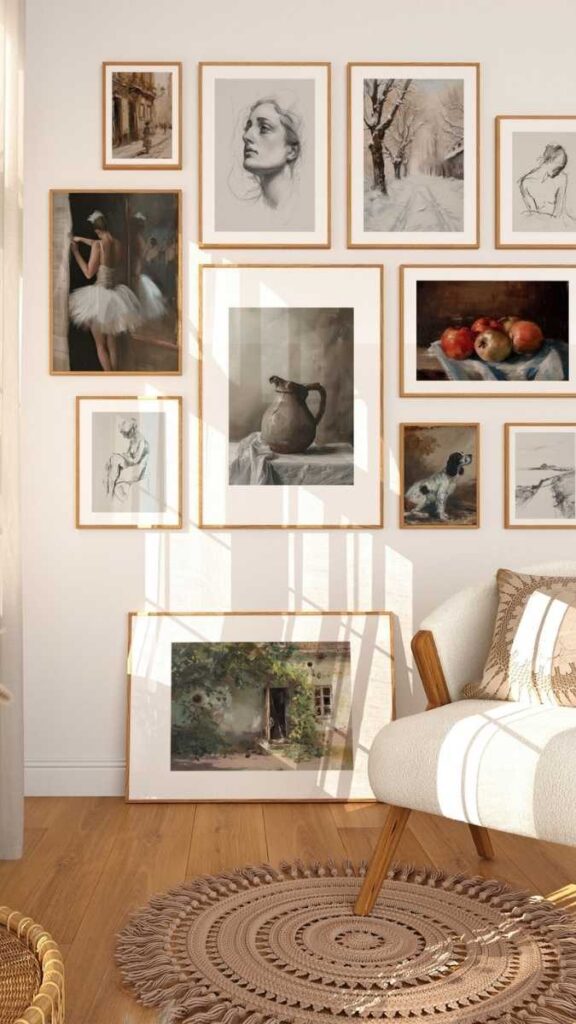
Empty entryway walls are a missed opportunity. A tightly grouped gallery wall, one that starts near the door and extends inward draws the eye through the space and creates movement that makes a short hallway feel longer.
The key is keeping the grouping relatively tight (leaving 2 to 3 inches between frames) and choosing frames in one or two finishes, not a mix. This layout works in hallways that are too narrow for furniture because everything hangs flat on the wall. It solves the “bare walls make the space feel unfinished” problem without requiring any floor space at all.
Read More About: 49+ Christmas Bedroom Decor Ideas That Make Your Room Feel Like a Winter Fairytale
A Vintage or Antique Rug Under an Entry Console
A rug in an entryway does two things at once: it defines the zone and softens the transition from outdoors to indoors. An antique or vintage-style rug adds the kind of visual warmth that’s almost impossible to fake with newer materials. Place it so it sits fully under the console with 4 to 6 inches of rug visible on the sides; this makes the console look grounded rather than floating.
This setup works well in open-plan spaces where the entryway doesn’t have natural walls, because the rug creates a boundary that signals “this is the entry” without any architecture to back it up. Practically, it also catches dirt before it travels further into the house.
A Freestanding Coat Rack in an Awkward Corner
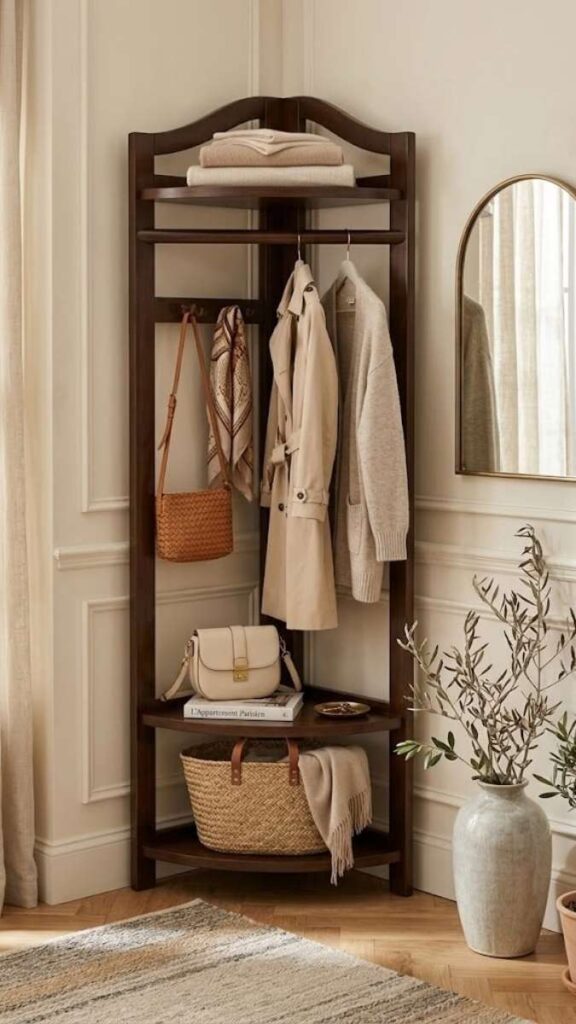
Corner space in an entryway is almost always wasted. A tall, freestanding coat rack, especially a wooden one with a base that holds umbrellas, takes up the footprint of a single tile and creates a full-height vertical element that draws the eye up. In rental spaces where wall drilling is limited, this is one of the more practical solutions.
Go for one in a material that reads warm oak, walnut, or even bamboo rather than metal, which can make a small entry feel industrial in a way that doesn’t translate to the rest of the home. This solves the problem of coats landing on chairs or the floor because there’s no obvious place for them.
A Slim Bookshelf Used as a Room Divider Entry
In open-plan apartments, the entryway doesn’t really exist; you just walk straight into the living room, and nothing signals the transition. A slim bookshelf (or even a low credenza) positioned perpendicular to the front door creates a soft separation.
It gives you wall space on the entry side for hooks or a mirror, and the living room side becomes a styled display. This is one I’d actually recommend trying first because it addresses the layout issue and the decor issue at once. It works best when the bookshelf is no taller than eye level keeping the room connected while still creating a defined entry zone.
Concrete or Terracotta Planters Flanking the Door
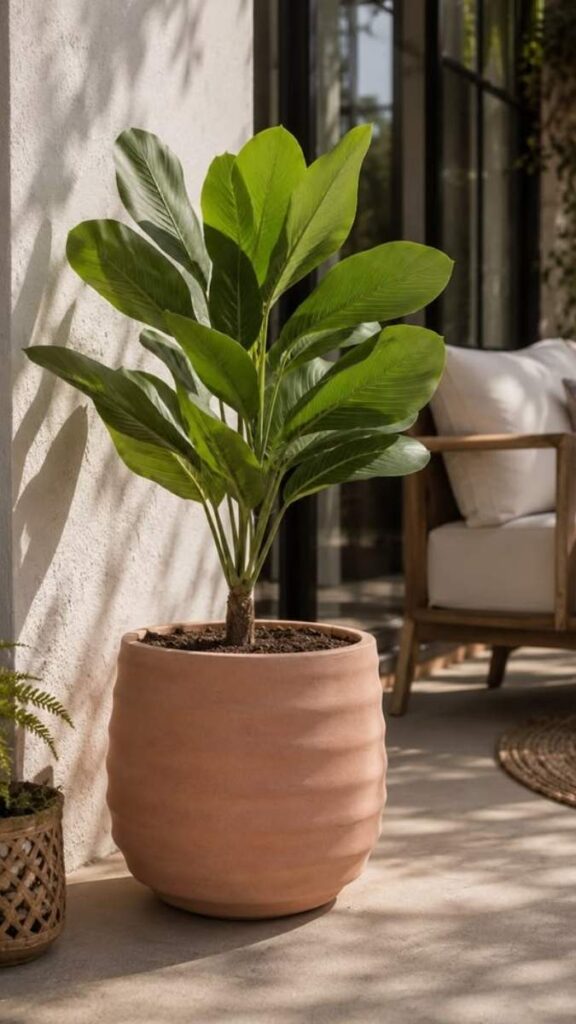
A pair of planters flanking an interior entry door creates a sense of arrival that’s usually reserved for formal foyers but it scales down well. Terracotta planters with a trailing or sculptural plant (a fiddle leaf, a snake plant, a trailing pothos) on either side of the door frame create a natural anchor without furniture.
The asymmetry of plants no two grow exactly the same way adds organic movement that styled decor can’t replicate. This works in apartment entryways that are essentially just a door inside a room, where the planting creates a threshold that didn’t previously exist. It also softens the echo of hard floors that most entry spaces have.
A Pegboard Panel Styled for the Entryway
Pegboards have moved well beyond the garage and studio. A painted pegboard panel in white, black, or sage mounted at entry height gives you a fully customizable, renter-friendly organizational system that you can rearrange as your needs change.
Hang hooks at different heights, add a small shelf for a tray or plant, and use a basket peg for mail or bags. The panel works particularly well in narrow entries where a console table won’t fit but a 24-by-48-inch panel on the wall can do most of the same jobs. The visual texture is interesting enough to carry the wall without additional art.
Read More About: 25+ Bathroom Decor Ideas That Actually Make Small Spaces
A Dark Accent Wall That Makes the Entry Feel Intentional
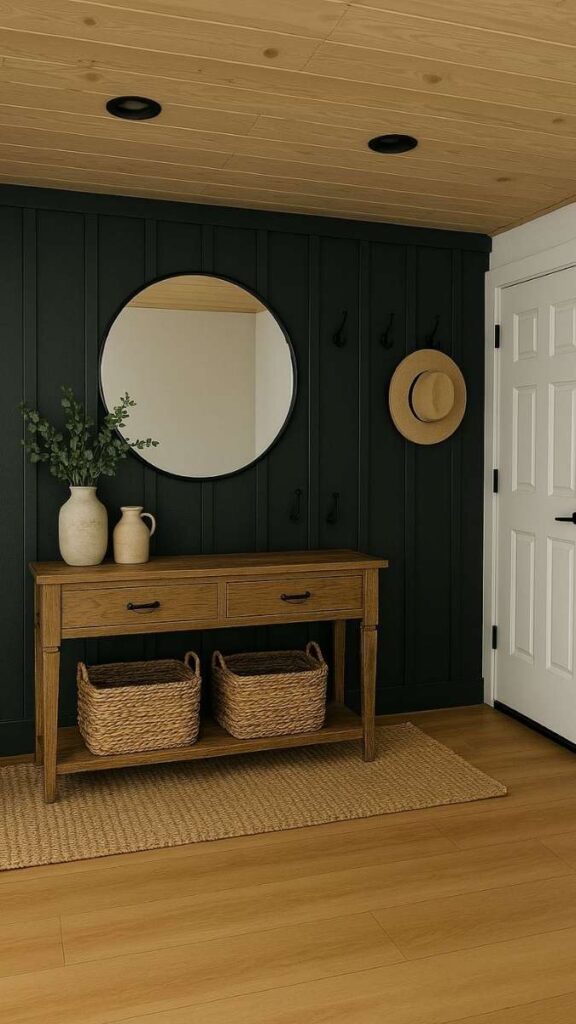
Painting just the entry wall a deep tone navy, forest green, charcoal is one of the few cases where a dark color genuinely makes a small space feel more deliberate rather than smaller. A dark wall paired with a brass or warm-toned mirror and warm sconce lighting reads as intentional and architectural, the opposite of the blank magnolia wall that most entries default to.
This works best when the floor is light or the hallway beyond is bright, so the contrast is doing something visually active. Honestly, this is a weekend project that changes how the entire entryway feels more than any furniture placement would.
A Tray System on the Console for Daily Essentials
The amount of daily friction that a single tray eliminates is disproportionate to how simple it is. A tray on an entryway console creates a contained zone for keys, transit cards, sunglasses, and anything else that tends to scatter. When everything lands in one place, the surface stays cleaner and the entry reads as organized even when life isn’t.
Marble, stone, or lacquered trays all add visual interest without requiring much styling around them. In smaller entries where the console itself is the only surface, the tray defines what stays there and what doesn’t, which is most of the organizational battle.
A Leaning Ladder Shelf as an Entryway Display
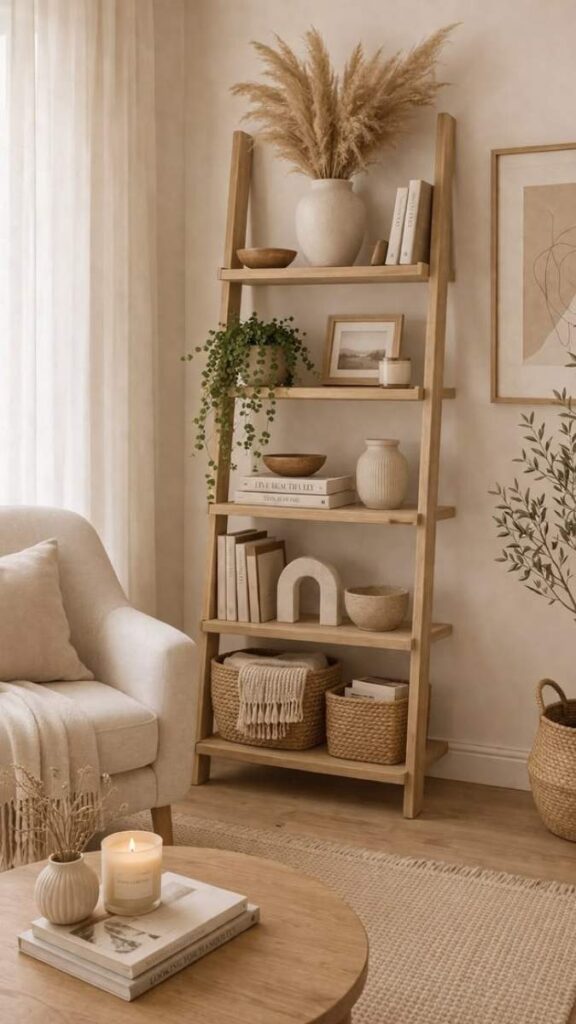
A leaning ladder shelf is one of the more versatile pieces for a tight entry because it doesn’t require mounting, takes up only a foot of floor depth, and gives you four or five horizontal surfaces to style with varying levels of purpose. Lower rungs hold baskets or shoes. Middle rungs hold books or a small plant.
The top rung is purely decorative. The leaning angle adds a slightly informal quality that feels considered rather than staged. This works well for renters who want some visual complexity without committing to anything on the walls.
Mirrors Placed Low and Angled for Small Hallways
In a hallway too narrow for a full-length mirror to hang flat, leaning it against the wall at a slight angle changes the geometry of the space. The angled mirror reflects the ceiling at a different angle than the walls, which breaks up the tunnel effect of a long narrow hall and makes the space feel more dimensional.
A leaned mirror also adds a relaxed quality; it reads as styled rather than installed. Go for a simple frame in a material that matches other metals or woods in the space. This solves the “hallway feels like a corridor” problem without any construction.
Read More About: Kitchen Makeover Ideas That Actually Change How the Space
Wainscoting or Shiplap on One Entry Wall
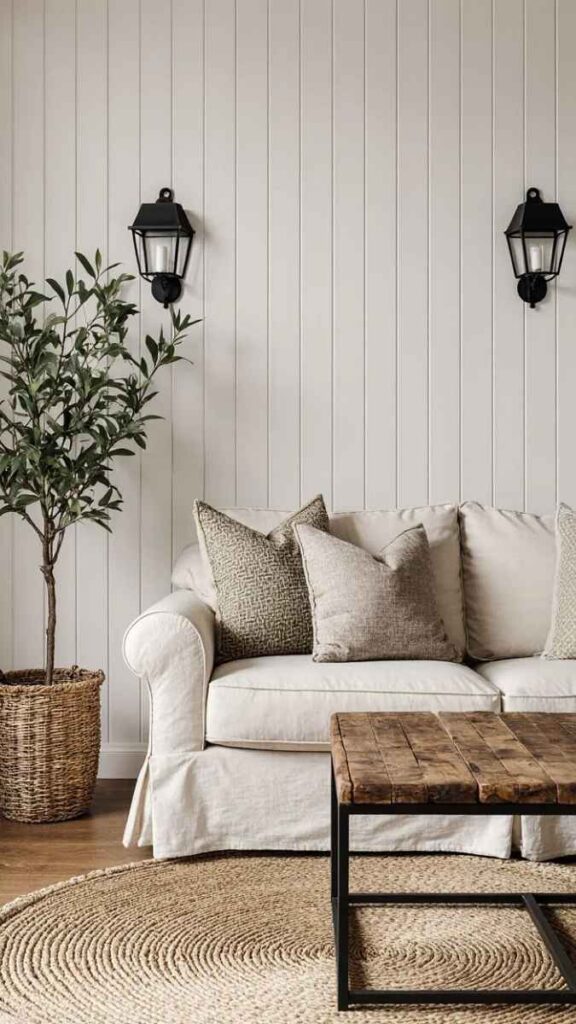
If your entry walls are plain drywall, adding a half-wall panel wainscoting, shiplap, or even square batten panels creates architectural interest that makes the space feel more finished than any amount of decor can. The lower portion becomes a defined zone that anchors hooks or a bench against it, while the upper portion stays open for a mirror or art.
I’ve noticed this style tends to work better in homes with traditional or transitional furniture in very minimal spaces, the panel can compete with the furniture. In rentals, peel-and-stick batten strips are a serviceable alternative that photographs surprisingly well.
A Hanging Textile or Macramé Panel for Bare Walls
A woven wall hanging or large macramé panel solves the bare entryway wall problem with texture and softness that framed art doesn’t have. Because textiles absorb sound, they also reduce the echo that hard-floored entryways often have which is a practical benefit that’s rarely mentioned.
Choose one with a neutral ground (cream, tan, rust) so it reads as an anchor point rather than a focal distraction. This works especially well in apartments where the entry opens directly into a living space, because the textile creates a warm visual “back wall” to the entry zone.
A Shoe Cabinet That Doubles as a Console
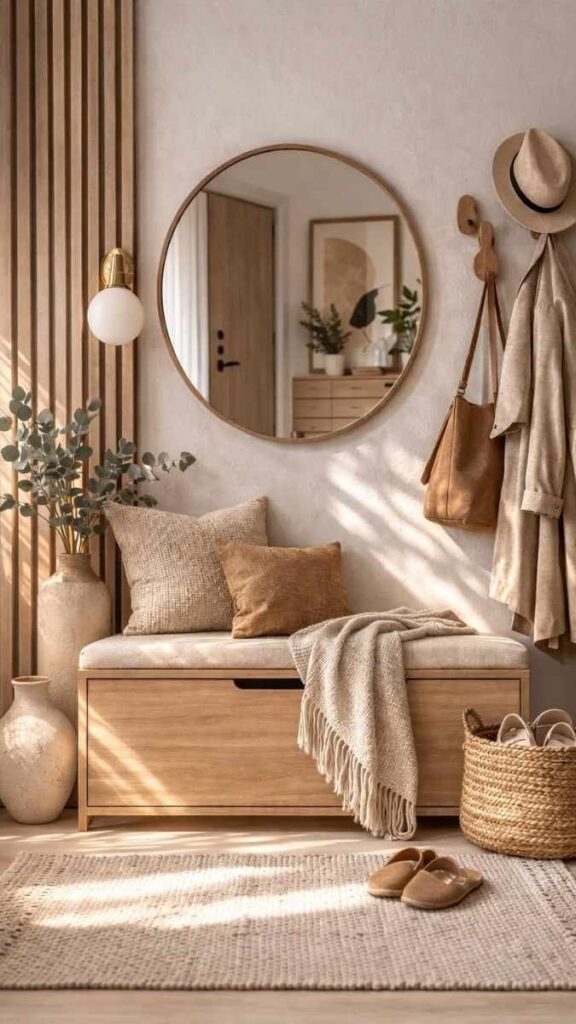
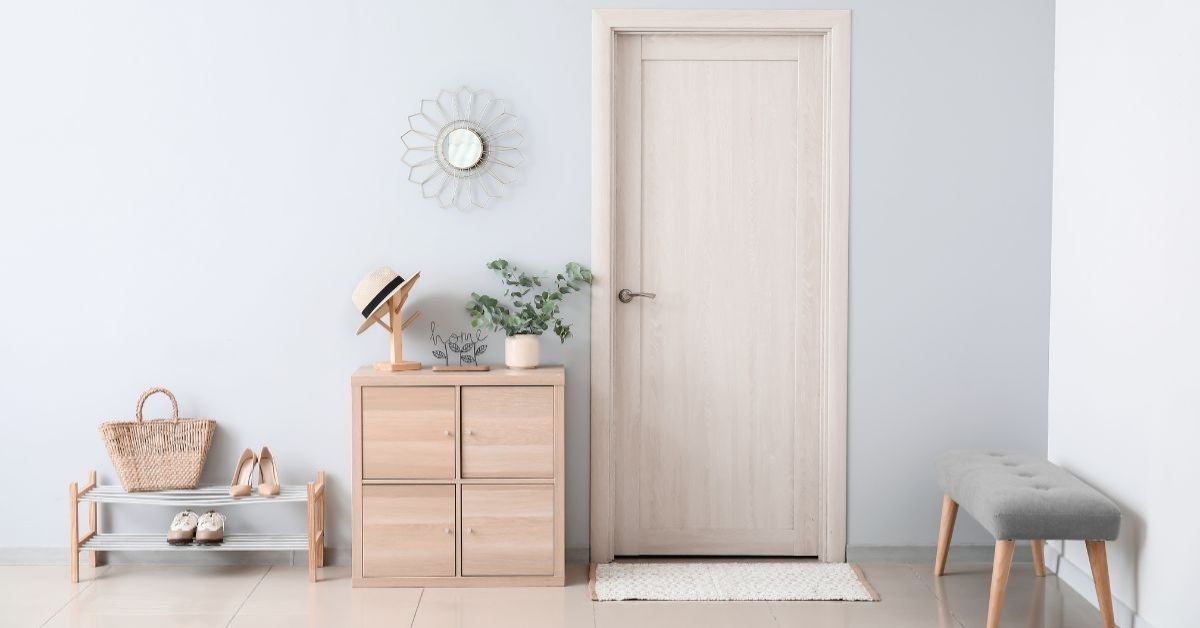
A shoe cabinet with a flat top surface is one of the smartest dual-purpose pieces for an entryway. The top functions as a console place for a lamp, tray, or small plant while the enclosed cabinet keeps shoes out of sight. Most entryway shoe problems come not from the number of shoes but from not having a closed storage solution, which means everything stays visible and the floor stays cluttered.
A shoe cabinet with a flat top that sits at console height (around 30 to 32 inches) integrates into the space as a piece of furniture rather than announcing itself as storage. This is especially useful in apartments where the entry and living room are essentially one zone.
A Sconce on Either Side of a Mirror
Symmetrical sconces on either side of an entryway mirror create a sense of architecture that’s usually only found in more formal homes. The paired light creates even, flattering illumination and adds a visual formality that makes the entry feel like a designed room rather than a transition.
This layout works particularly well in apartments where the ceilings are standard height, because the horizontal spread of the sconces makes the wall feel wider. Go for warm-toned bulbs (2700K) and simple metal sconce forms globe, cone, or arm styles in a finish that matches the mirror frame. The combined effect is a focal wall that works at every hour of the day.
A Folding or Slim Console That Disappears Entryway Decor Ideas
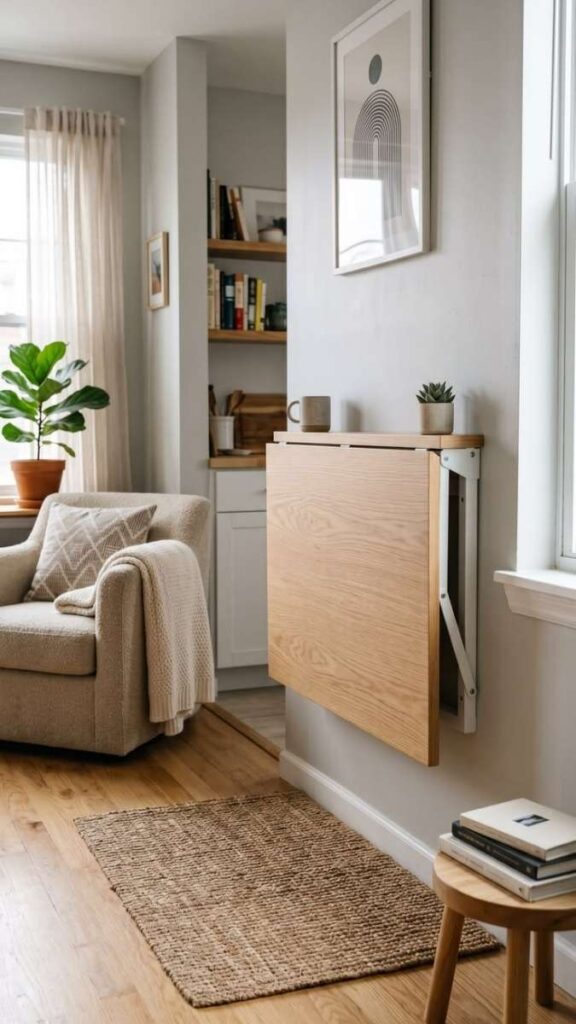
In very small entries the kind found in studio apartments or older city buildings even a narrow console can feel like too much. A folding console table that sits flat against the wall when not needed gives you the functional surface when you want it without permanently committing that floor space to furniture.
When open, it holds a tray and lamp like any console. When folded, the entry becomes a clear walkthrough again. This is especially useful for homes where the entry doubles as a path to other rooms and needs to accommodate movement as much as storage.
Architectural Plants in Tall, Sculptural Pots
A single tall plant in a statement pot does more for an entryway than a cluster of small decorative objects. The height creates a vertical element that draws the eye up making low-ceilinged entries feel less compressed and the organic form softens the hard lines of doors, walls, and floors.
A dark ceramic pot in a corner reads as a sculptural object even before you notice the plant inside it. Choose a plant that tolerates indirect light: a snake plant, a ZZ plant, or a cast-iron plant for low-light entries, or a fiddle-leaf fig near a door with glass panels. The pot and plant together should sit somewhere between 4 and 6 feet tall to work as a visual anchor.
A Monochromatic Entryway in One Neutral Tone
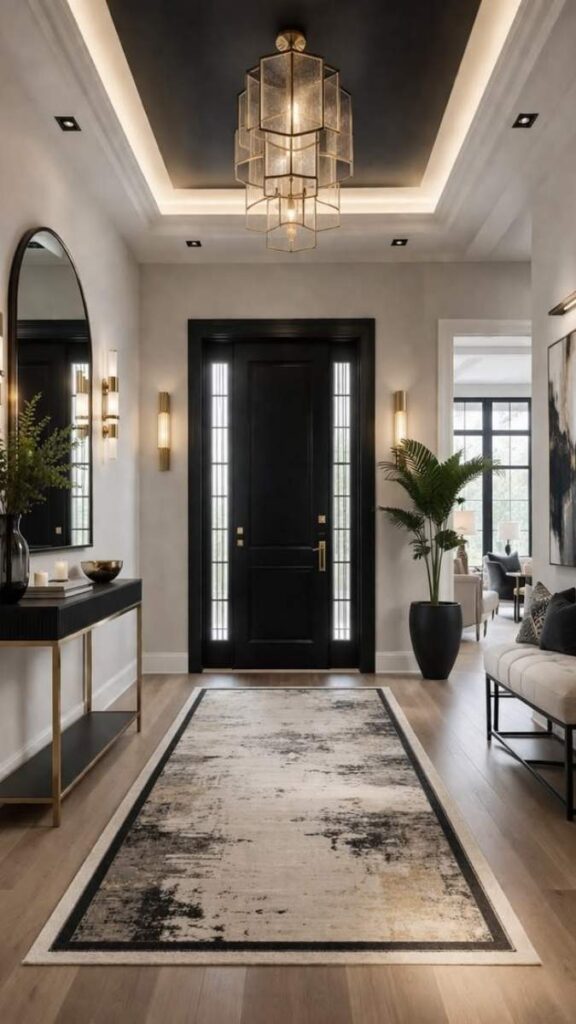
A monochromatic entry where walls, furniture, and accessories all sit within one color family feels cohesive in a way that contrasting schemes often don’t in small spaces. Instead of color doing the work, texture becomes the main design element: a linen cushion on the bench, a rattan basket, a matte ceramic vase against a painted wall.
The result is quiet but not boring. This approach works best in entries that get natural light during the day, because the light shifts across the neutral tones and creates natural variation. For entries that are dark or north-facing, a warm neutral (cream, stone, warm sand) reads better than a cool one (gray, white), which can feel stark.
What Actually Makes These Entryway Ideas Work
The ideas above span different budgets, sizes, and aesthetics but the ones that tend to have the most impact share a few consistent traits.
Containment over display.
Entryways are high-traffic zones where stuff naturally accumulates. The most effective setups give that stuff a container, a tray, a basket, a closed cabinet rather than styling around the clutter. When storage is the starting point, the decor on top of it stays cleaner longer.
Vertical use of space.
Most small entries underuse the wall from shoulder height upward. Hooks, shelves, mirrors, and art placed higher on the wall make the eye travel up, which creates a perception of more height and more space.
One focal element.
Entries that try to do too much a gallery wall, a bench, a plant, a statement rug, a pendant light can feel chaotic in a small space. Choosing one element to lead (a great mirror, a strong light fixture, a deep accent wall) and keeping everything else supporting works better than giving equal weight to everything.
Light matters more than most decor.
A warm light source whether a sconce, a small table lamp on a console, or a well-placed pendant changes how an entryway feels at night more than any furniture arrangement. If the only light is an overhead fluorescent, fixing that has a bigger impact than any styling decision.
Entryway Setup Guide by Space Type
| Setup | Best For | Space Type | Key Problem Solved | Difficulty |
| Console + mirror | Most homes | Any size | No sense of arrival | Easy |
| Layered hooks + shelf | Families, renters | Narrow hallways | Coat and bag overflow | Easy |
| Storage bench | Families, high traffic | Medium entries | Shoe clutter | Easy |
| Pegboard panel | Renters, small spaces | Very narrow | No drilling, flexible storage | Easy |
| Slim shoe cabinet as console | Apartment dwellers | Small–medium | Hidden shoe storage | Easy |
| Ladder shelf | Renters, minimalists | Tight spaces | No mount needed | Easy |
| Bookshelf divider | Open-plan apartments | Studio/open plan | No defined entry zone | Moderate |
| Accent wall + sconces | Homeowners | Any size | Flat, undesigned feel | Moderate |
| Wainscoting or battens | Homeowners | Medium–large | Plain drywall, no character | Moderate |
| Folding console | Very small apartments | Under 4 ft wide | No permanent floor space | Easy |
How to Design Your Entryway Without Buying More Furniture
The most common mistake in entryway design is buying things before solving the layout. Here’s how to approach it without adding more pieces:
Start with the wall, not the floor.
Before anything else, figure out what the wall behind or beside the door can hold. A mirror, a hook rail, a pegboard, or a shelf can often do everything a console table does in half the footprint.
Use vertical zones deliberately.
The zone below 18 inches is for shoes and bags. From 18 to 48 inches is the functional zone hooks, tray, console surface. Above 48 inches is a visual mirror, art, sconces. When each zone has a purpose, the space organizes itself.
Borrow light from adjacent rooms.
If the entryway is dark, moving a lamp from a nearby room to the entry console creates warmth without buying anything new. The lamp also signals that the entry is a designed space, not a pass-through.
Define the zone with a rug.
If the entry doesn’t have walls of its own (open-plan), a rug placed where the entry should be creates a boundary without any construction. It’s often the cheapest single change that has the most spatial impact.
Remove before you add.
In most entries, there are two or three objects that arrived without intention and stayed: a random chair, a stack of unopened mail, a shoe rack that doesn’t contain the shoes anymore. Removing those often reveals a space that’s already more functional than it seemed.
FAQ’s
What is the most important element in entryway decor?
Storage comes first. An entryway that looks good but has no place for coats, bags, or keys will always revert to clutter. Solve the functional layer first hooks, a tray, a bench or basket then layer in the decorative elements on top.
How do I make a small entryway look bigger?
Use a mirror on the wall opposite or beside the door to reflect light and visually expand the space. Keep the floor clear with contained storage, and use vertical elements (tall hooks, a lean mirror, wall-mounted shelves) to draw the eye upward. Avoid rugs with strong pattern in very tight spaces. A solid or low-contrast rug keeps the floor from feeling busy.
What type of lighting works best in an entryway?
Warm-toned, directional light (around 2700K) works best. A pendant, wall sconce, or even a small table lamp on a console creates a much more welcoming atmosphere than a flat overhead light. If a ceiling fixture is the only option, switch the bulb to a warm-white LED and add a dimmer if possible.
Can I decorate an entryway in a rented apartment?
Yes most of the best entryway setups for small apartments are renter-friendly. Freestanding coat racks, leaning mirrors, ladder shelves, pegboards with removable mounting strips, and console tables all work without drilling. A rug and a plant can create a defined entry zone without touching the walls at all.
Is a console table necessary in an entryway?
No. A console is useful if you have the depth for it (at least 10 to 12 inches), but wall-mounted shelves, a slim shoe cabinet, or a bench can serve the same functional purpose. The key is having some horizontal surface near the door where daily essentials can land intentionally rather than randomly.
How do I choose between an open and a closed storage bench?
If the items going into it are visually tidy (folded blankets, organized shoe pairs), open storage looks cleaner and feels more intentional. If the reality is more chaotic mismatched shoes, random bags, a closed bench with a lift-top lid keeps the entry looking organized regardless of what’s inside.
What’s the best way to define an entryway in an open-plan home?
A rug is the fastest way to signal “this is the entry.” A slim bookshelf or low credenza positioned perpendicular to the front door adds a soft wall that creates separation. Both can be combined under or just beyond the credenza to create a defined zone without any construction or permanent changes.
Conclusion
A well-designed entryway isn’t about having a dedicated foyer or a large budget, it’s about making deliberate decisions in a small amount of space. When the entry has somewhere for coats to go, a surface for daily essentials, and at least one element that feels considered rather than functional-only, the whole experience of coming and going from your home changes. These aren’t large renovations. Most of the ideas above can be done in an afternoon with a trip to a home goods store.
Start with the two problems that bother you most probably clutter and bare walls and pick one idea from each category that fits your space and budget. Add a mirror if the space feels small. Add a hook rail if things pile up on the floor. Once those are in place, the styling layer has something to build on. Small changes in high-traffic spaces compound faster than anywhere else in a home.