31+Bedroom Wall Decor Above Bed Ideas That Make Your Headwall the Focal Point
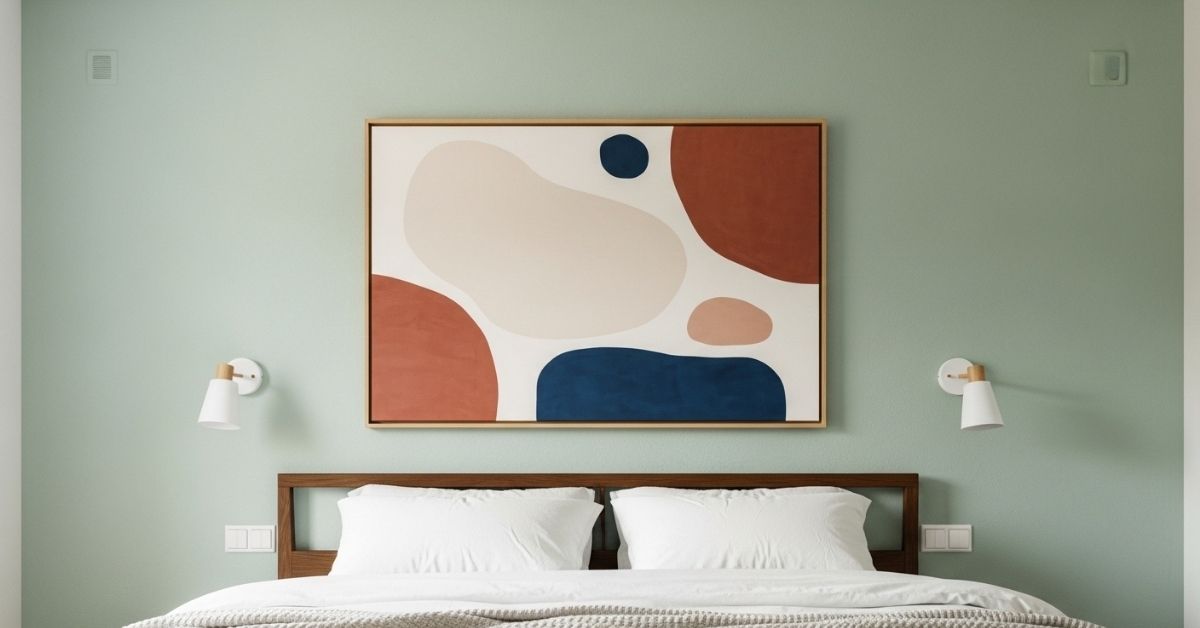
If your bedroom feels like it’s missing something but you can’t quite place it, it’s usually the headwall. A bare or poorly styled wall above the bed pulls the eye upward into emptiness, Bedroom Wall Decor Above Bed which makes the room feel unfinished even if everything else is in place. The right setup above the bed grounds the furniture, balances the ceiling height, and gives the space a clear visual center.
Whether you’re working with a small apartment bedroom, a rental where you can’t drill, or a large room that needs something substantial, there are workable approaches at every budget and skill level. These ideas cover real layouts not just aesthetic inspiration so you can actually picture what works in your space.
Oversized Single Art Print in a Simple Frame
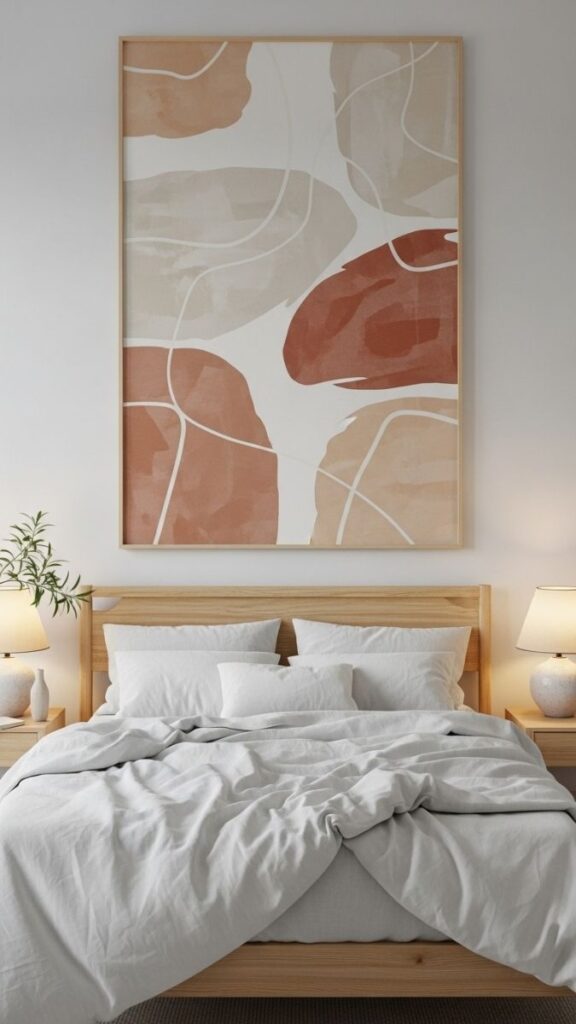
One large print above the bed almost always outperforms a cluster of smaller ones in rooms where the ceiling height is standard (8–9 feet). The scale fills the wall without requiring multiple hanging points, and the single frame keeps the space visually calm.
Go for something at least 24×36 inches. Anything smaller on a queen or king bed looks like it floated up from the wrong wall. This works especially well in minimalist or Scandinavian-leaning rooms where the rest of the furniture is already clean-lined. The problem it solves is the “too much going on” feeling that comes from overdecorating a small room.
Grid Gallery Wall With Matching Frames
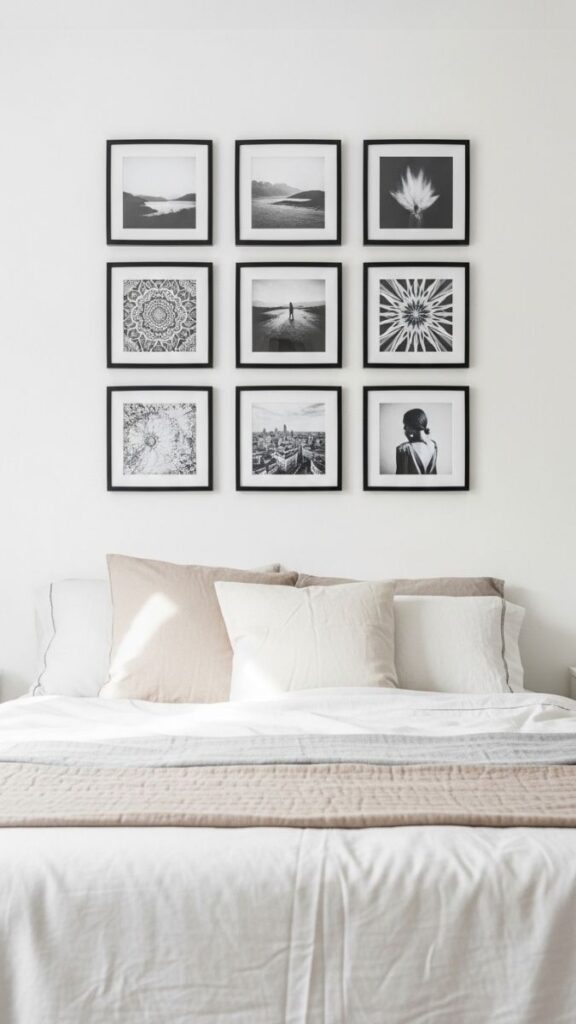
A grid arrangement typically 3×3 or 2×4 works because the rigid structure reads as one cohesive unit rather than scattered pieces. Matching frame sizes and colors are non-negotiable here; mixing them breaks the grid logic and the whole thing looks accidental.
Black frames on a white wall give the most contrast; natural wood frames on warm or beige walls feel softer. This setup works best above a king bed where the wall is wide enough to justify the horizontal spread. I’ve noticed this style tends to photograph well, which is part of why it saves so heavily on Pinterest but it also genuinely looks considered in person.
Read More About: 28+Gallery Wall Ideas for Your Living Room That Actually Work in Real Homes
Woven Wall Hanging as a Soft Textile Focal Point
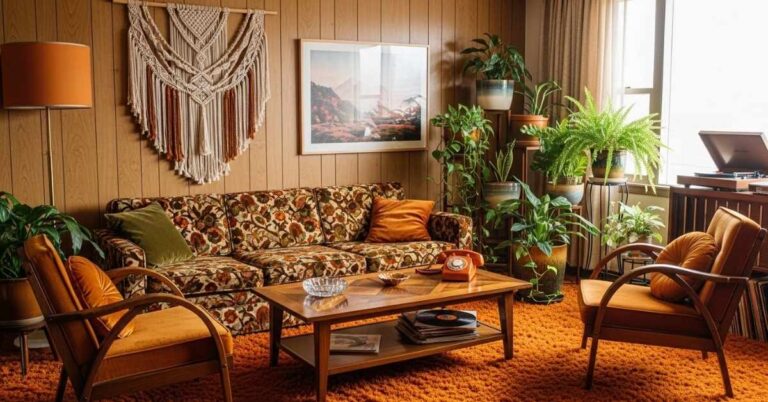
A large woven or macramé hanging adds texture that paint, art, and mirrors can’t replicate. The material absorbs light rather than reflecting it, which softens the whole wall and makes the room feel warmer without requiring additional lighting changes.
Hang it wide ideally spanning about two-thirds of the bed width and position the bottom edge roughly 8–10 inches above the headboard. This is one I’d actually recommend trying first for renters because it requires only one or two hooks, causes minimal wall damage, and can move with you. It also solves the “too cold and modern” problem in rooms where the furniture is all hard edges and smooth surfaces.
Arch-Shaped Mirror Above a Low-Profile Bed
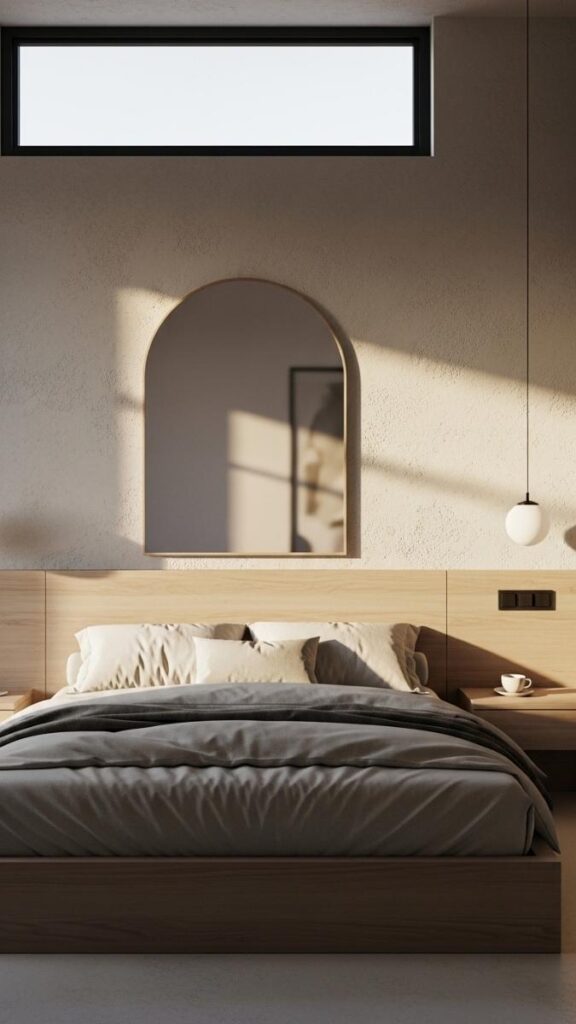
An arched mirror above the bed introduces a shape that most bedrooms are missing: the curved top breaks the grid of rectangular furniture and architecture without feeling chaotic. Positioned above a low platform bed, it draws the eye upward, making the ceiling feel higher than it is.
The reflective surface also bounces light across the room, which matters a lot in bedrooms with a single window or overhead-only lighting. This setup is especially useful in compact rooms where you want the wall to do more than one decorative and functional job at once.
Floating Shelves With Curated Objects
Two symmetrical shelves positioned at equal heights on either side of the center point above the bed give you storage and visual balance simultaneously. The key is to rest three to five objects per shelf maximum, mixing heights (a taller vase, a small plant, a short candle or book stack).
Overcrowding the shelves turns this from a design choice into visual clutter. This works particularly well in small bedrooms where the nightstands are already at capacity and you need a vertical surface without floor footprint. For renters, most floating shelf systems use minimal wall anchors and patch easily.
Horizontal Wood Plank Accent Wall Panel
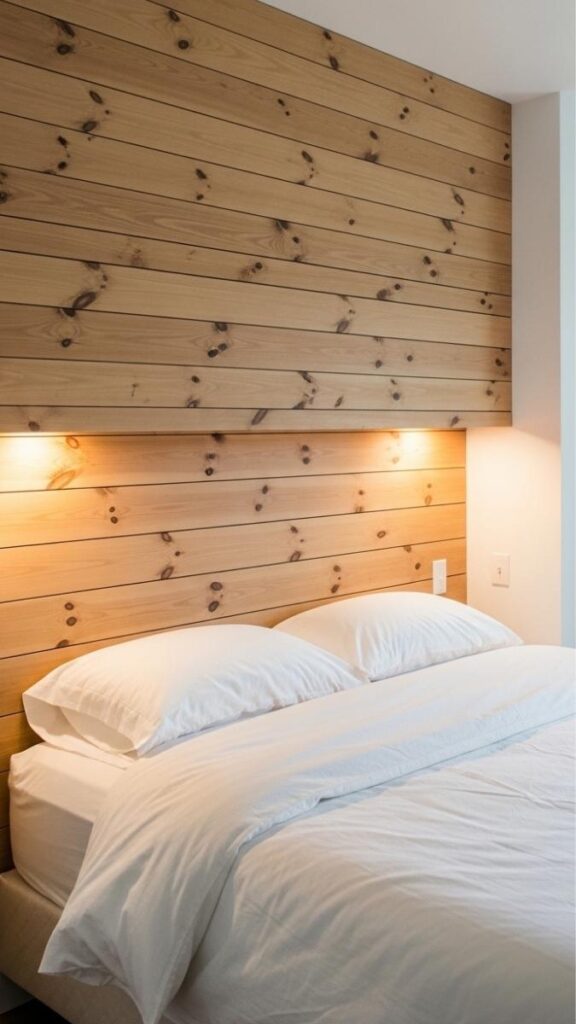
You don’t have to panel the entire wall; a defined rectangular section of horizontal wood planks directly above the bed frame works as a built-in headboard alternative and architectural detail in one move. It adds warmth through material contrast (wood against paint) and defines the bed zone clearly within the room.
This is especially effective in open-plan studio bedrooms where the sleeping area needs visual separation without actual walls. It’s a semi-permanent solution, but the visual payoff is significant, and it photographs consistently well in both natural and warm artificial light.
Read More About: 33+Spring Home Decor Ideas That Actually Make Your Space Feel Different
Framed Botanical Prints in a Loose Row
Three framed botanical prints hung in a horizontal line above the bed is one of the most consistently successful setups for medium-sized walls because it’s wide enough to anchor a queen bed without overwhelming a smaller room. The organic subject matter (leaves, botanicals, plants) softens the geometry of the frames, so the overall effect feels curated but not rigid.
Thin gold or brass frames on a muted wall color sage, dusty blue, warm white are the most versatile combinations right now. Leave consistent spacing between frames (4–6 inches) and hang them at the same baseline height, not centered at the same point.
Neon or LED Sign With a Personal Phrase
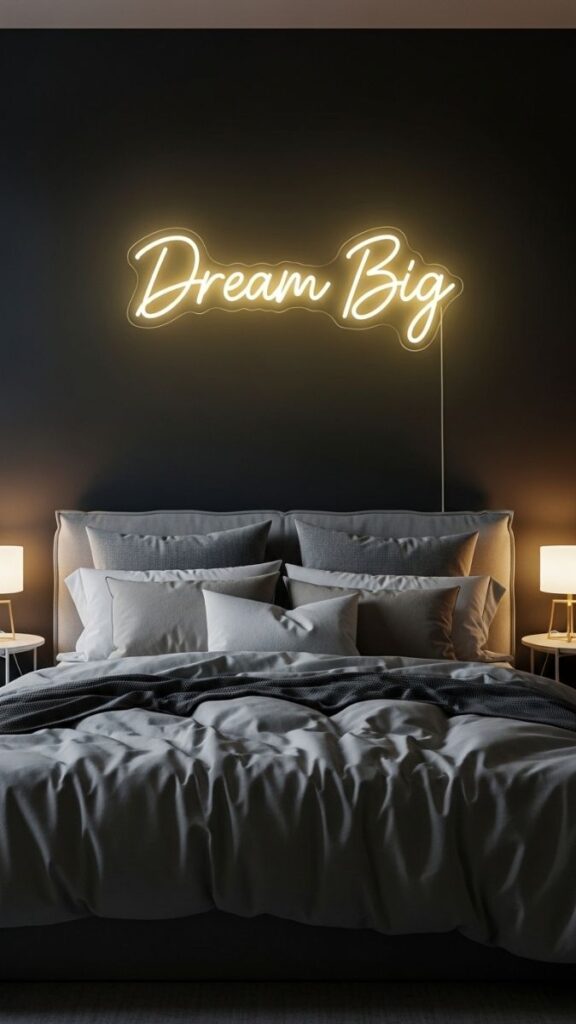
A neon or LED sign works above the bed when everything else in the room is dialed back. If the wall is otherwise bare and the bedding is simple, a single phrase sign becomes the room’s personality point without competing with other elements. Choose warm white or soft amber over bright colors unless the room is intentionally moody and dark-walled.
The sign works as the primary light source in some rooms at low brightness; it adds ambient warmth that overhead lighting can’t replicate. This is a strong choice for younger renters or anyone who wants the room to feel more personal without committing to permanent changes.
Oversized Tapestry as a Soft Headboard Alternative
A full-width tapestry hung low enough that the bottom edge nearly meets the headboard (or bed frame top) functions as both wall decor and a visual headboard useful when the actual bed frame is frameless or the headboard is plain.
The fabric softens echo and sound in the room subtly, and it gives the wall a finished look even in rentals where nails are a concern (most tapestries can be hung with adhesive strips or a tension rod). This works best in rooms with warm or earthy color palettes; cool-toned tapestries can feel flat against neutral walls.
Asymmetric Gallery Mix With One Anchor Piece
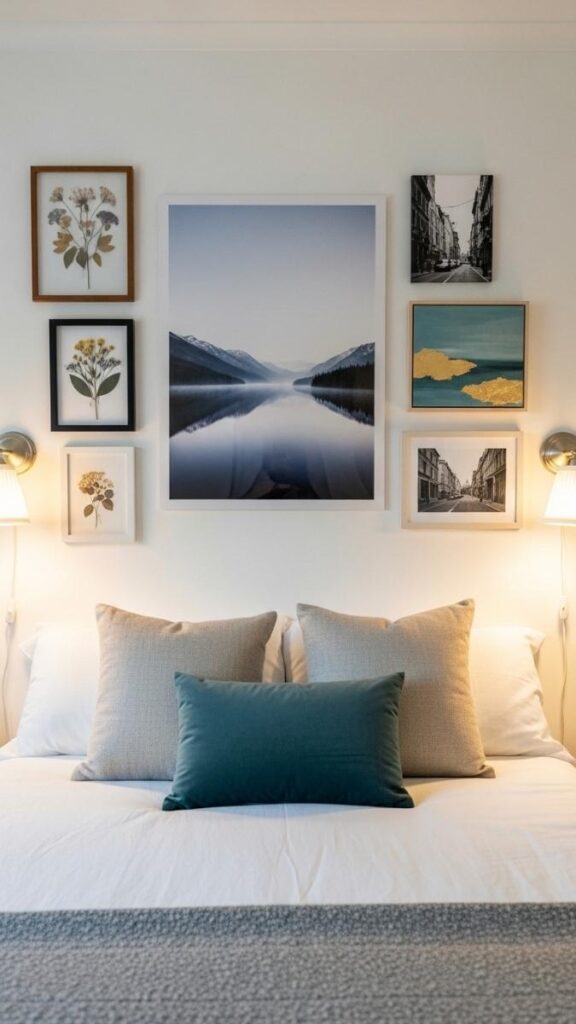
An asymmetric gallery layout anchored by one large piece typically on the left or right of center and filled with smaller pieces around it creates a more editorial feeling than a traditional grid. The anchor piece (at least 18×24 inches) gives the arrangement a foundation so it doesn’t read as random.
This is one of the harder setups to execute well, but when it lands, it looks genuinely designer-level. The trick is to lay everything out on the floor before hanging, then photograph it and step back. You’ll see balance issues from the image that you miss standing close to the wall.
Round Mirror Flanked by Two Sconce Lights
This combination solves two problems at once: the wall above the bed feels finished, and the bedside lighting situation improves without needing table lamps that eat up nightstand surface space. The round mirror provides the soft shape contrast; the sconces frame it and cast downward-angled light that’s actually useful for reading.
Hardwired sconces require an electrician, but plug-in sconce options are widely available now and work well in rentals. Center the mirror at eye level when seated in bed around 60–66 inches from the floor to the mirror center and place sconces at the same height on either side.
Vertical Canvas Stack for Low-Ceiling Rooms
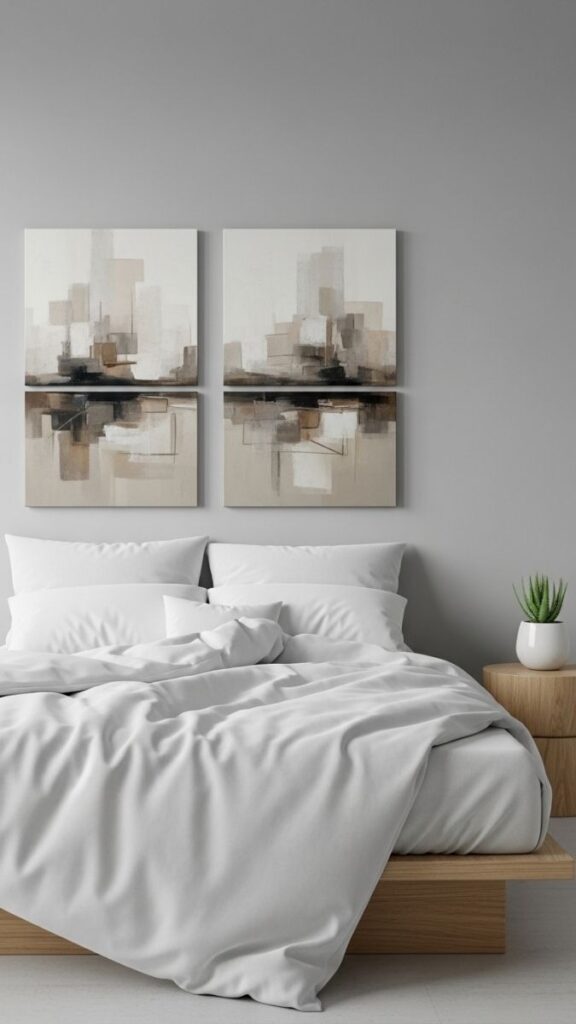
In rooms where the ceiling feels low (under 8 feet), a vertical canvas stack with two pieces of equal width hung one above the other draws the eye upward more effectively than a horizontal arrangement. The vertical line tricks the brain into reading the wall as taller than it is.
Keep the gap between the two pieces tight (2–3 inches) so they read as a pair, not two separate artworks that happened to land near each other. Abstract or landscape pieces work better than portraits in this format because there’s no subject-matter logic that demands one orientation over another.
Read More About: 26+DIY Bedroom Decor Ideas That Actually Work in Real Homes
String Lights Draped Across a Bare Headwall
Done carelessly, string lights above the bed look like a college dorm. Done with intention, they add a layer of ambient warmth that almost no other lighting solution can replicate at this price point.
The difference is in the draping of a clean horizontal line or a gentle downward arc looks deliberate; random zigzagging doesn’t. Pair them with something on the wall (a small print, a short shelf) so the lights feel like they’re framing something rather than just filling space. Warm white (2700K) only cool white reads as clinical in bedrooms.
Framed Fabric or Wallpaper Panel as Art
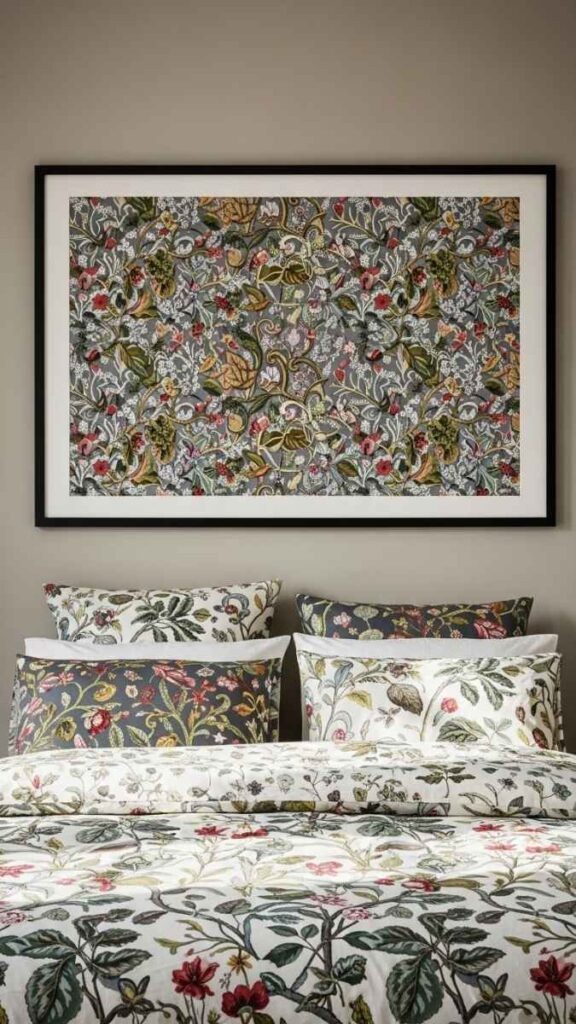
A single section of patterned fabric or wallpaper mounted in a large frame works as statement art at a fraction of the cost of a commissioned print or large canvas. The key is choosing a pattern with enough visual weight that small, busy prints get lost at scale; larger botanical or geometric patterns hold the wall.
This is one of the most budget-conscious approaches that still looks intentional and high-effort. It also solves a specific problem: large art prints in sizes above 24×36 inches get expensive fast, and framed fabric covers that gap without the cost.
Scallop or Cloud Shelf as Decorative Storage
Shaped shelves, scallop edges, cloud cutouts, arched backs are one of the cleaner ways to add personality above the bed without introducing art or mirrors. They function as storage while also being decorative enough to stand alone as a visual element.
Position a single wide scallop shelf about 12–16 inches above the headboard and keep the objects on it light and airy (small plants, a tiny candle, a folded card). This reads especially well in rooms that lean soft and feminine without wanting to commit to full maximalism.
Mural Wallpaper Panel Behind the Bed
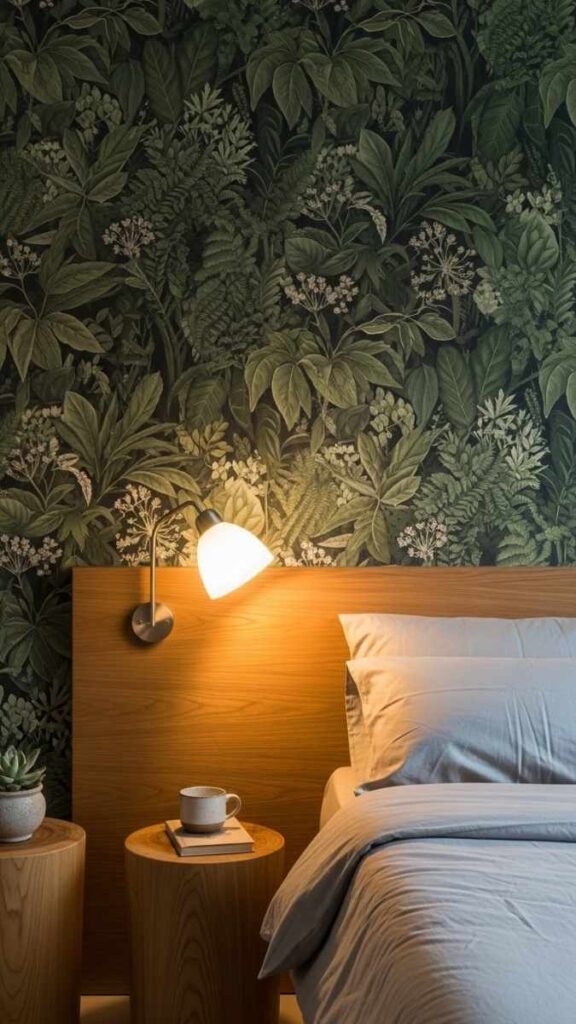
A mural wallpaper panel applied to the wall behind the bed only creates a focal point without requiring the whole room to commit to the pattern. Peel-and-stick mural options have improved significantly; the texture and print quality are now close enough to traditional wallpaper that the distinction isn’t obvious.
Floral, abstract watercolor, and maximalist botanical are the formats that perform best in this location because the bed covers the lower portion, so only the upper two-thirds of the mural is fully visible. This is one of the biggest visual-impact moves you can make in a bedroom without touching furniture.
Architectural Molding or Picture Rail Frame
Painting or installing simple picture-frame molding directly onto the wall above the bed creates a built-in, architectural look without actually renovating anything. The molding defines the space above the headboard the same way a piece of art would, but the three-dimensional depth of the trim adds something a flat canvas can’t.
Paint the interior of the molding box the same color as the wall (tonal, not contrasting) for a sophisticated, almost imperceptible depth effect. Paint it a contrasting color for something more graphic and modern. This works in practically any room size and pairs well with traditional, transitional, and even contemporary bedroom furniture.
Hanging Dried Botanicals or Pampas Grass
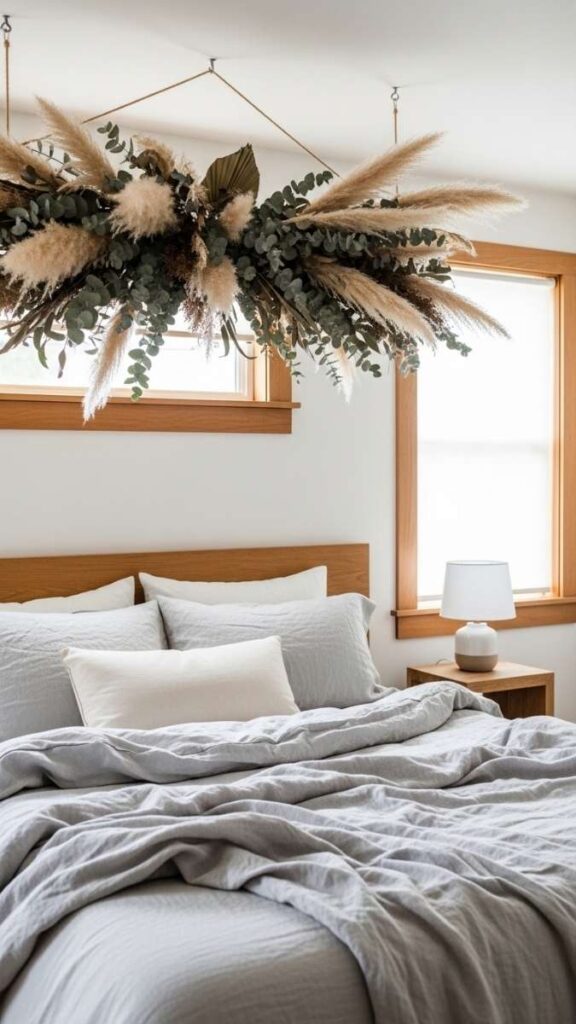
Dried botanicals hung in a loose cluster above the bed bring organic texture and a muted color palette that feels current without being trendy in a way that dates quickly. In 2026, dried arrangements are shifting away from the over-fluffed pampas toward more structured, sculptural groupings, thinner stalks, darker dried flowers, mixed seed pods alongside the grass.
Hang them from a simple wooden dowel or a discrete hook; the hanging mechanism can be part of the visual if it’s clean and minimal. This works best in rooms with natural light and warm-toned walls because the neutral tones of dried botanicals can look dusty under cool-white overhead lighting.
Cane or Rattan Headboard Wall Panel
A cane or rattan panel hung flat against the wall, separate from the actual headboard adds texture that reads as warm and handcrafted without being heavy. Position it so it visually extends the height of the headboard upward, giving the bed zone more vertical presence.
This is a strong approach for rooms where the bed frame is low or frameless because the rattan panel does the visual work the headboard isn’t doing. The woven texture also holds differently in different lighting: warm artificial light makes it amber and rich; natural light keeps it lighter and more airy.
Three-Dimensional Wall Tiles or Plaster Panels
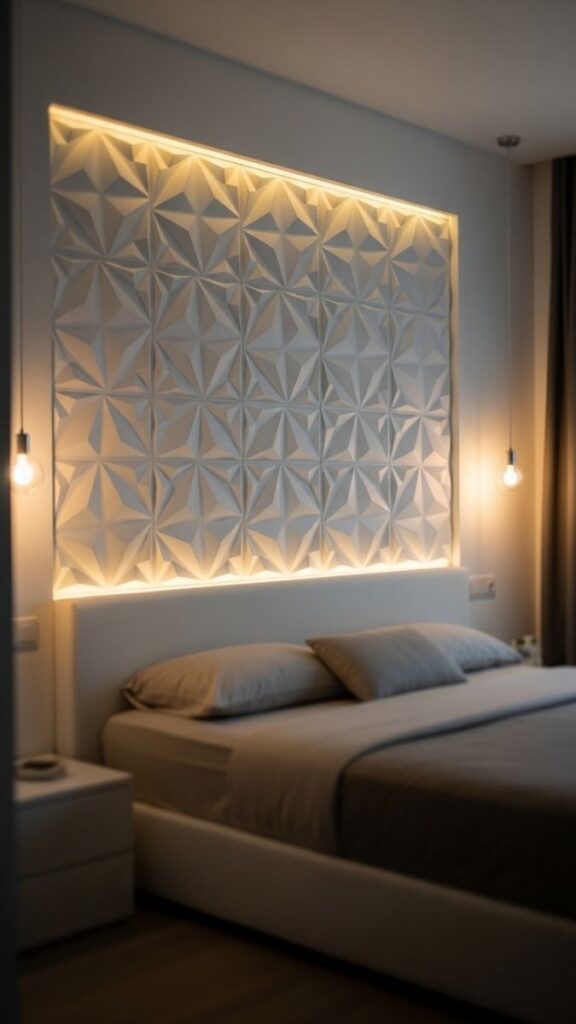
Textured wall panels either peel-and-stick 3D tiles or lightweight plaster-look panels add depth through shadow rather than color. The geometry of the texture catches light from different angles, which means the wall changes throughout the day as natural light shifts.
This works especially well in rooms with a single strong light source (a window to one side) because the angled light creates more defined shadow in the texture. It’s a less common approach than art or mirrors, which is part of its appeal; it genuinely reads as intentional and architectural in a way that’s harder to achieve with flat surfaces.
Curtain Canopy Hung From Ceiling Above Bed
A ceiling-hung canopy with two or four panels of sheer or linen fabric attached to the ceiling and draping down on either side of the headboard solves the “wall above the bed feels too tall and empty” problem by pulling attention inward and downward rather than upward.
It creates an enclosed, cocoon-like feel without actually closing off the space because the fabric is sheer. This is one of the more dramatic moves on this list, and it works best in rooms with higher ceilings (9 feet or more) where the canopy doesn’t feel like it’s crowding the sleeping space.
Custom Name or Initial Letters in 3D
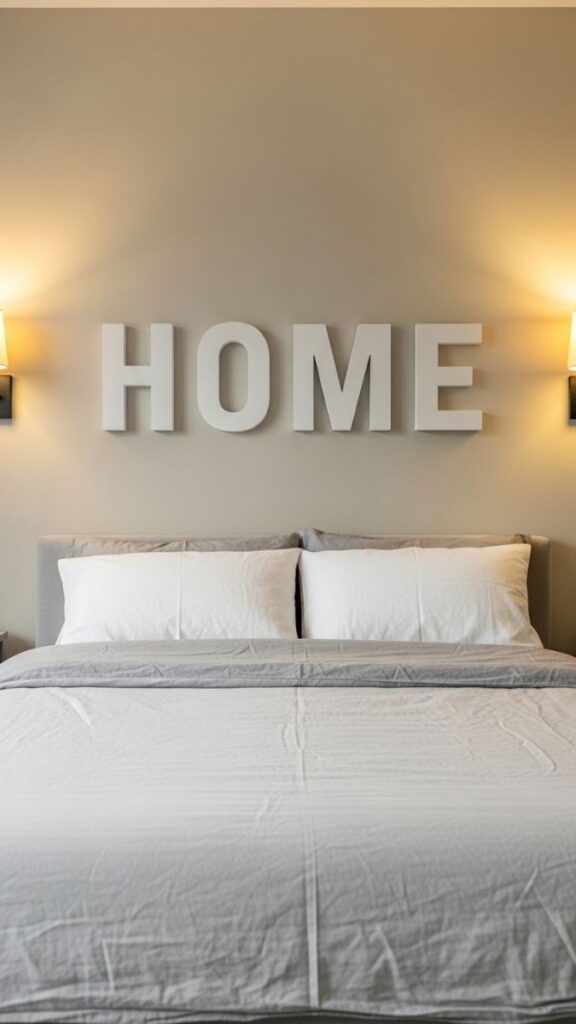
Large three-dimensional letters mounted directly to the wall work in bedrooms when the word or phrase is short (3–5 letters maximum) and the finish is matte rather than glossy. A glossy finish catches light unevenly and can look cheap; matte reads as intentional and sculptural.
This is a stronger choice for children’s or teen bedrooms, but it works in adult spaces too when the word is minimal (a single letter, a short word like “rest” or “dream”) and the rest of the room is quiet. The 3D depth adds shadow variation that flat art can’t, which gives the wall more interest than a print of comparable size.
Monochromatic Art Collection in One Color Family
A gallery wall built around a single color family of all pieces within a defined palette solves the “gallery wall looks chaotic” problem by reducing visual noise. The frames can vary in size and even in style as long as the art content stays within one color range.
Dusty blue, terracotta, sage, and warm earth tones are the most consistently successful families for this approach because they’re saturated enough to register as intentional but not so bright that they dominate the room. This is especially effective in rooms with a defined accent color that you want to reinforce without using paint.
Pegboard Art Wall With Rotating Display
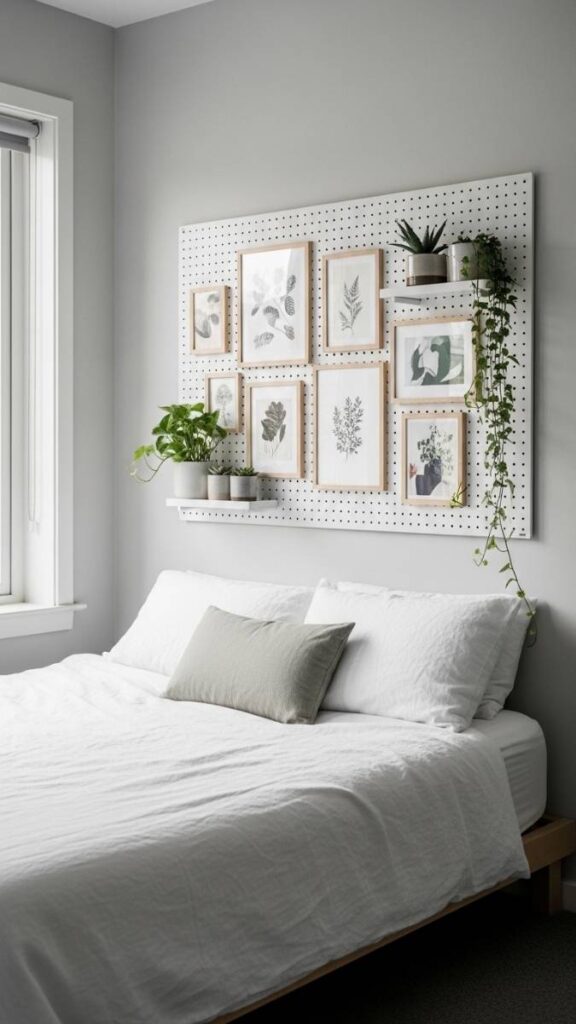
A pegboard mounted above the bed painted to match the wall or in a contrasting matte tone works as a rotating display surface for small art prints, mini shelves, and lightweight plants. The benefit over a fixed gallery wall is flexibility: you can rearrange without re-patching holes, which makes it useful for anyone who changes their style seasonally or just likes the option.
This setup works best in bedrooms that skew more playful or creative in their overall aesthetic; it can look out of place in a room that’s otherwise very quiet and minimal.
Framed Textile or Embroidery as Statement Piece
Framed textiles, embroidery, woven fabric art, needlepoint bring handcraft into the room in a way that mass-produced prints can’t replicate. The texture of the thread or weave is visible up close and creates a sense of depth that flat prints don’t have.
A single large piece in a simple frame above the bed reads as a considered art choice rather than a filler piece. This is gaining traction in 2026 as part of the broader shift toward handmade, craft-forward decor especially in rooms that are otherwise minimal and need one meaningful focal point rather than layered decoration.
Dark Painted Accent Wall Behind Bed
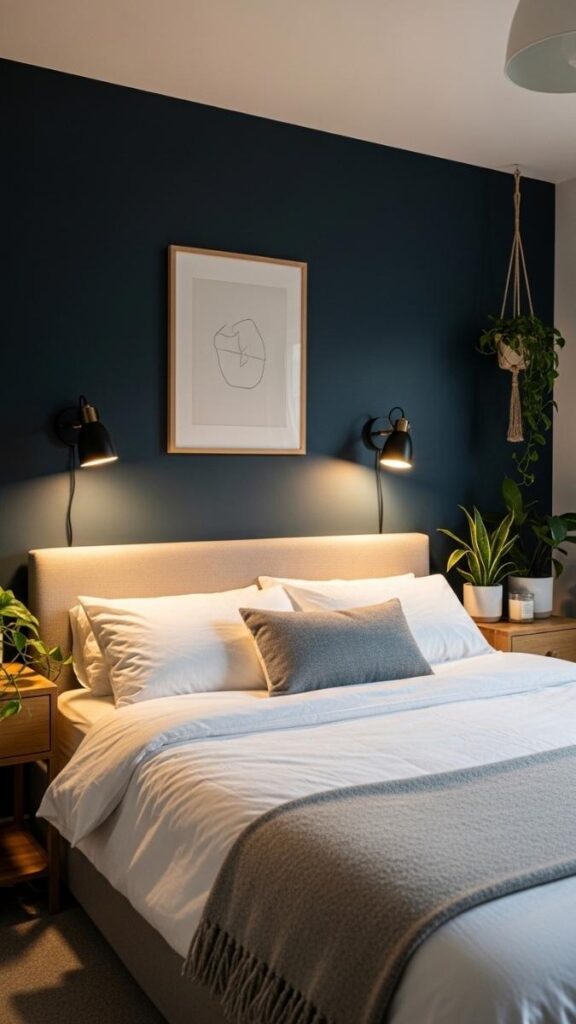
Painting the wall behind the bed a deep tone of charcoal, navy, forest green, or plum doesn’t require any hanging at all, but it creates a backdrop that makes the bed feel intentionally framed.
The dark wall absorbs light and pushes the bed visually forward, which adds depth to the room without changing any furniture. On a dark wall, even simple art, a small white-frame print, a single candle sconce stands out more than it would on a white background. This is honestly one of the most underrated moves in bedroom design because the effort is low (one wall, one paint color) and the visual shift is significant.
Layered Mixed-Media Wall Art + Shelf + Mirror Combined
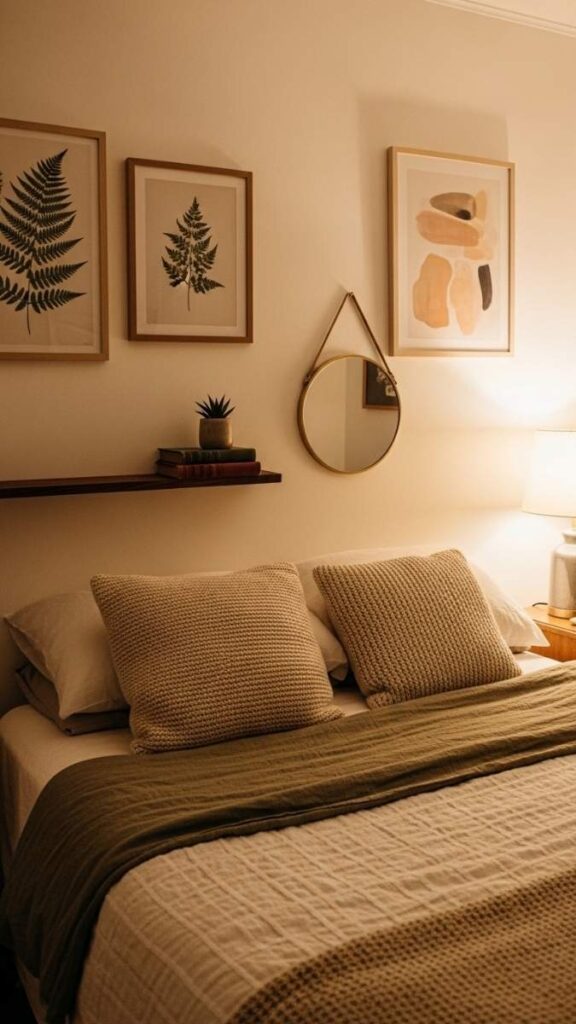
The most visually complex approach on this list, but also the most dynamic combining a mirror, a small shelf, and one or two art pieces on the same wall above the bed. The key to making this work is treating the arrangement as one unit, everything within a defined width (equal to or slightly wider than the headboard) and contained within a consistent height range (between the top of the headboard and about 12 inches below the ceiling).
The mirror adds depth, the shelf adds dimension, and the art adds personality. Start by placing the largest piece first, then build outward. In my experience, this works best when you limit the total number of elements to four or five beyond that, it stops reading as a curated display and starts looking like an overcrowded wall.
What Actually Makes These Ideas Work
The difference between a wall above the bed that looks designed and one that looks like an afterthought usually comes down to three things: proportion, height, and containment.
Proportion means the width of whatever you hang should relate to the width of the bed. A general rule is that your arrangement should cover roughly two-thirds of the bed width. A piece too narrow on a king bed floats. A piece too wide on a twin bed crowds.
Height means positioning the bottom edge of your arrangement about 8–12 inches above the headboard (or pillow line if there’s no headboard). Lower than that and it feels like it belongs to the bed, not the wall. Higher than that and the gap reads as disconnected.
Containment is about keeping the eye from wandering. Whether it’s a single large piece or a gallery arrangement, the overall grouping should have clear edges left, right, top, and bottom. That defined boundary is what makes the wall feel finished rather than in-progress.
Bedroom Wall Decor Above Bed Quick-Reference Guide
| Setup Type | Best Room Size | Problem It Solves | Effort Level | Budget Range |
| Single large print | Any | Empty, unfinished wall | Low | $30–$150 |
| Grid gallery wall | Medium–Large | Blank expanse above king bed | Medium | $50–$200 |
| Woven wall hanging | Small–Medium | Cold, hard-surface room | Low | $25–$120 |
| Arch mirror | Small | Low ceiling, poor light | Low | $40–$200 |
| Floating shelves | Small | No nightstand surface space | Medium | $30–$100 |
| Wood plank panel | Medium–Large | No headboard, bare wall | High | $60–$250 |
| Mural wallpaper | Any | Flat, personality-less space | Medium | $50–$300 |
| Accent paint wall | Any | Unanchored bed zone | Low | $20–$60 |
| Canopy drape | Large (high ceiling) | Ceiling too tall, no coziness | Medium | $40–$150 |
| Layered mix (art+mirror+shelf) | Medium–Large | Wants designer-level complexity | High | $80–$400 |
Common Bedroom Headwall Mistakes That Make the Space Feel Off
Hanging art too high.
This is the most frequent issue. Art hung at standing eye level (around 57–60 inches center from the floor) works in hallways and living rooms, but above a bed you want it lower closer to 48–54 inches center from the floor so it reads as connected to the bed rather than floating near the ceiling.
Going too small.
A single 8×10 print above a queen bed is one of the most common mistakes in bedroom decorating. The scale mismatch makes both the art and the bed look smaller. If you’re not ready to invest in large-format art, clustering three or four small pieces together creates enough mass to hold the wall.
Ignoring the headboard height.
The headboard defines the starting point for everything above it. A tall upholstered headboard already fills a lot of vertical space, which means the wall above it needs something with less visual mass (a single clean piece, a narrow shelf). A low-profile platform bed leaves much more wall to work with and can handle larger or more complex arrangements.
Matching the frame color to the wall too closely.
Tonal framing can work, but it requires intention. Most of the time, a frame that blends into the wall makes the art disappear rather than feel curated. A contrast dark frame on a light wall, light frame on dark wall, brass on warm white gives the piece the visual edge it needs to register.
Treating the arrangement as permanent from day one.
Paper templates taped to the wall before any nails go in saves significant patching and frustration. Cut paper to the exact size of each piece, arrange them on the wall with painter’s tape, and live with the layout for a day before committing.
FAQ’s
What size art should go above a queen or king bed?
For a queen bed, aim for art that’s at least 24–36 inches wide for a single piece, or a grouping that spans 40–50 inches total. For a king, the grouping should ideally reach 60–70 inches wide. Anything narrower creates a visual imbalance between the bed and the wall.
How high above the headboard should I hang wall decor?
Position the bottom edge of your art or arrangement 8–12 inches above the headboard. If there’s no headboard, measure from the top of the pillows. This keeps the decor visually connected to the bed without looking attached to it.
Can I decorate the bed without making holes in the wall?
Yes several options work without drilling adhesive picture strips (rated for the weight of your piece), peel-and-stick mural wallpaper, tapestries hung from adhesive hooks, and LED neon signs that rest on a shelf rather than mount to the wall. Most of these work in rentals without deposit issues.
Is a gallery wall or a single large piece better above the bed?
It depends on ceiling height and room size. Single large pieces work better in smaller rooms or lower ceilings; they’re simpler and don’t fragment the visual space. Gallery walls work better in larger rooms or above king beds where there’s enough wall to fill without a single piece looking undersized.
What type of mirror works best above the bed?
Arch or round mirrors are the strongest choices because the curved shape contrasts with the rectangular geometry of the bed and room. Avoid large rectangular mirrors directly above the bed; the hard corners and flat edges don’t add much that art couldn’t do, and very large flat mirrors above sleeping areas can feel visually heavy.
Why does my bedroom wall still look unfinished after decorating it?
Usually it’s a scale or height issue. If the piece is the right size but still looks off, check the gap between the headboard and the art. A gap larger than 12–14 inches breaks the visual connection. Also check if the arrangement is wide enough relative to the bed; narrow arrangements on wide beds leave empty space on the sides that makes everything look tentative.
How do I make an above-bed gallery wall look cohesive instead of random?
Choose one unifying element before you start consistent frame color, consistent mat color, consistent art style, or consistent subject matter. You only need one through-line for the arrangement to hold together. Trying to match all four makes the wall look overly coordinated; matching none makes it look chaotic.
Conclusion
The wall above your bed doesn’t need a major renovation or a large budget to look intentional; it needs the right scale, the right height, and a clear visual anchor. Small adjustments in those three areas make a more noticeable difference than adding more pieces or spending more money.
Start with one or two ideas from this list that match your room size, your current furniture, and what you’re actually willing to commit to. If you’re unsure, a single large print is almost always the lowest-risk starting point you can build around it later. Experiment with placement before you hang anything permanently, and let the room guide the decision more than the trend.