60+ Light Blue Bathroom Ideas That Make Small Spaces Feel Airy and Intentional
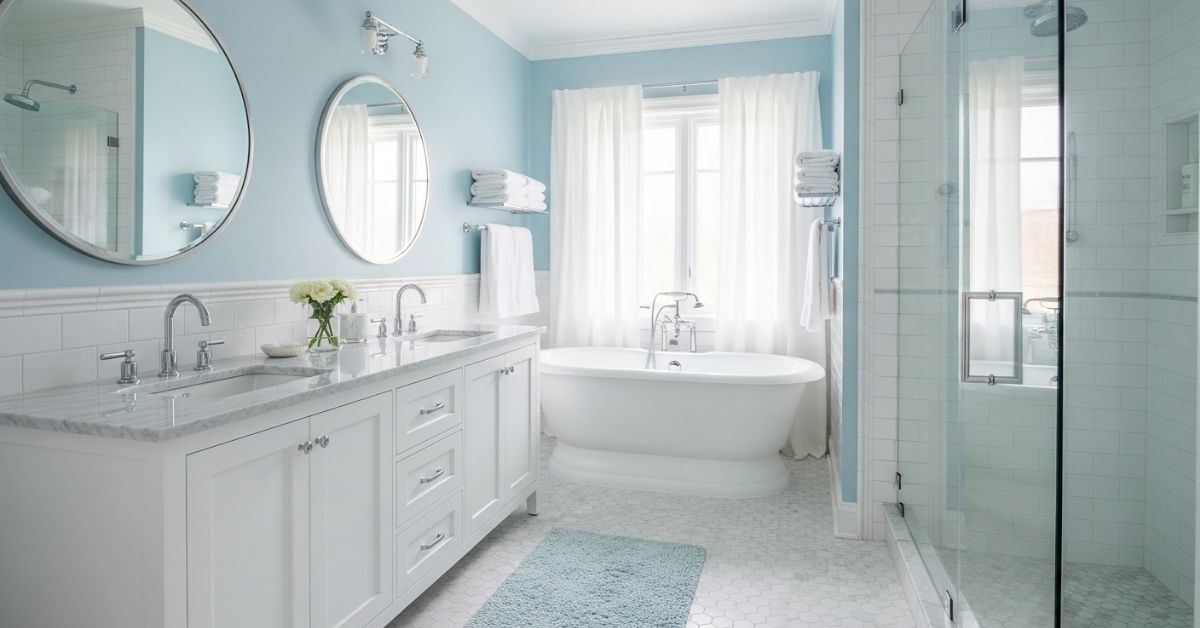
If you’ve been staring at your bathroom wondering why it feels flat or cramped despite being “clean,” the answer might be color, not square footage. This roundup focuses on setups that actually work in real homes: Light Blue Bathroom Ideas small apartments, older construction, rentals, rooms with one tiny window, and everyday bathrooms that need to pull double duty.
For anyone working with a compact bathroom or a space that feels cold and forgettable, these ideas are built around spatial logic not just aesthetics.
Powder Blue Shiplap with Raw Wood Vanity
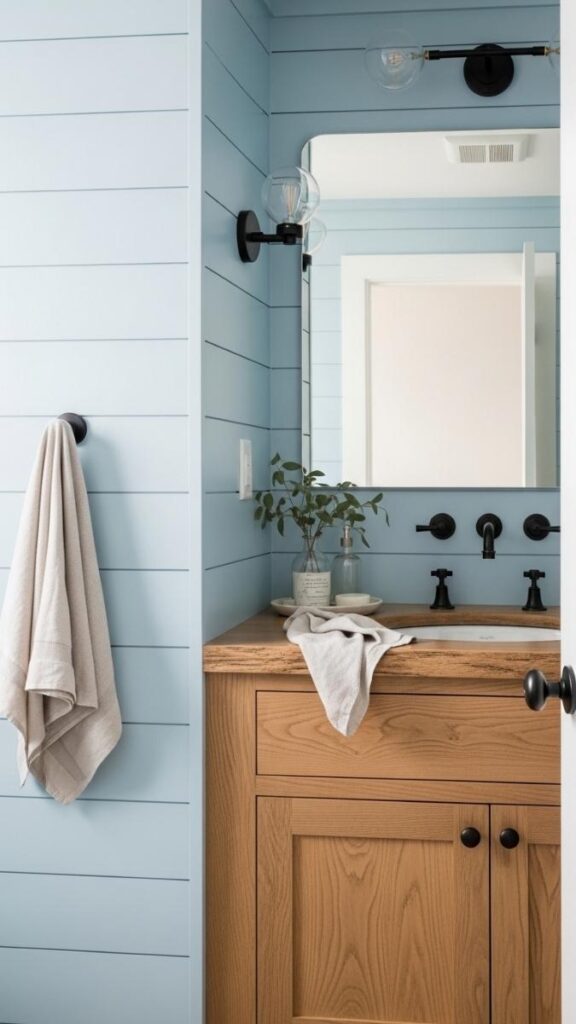
Shiplap in a muted powder blue works particularly well when it’s paired with something that grounds it; a raw wood vanity does exactly that. The wood introduces warmth that prevents the blue from reading as cold or clinical. Horizontal lines on the walls also create the visual impression of width, which matters in rooms under 40 square feet.
This setup works best in narrow bathrooms where the walls are your biggest design surface. It solves the problem of a space that feels both dated and sterile. The warm-toned Edison bulbs above the mirror keep the mood from tipping too cool, and the textural contrast between the matte paint and the wood grain keeps the eye moving. I’ve noticed this pairing tends to land best in cottagecore or transitional interiors; it bridges rustic and modern without leaning too hard in either direction.
Icy Blue Subway Tile with Black Grout
Black grout is what elevates basic subway tile into something with real graphic impact. In a light blue colorway thick, almost translucent blue the dark grid adds definition without weighing down the room. The result is a bathroom that looks deliberately designed rather than builder-grade.
This works especially well if you’re renting and can choose tile during a refresh, or if you’re doing a full renovation on a mid-range budget. The contrast pattern draws the eye upward, which has a subtle height-expanding effect. It pairs naturally with matte black fixtures, which keeps the palette tight and intentional. Avoid warm brass here it competes with the cool blue and muddies the whole direction.
Dusty Blue Limewash Wall with White Freestanding Tub
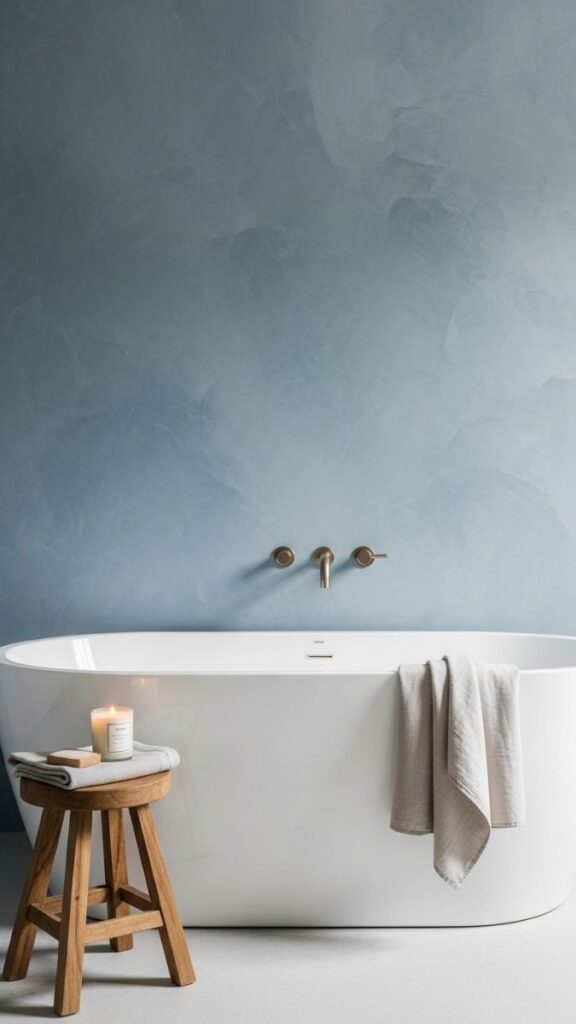
Limewash in dusty blue is one of the most forgiving wall treatments for imperfect walls; the texture actually hides unevenness while adding depth. When paired with a white freestanding tub, the blue recedes visually and the tub becomes a clean focal point. The organic variation in limewash means no two walls look identical, which gives bathroom spaces a curated, handcrafted quality.
This is best suited to larger bathrooms at least 60 sq ft where the tub has room to breathe. It solves the problem of a bathroom that looks too polished or impersonal. The terracotta floor creates a warm anchor that keeps the blue from feeling cold, a Mediterranean logic that’s finding real traction in 2026 interiors.
Sky Blue Ceiling with White Walls
Painting just the ceiling blue is one of the more underused spatial tricks in small bathrooms. When the walls stay white and the ceiling gets the color, it creates a tent-like sense of height without making the room feel enclosed. The eye reads the color overhead as “sky,” which psychologically expands the vertical space.
This works in rentals too; ceilings are rarely off-limits. It’s an especially smart move in bathrooms with low natural light, because a pale blue overhead reads as a light source of its own. Warm gold or antique brass fixtures keep the palette from going too cold. This is one I’d actually recommend trying first if you’re nervous about committing to blue walls; the ceiling is always the lowest-risk experiment.
Read More About: 71+ Furniture Layout Ideas That Make Any Room Feel Bigger, Balanced
Baby Blue Zellige Tile Backsplash with Cream Walls
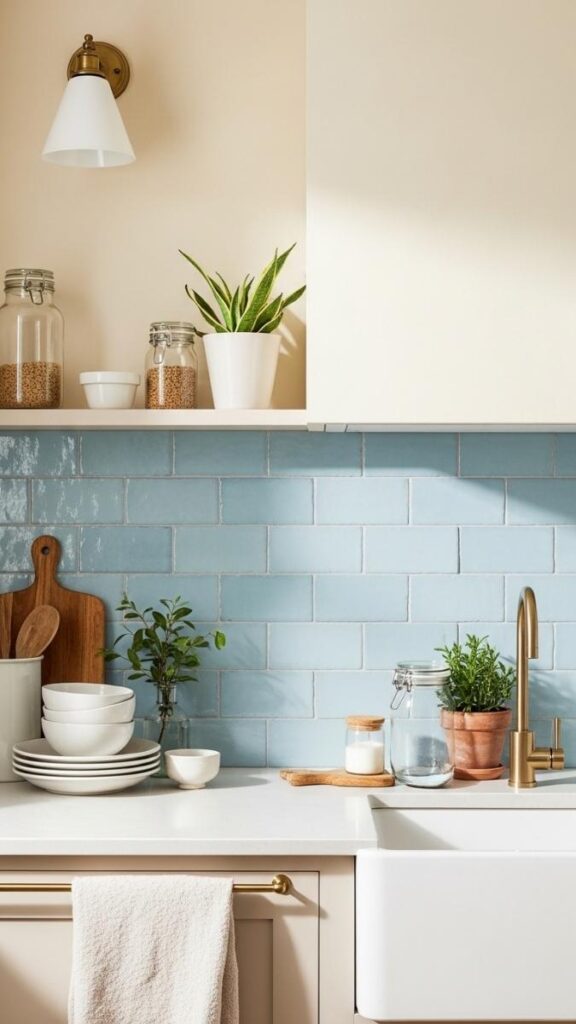
Zellige tiles the handmade Moroccan clay tiles with slightly uneven surfaces catch light in a way that flat ceramic simply can’t. In baby blue, the natural variation creates a mosaic-like shimmer that shifts with the time of day. Used as a backsplash above the vanity rather than across the entire bathroom, this approach keeps the cost manageable while delivering maximum visual payoff.
The irregular surfaces also add tactile richness that cream walls and linen textures complement rather than compete with. This works especially well for bathrooms where you want one strong design moment without overwhelming the room. Budget tip: zellige tile can run expensive per square foot, so a contained backsplash typically 8–12 sq ft keeps it affordable.
Light Blue Bathroom with Arched Mirror and Brass Fixtures
An arched mirror in a blue bathroom solves two problems at once: it introduces architectural interest where the walls are flat, and it reflects light back into the room. Unlacquered brass fixtures, the kind that patina over time add warmth against the blue so the room doesn’t feel like a spa brochure.
This is a strong choice for bathrooms that lack molding or built-in architectural detail. The arc of the mirror draws the eye upward, and in smaller bathrooms with lower ceilings, that vertical pull is worth a lot. The blue works at almost any saturation here; pale powder, steel blue, or muted slate all work differently but read well.
Pale Blue Bathroom with Wainscoting Panel Detail
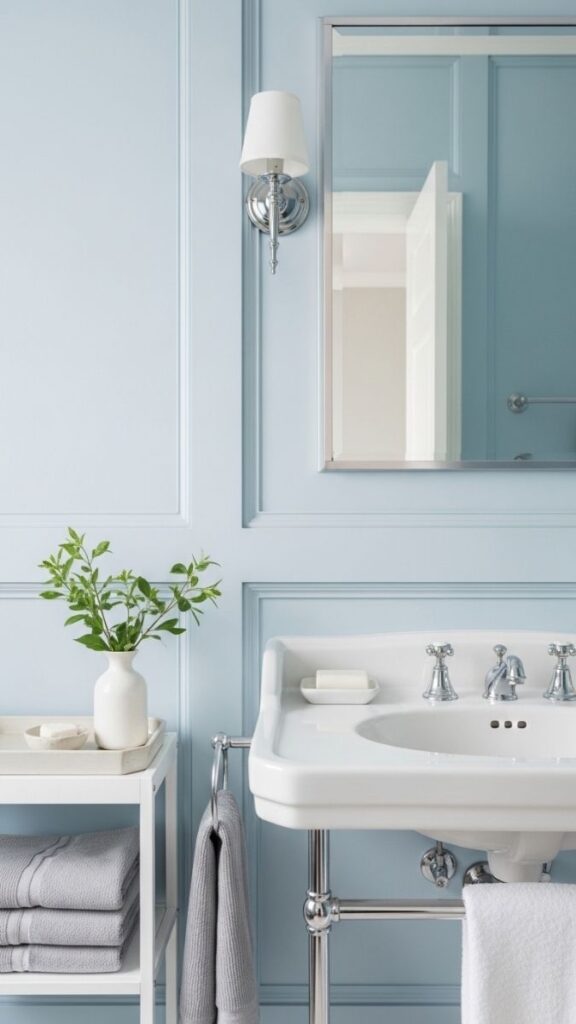
Wainscoting with pale blue paint above it brings a classic American-cottage quality to a bathroom without needing much renovation. The paneling acts as a visual baseline that grounds the space and gives it a layered,
built-in look even if it’s just MDF panels installed DIY. The blue wall above works with almost any ceiling height in a tall room, it pushes color to a more comfortable eye-level zone; in a low room, the light hue keeps the space from compressing. This is particularly suited to homes with older Victorian, Craftsman, colonial architecture where the paneling feels period-appropriate rather than out of place.
Chrome fixtures here are underrated: they add a clean crispness that blends with both the white paneling and the cool blue tone.
Teal Blue Matte Paint with Warm Rattan Accents
Teal-blue sits at the intersection of green and blue, which makes it one of the more flexible bathroom colors; it bridges nature-inspired palettes and cool modern ones simultaneously. In matte finish, it absorbs light rather than reflecting it, creating a cocoon effect that works well in evening-use bathrooms, especially main bathrooms used for unwinding.
Rattan hooks and a rattan-framed mirror introduce a natural, porous texture that softens what could otherwise feel like a dramatic statement. This layout works best in bathrooms where you want to feel moody and intentional rather than bright and functional. Honest note: matte paint requires a more durable washable formulation in bathrooms investing in bathroom-specific matte finishes to prevent peeling.
Read More About: 73+ Aesthetic Setups That Make Your Home Feel Intentional Without Starting Over
Light Blue and White Floral Tile Floor with Simple Walls
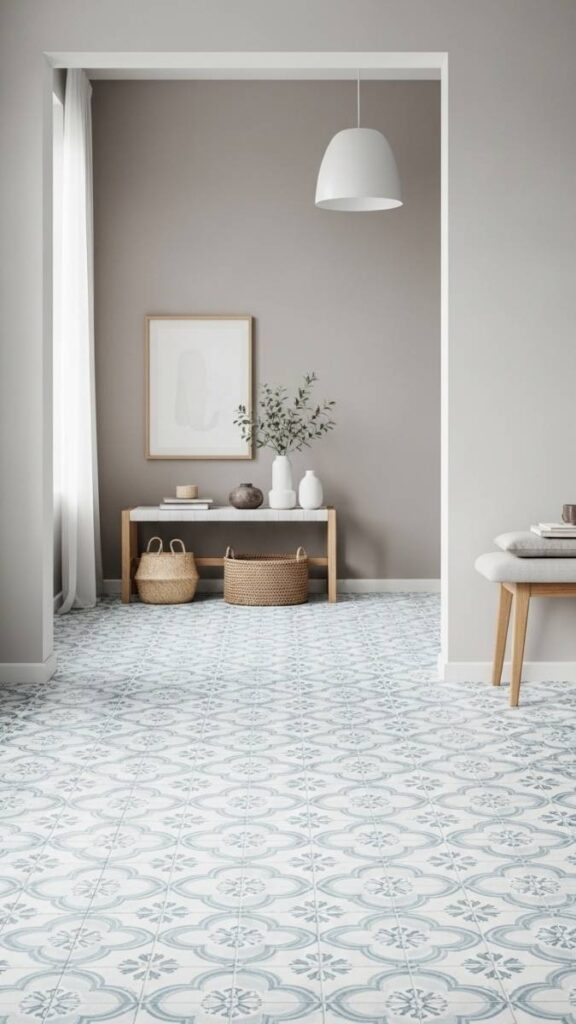
The most visually powerful surface in a bathroom is often the floor and a blue-and-white encaustic or cement tile pattern does the work of an entire design scheme from the ground up. This approach lets the walls and fixtures stay simple flat white, basic chrome while the floor anchors the entire aesthetic. The blue in the tile pattern connects to any wall color you layer on top, even if the walls stay white.
This is especially useful in older bathrooms where the layout is fixed; a new floor can completely reframe the room’s character. The vintage-style pedestal sink leans into the pattern’s heritage quality. Go for pattern scales proportional to the floor size: small rooms need smaller repeat tiles to avoid visual chaos.
French Blue Bathroom Walls with Marble Accents
French blue, a medium-depth, slightly gray-toned blue sits comfortably between a statement and a neutral. It’s deep enough to feel intentional but light enough not to dominate. Against white Carrara marble, it reads as quietly sophisticated without trying too hard.
This is a strong choice for main bathrooms in apartments or homes where you want character without strong trend dependency. French blue has real staying power because it’s historically grounded. The marble countertop or even a marble-look quartz alternative adds cool-toned texture that reinforces the calm quality of the blue. In my experience, this combo tends to age better than bolder jewel tones five years from now; it still reads as considered, not dated.
Aqua Blue Painted Vanity in an Otherwise White Bathroom
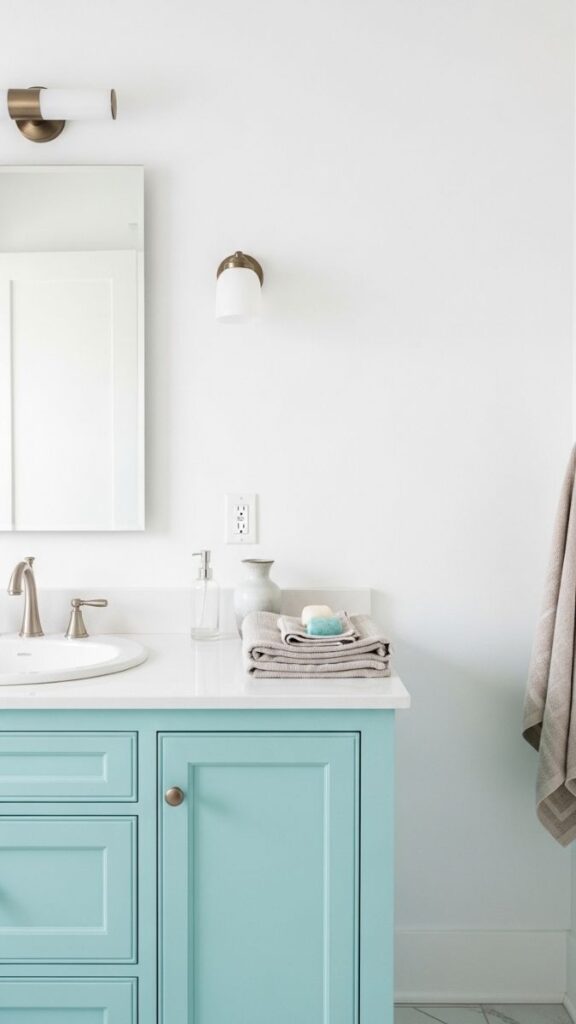
If full blue walls feel too committed, a painted vanity delivers the same color punch with zero permanence risk. An aqua-painted vanity in a white bathroom becomes the room’s focal point while everything else stays neutral.
This also works brilliantly for renters to paint your own vanity, take it with you when you leave. The aqua sits warmer than icy blue, pulling slightly green, which means it reads as fresh and organic rather than cold. White subway tile keeps the background crisp, and chrome fixtures add a clean finish that doesn’t clash with the aqua’s warm undertone. This is the most budget-friendly blue bathroom approach on this list.
Dusty Blue with Exposed Concrete Floor
Dusty blue against raw concrete is an unexpected pairing that works because in contrast the soft muted tone of the blue pushes back against the hard, industrial quality of the concrete. The result is a bathroom that feels both cool and minimal without becoming clinical.
This is particularly strong in urban apartments with existing concrete construction or loft-style bathrooms where you’re not covering anything up. The concrete floor doesn’t absorb light, so layering in a warm overhead fixture is essential to keep the room from reading as stark. Wall-mounted faucets are worth the extra cost here; they reinforce the minimal aesthetic and keep the vanity surface completely clear.
Soft Blue Bathroom with Sheer Linen Curtain in Window
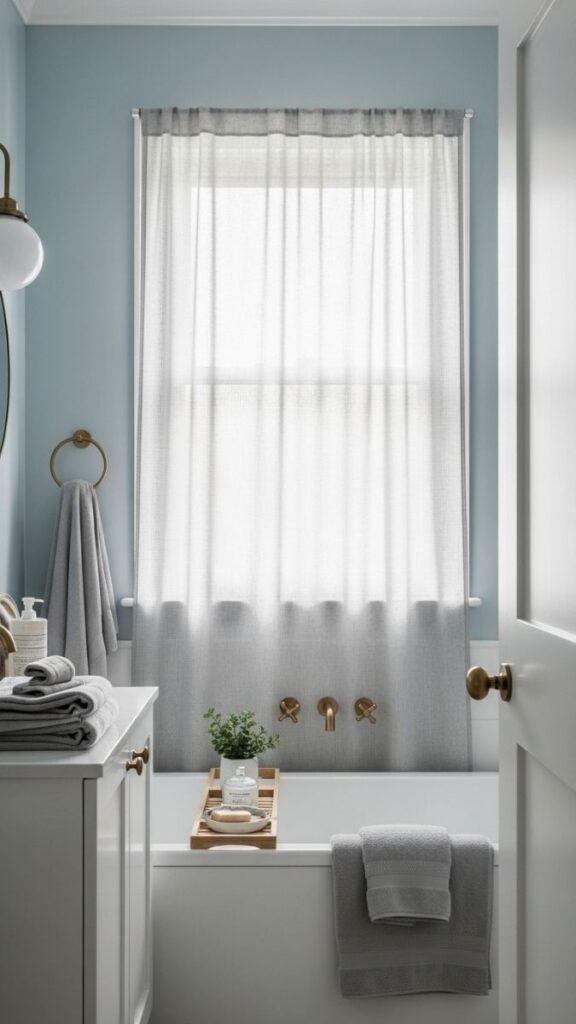
In bathrooms with a window, the window treatment shapes the entire mood. A sheer linen curtain in natural undyed linen filters light into a warm glow that reads beautifully against soft blue walls. This setup pulls simultaneously from Scandinavian minimalism and relaxed farmhouse aesthetics:
The blue provides color depth, the linen adds organic texture, and the filtered light makes everything feel softer. It works in primary bathrooms where natural light is a feature worth emphasizing. The clawfoot tub or a simple wooden vanity connects the floor plane to the organic warmth of the linen, keeping the blue from floating without grounding.
Sapphire Blue Accent Niche in a White Shower
A built-in niche painted or tiled in sapphire blue inside a white shower is one of the most spatially efficient ways to add dramatic color in a bathroom. The niche itself is small, typically 12 x 24 inches but the saturated blue inside it creates a visual depth that makes the shower feel larger and more finished.
White subway tile around it emphasizes the contrast. Practically speaking, a tiled niche is also functional: it keeps shampoo bottles organized and off the floor. This is one of the best high-impact, low-square-footage design moves in a bathroom renovation. If tiling the niche is too complex, a bold paint color inside works with a coat of moisture-resistant enamel.
Pastel Blue Bathroom with Gold Leaf Mirror
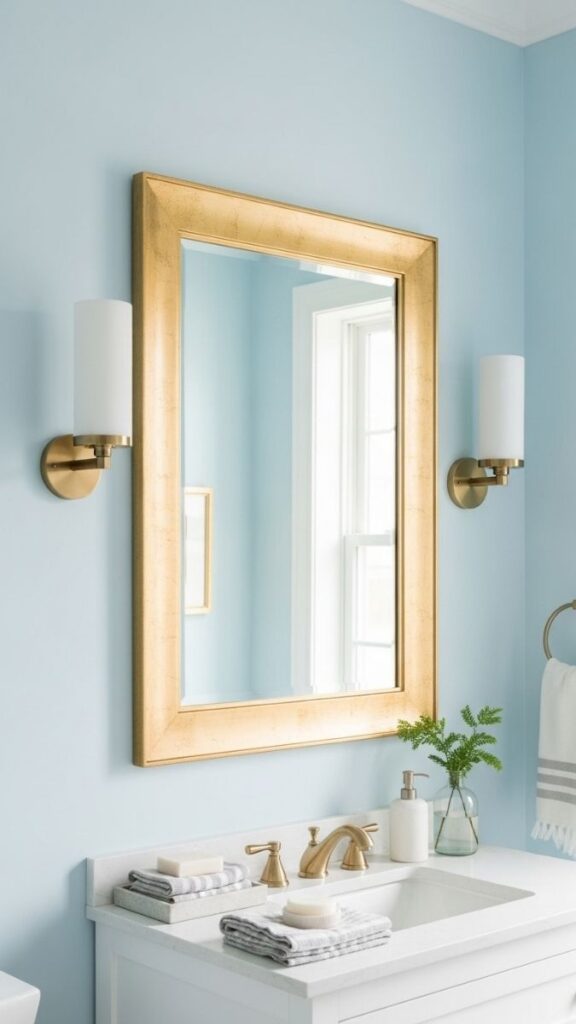
Pastel blue and ornate gold is a Parisian-apartment combination that has been circulating on Pinterest heavily in the last two years and for good reason. The lightness of the pastel prevents the room from feeling heavy despite the richness of the gold mirror frame.
The gold acts as a warmth anchor, pulling the cool blue toward a more livable middle. This works in small powder rooms particularly well: the drama is contained, the square footage is low, and a single ornate mirror has room to make a statement. Keep everything else paired back with a clean round basin, a simple wall sconce and let the mirror do its thing.
Read More About: 72+ Home Color Schemes That Actually Work in Real Rooms
Steel Blue Bathroom with Dark Grout and Penny Tile
Steel blue is the most versatile shade in the light blue family; it reads differently depending on lighting, leaning either silvery-gray or more definitively blue. Against white penny tile with dark grout, it anchors the room in a way that feels collected and specific. Penny tile’s pattern scale creates movement on the floor that keeps the space lively even when the walls are clean.
This layout is best in bathrooms where the fixtures are older chrome or brushed nickel steel blue and doesn’t clash with either metal finish the way warmer or cooler blues can. The dark grout on the penny tile visually ties back to the cooler, grayed tone of the steel blue wall.
Light Blue Bathroom with Floating Shelves and Minimal Decor
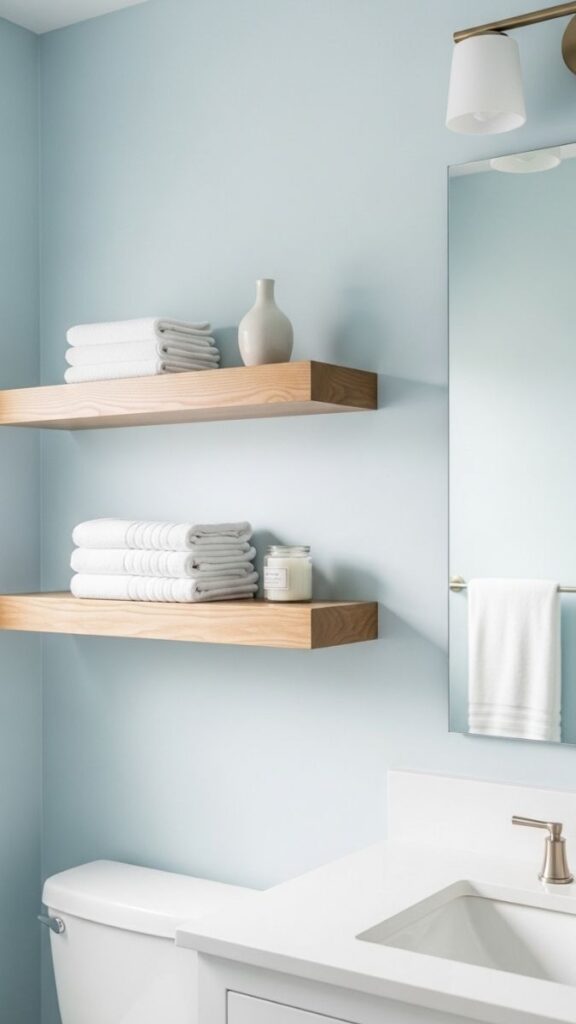
In a bathroom that needs to function efficiently without extra storage furniture, floating shelves in white against a light blue wall create storage without visual weight. The blue acts as a soft backdrop that makes the shelf contents, towels, a small plant, and a candle look curated rather than cluttered.
This setup is especially practical in bathrooms under 50 square feet where a free-standing shelf or cabinet would eat up floor space. The trick is keeping the shelf styling restrained: three to five items max, with a mix of heights. The combination of the blue wall and the white shelves reads clean and cohesive without requiring any additional investment in furniture.
Coastal Blue Bathroom with Rope Accents and Natural Stone
Coastal doesn’t have to mean seashell collections and fish prints. A muted coastal blue thick, weathered, slightly gray-toned with a rope-frame mirror and travertine stone countertop is a grounded, material-focused interpretation that avoids looking kitschy.
The natural stone adds warmth and weight that keeps the coastal theme from floating into beach-shack territory. Woven baskets under the vanity or on a low shelf add texture and function simultaneously. This works especially well in homes near water or with natural light that shifts throughout the day. Travertine reflects light differently as the light quality changes, which means the bathroom reads differently in the morning versus evening.
Periwinkle Bathroom with Unlacquered Brass Fixtures
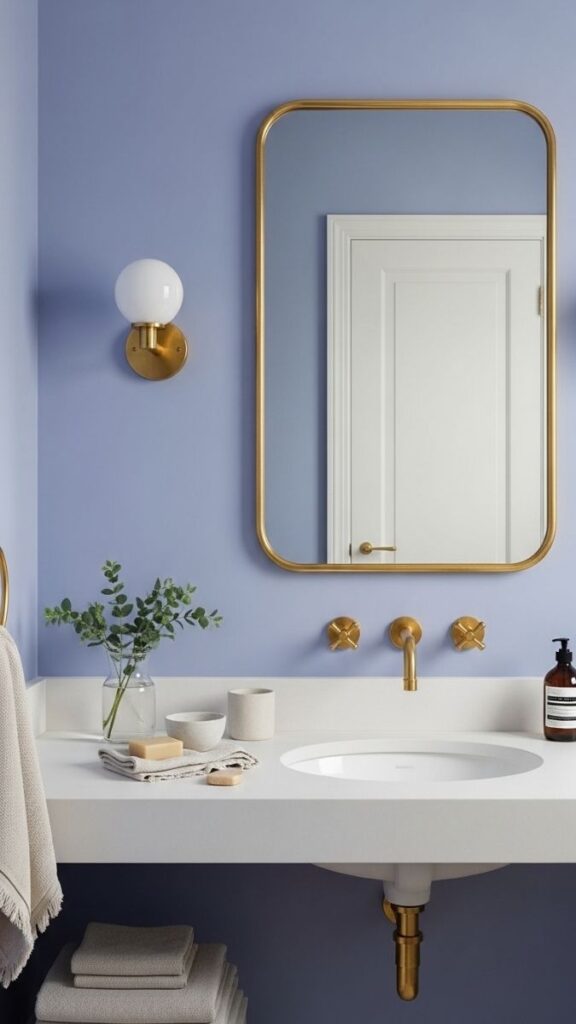
Periwinkle sits at the purple-blue intersection, which makes it one of the warmer options in the light blue family. Against unlacquered brass the kind that develops a living patina it has a warmth and richness that reads as intentional luxury.
The aging quality of unlacquered brass also complements the nostalgic, slightly retro quality that periwinkle carries. This is a strong direction for a primary bathroom where you want warmth without wood and luxury without marble.
The vessel sink keeps the vanity surface visual and the fixture pairing tight. IMO, this is one of the combinations that looks better in person than in photos. The warmth is subtle in renderings but very present in real light.
Ice Blue Bathroom with Terrazzo Floor and Warm Wood
Ice blue, the palest, most translucent version of the blue family pairs beautifully with terrazzo flooring because the terrazzo’s speckled pattern introduces warmth and visual complexity at floor level while the walls remain airy and simple. The floating wood vanity adds grounding weight at mid-height,
keeping the room from feeling like it’s floating. This three-layer approach, airy walls, grounded vanity, and visually rich floor is a solid formula for bathrooms with good natural light but limited space. The ice blue reflects available daylight well, making rooms feel larger than they are without any tricks with mirrors.
Chambray Blue with Black Pipe Shelving
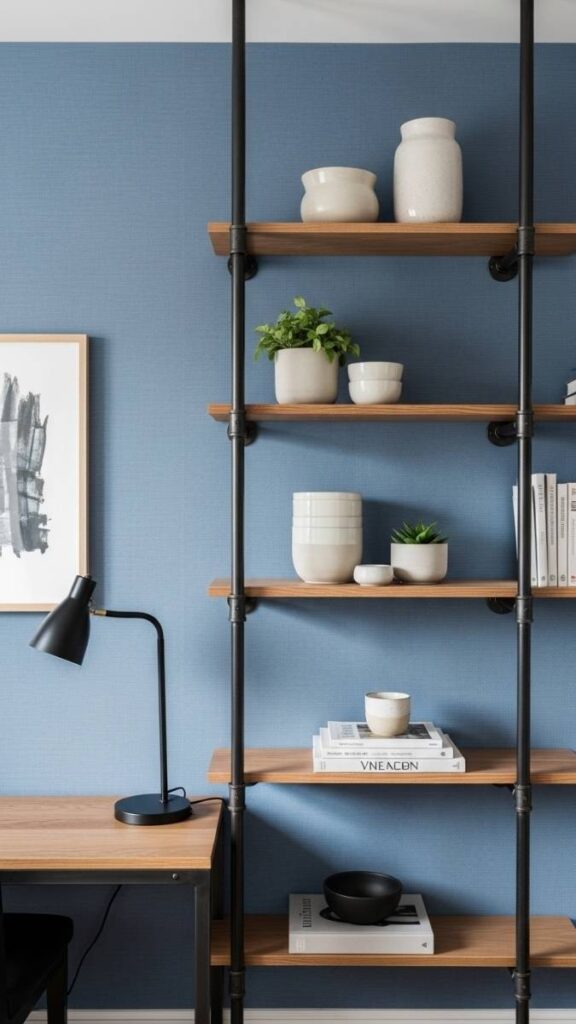
Chambray blue has a faded, worn-in quality that reads particularly well in industrial-adjacent bathrooms. Against black pipe shelving the kind originally popularized in industrial loft spaces it creates a contrast that feels functional and masculine without being cold.
The chambray’s warmth relative to other blues prevents the black pipe from reading as harsh. This is a strong approach for bathrooms with high ceilings or exposed pipes, because the pipe shelf style acknowledges and leans into the construction rather than hiding it. Practically, pipe shelving is DIY-friendly and cheap to install, available at any hardware store in multiple configurations.
Light Blue Bathroom with Terraced Hexagon Tile Walls
Hexagon tile in a single light blue colorway with white grout creates a geometric texture that’s more interesting than flat subway but still cohesive enough to not overwhelm a small room.
Arranged floor to ceiling, the pattern reads as a texture rather than a pattern which is a useful trick for keeping a small bathroom from feeling visually chaotic. The white grout lines break up the blue at regular intervals, preventing saturation and keeping the palette breathable. This is especially effective in bathrooms with no windows, where the tile’s geometric depth substitutes for the visual interest that natural light would normally provide.
Duck Egg Blue Bathroom with Freestanding Shelving Unit
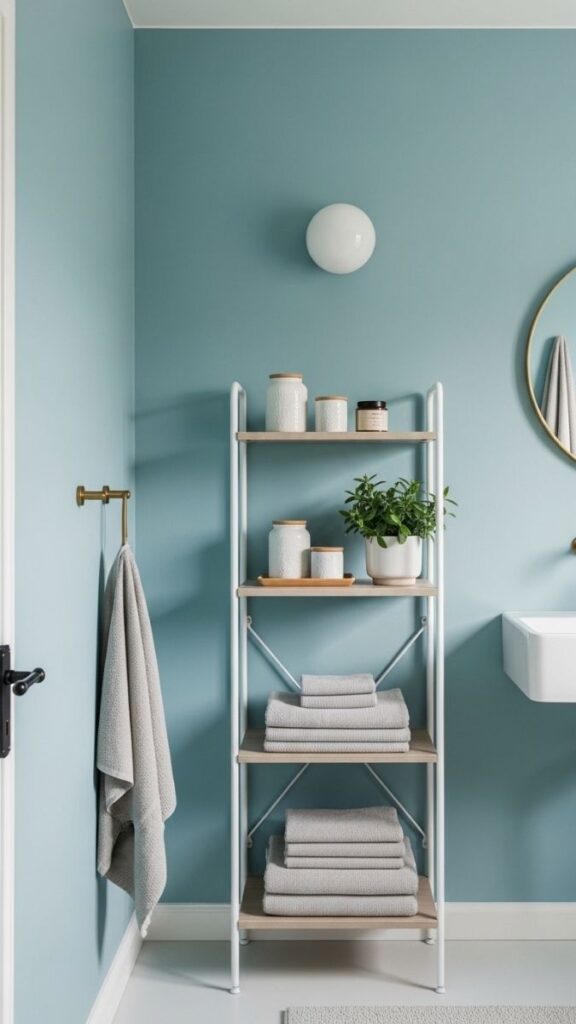
Duck egg is the most green-adjacent of the light blue family, which makes it particularly alive-feeling in bathrooms; it reads like something botanical rather than purely architectural. Against a white freestanding shelving unit, the duck egg blue acts as a framing color that makes the shelf’s contents look deliberately styled. This approach works for renters who can’t drill into walls:
a freestanding unit provides the same storage and display functionality as built-ins without the commitment. The round mirror above the sink complements the softer, rounder quality that duck egg blue carries versus its sharper blue counterparts.
Slate Blue Bathroom with Honed Black Marble
Slate blue against honed black marble is one of the more dramatic combinations in this list, but it works because both materials share a quality of muted sophistication neither is shiny, neither is loud. The blue reads as a cool mid-tone against the darker marble, creating contrast without creating conflict.
Honed marble rather than polished keeps the surface from being too reflective, which matters because you want the texture, not the glare. This setup works best in a primary bathroom where the design is the priority, not just the function. Warm overhead lighting is essential without it, the combination tips toward cold and uninviting.
Robin’s Egg Blue with Vintage-Style Pedestal Sink
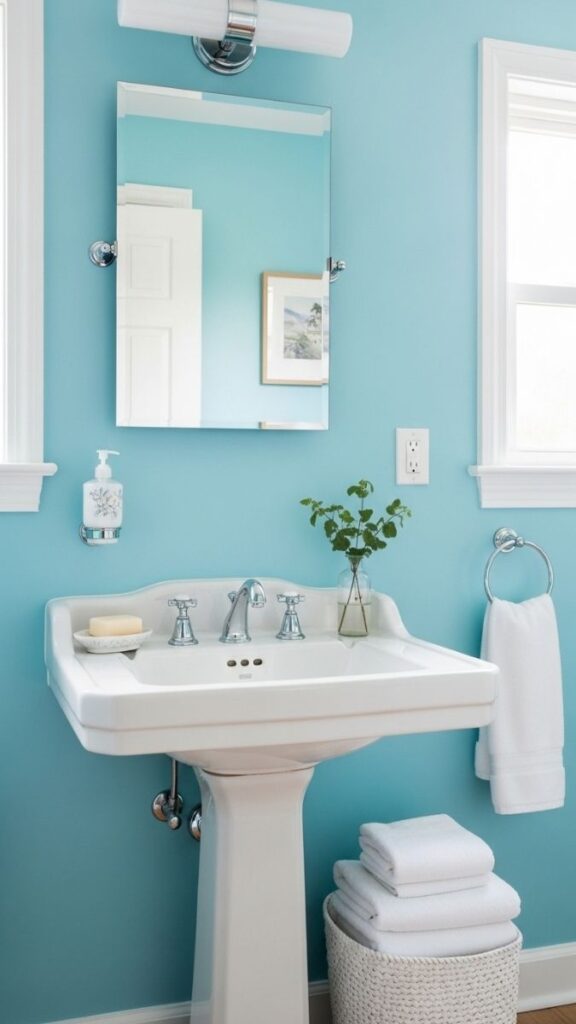
Robin’s egg blue has a spring-fresh quality that works exceptionally well with classic, period-appropriate fixtures. Paired with a vintage-style pedestal sink the kind with a column base rather than a vanity cabinet the combination feels authentic rather than costume-y. The absence of a vanity cabinet also means the floor is fully visible, which makes the room feel larger even in tight square footage
The blue reads warm and cheerful in this context, especially with natural light or warm bulb lighting. This is a strong choice for older homes where you’re restoring rather than renovating. It respects the original architecture while adding intentional color.
Pale Blue Bathroom with Geometric Brass Mirror Grid
A grid of small brass-framed mirrors in place of a single large mirror is a functional and visual play that works especially well in light blue bathrooms. The brass frames warm up the pale blue, the multiple reflection surfaces make a small bathroom feel larger because they’re catching light from multiple angles, and the grid pattern adds architectural structure to an otherwise simple wall.
This works in bathrooms where the vanity light is limited; the additional mirror surfaces amplify whatever light you have. It also works well for shared bathrooms with two sinks, since the grid can span the full width of the wall between both fixtures.
Light Blue Bathroom with Exposed Ceiling Beams and Wood Accents
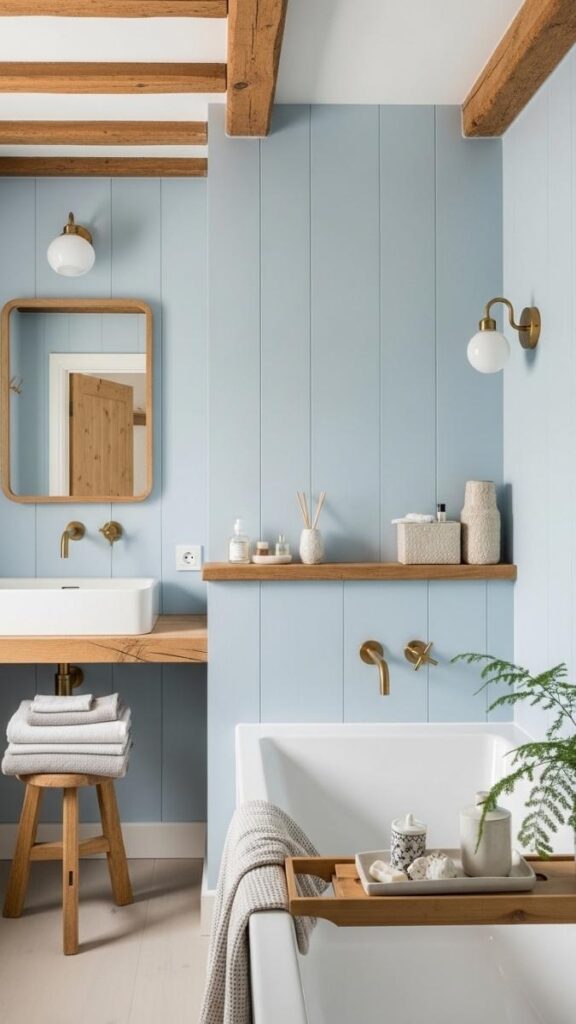
Exposed ceiling beams in a bathroom with light blue walls create an unexpected warmth. The wood overhead grounds the blue in a way that reads like a Nordic or Alpine chalet space. The juxtaposition of the soft painted walls and the structural overhead wood is what makes it interesting.
This is clearly most relevant to homes that actually have existing beams but it’s worth noting that faux-beam kits have become much more convincing in recent years if you want the effect without the construction. The blue walls in this context read warmer than they would in a more minimal setting because the wood introduces so much tactile richness. It’s particularly effective in a primary bathroom where you want to feel like a retreat.
What Actually Makes These Light Blue Bathroom Ideas Work
Color in a bathroom isn’t just about aesthetics, it’s about spatial perception, light behavior, and how you actually experience the room at different times of day. Here’s what ties these ideas together practically.
Light quality changes everything.
Light blue reads completely differently under natural daylight versus incandescent versus cool LED. Natural light pushes it toward fresh and airy; warm bulbs push it toward cozy and calm; cool LEDs can make it feel sterile. Before committing to any blue, test a large swatch under your bathroom’s actual lighting conditions. A 4×4-inch paint sample is not enough to get a 12×12-inch section on the wall.
Undertone matching is what separates a good room from a great one.
Light blue exists on a spectrum from green-adjacent duck egg, aqua to purple-adjacent periwinkle, powder blue to pure neutral blue icy blue, sky blue. Warm-toned materials wood, brass, terracotta pair better with green-adjacent blues. Cool-toned materials marble, chrome, concrete pair better with purple-adjacent or neutral blues. Mixing across that line is where bathrooms start to feel “off” without the homeowner understanding why.
Scale matters more in bathrooms than in any other room.
Because the square footage is small, pattern repeat, tile size, and fixture proportion all have outsized impact. Large-format tile in a small bathroom reads as crowded; small tile creates more visual noise. The sweet spot for most standard bathrooms 40–80 sq ft is medium-scale tile 4×4 to 3×6 subway range or a bold but contained accent niche, backsplash, floor rather than full-room patterning.
Light Blue Bathroom Setup Guide by Space Type and Scenario
| Setup | Best For | Space Type | Problem Solved | Difficulty |
| Blue shiplap + wood vanity | Cottagecore, transitional | Small to medium | Sterile or dated feel | Medium |
| Blue ceiling only | Nervous beginners, renters | Any size | Flat, lifeless walls | Easy |
| Zellige tile backsplash | Budget-conscious renovators | Any size | Builder-grade look | Medium |
| Limewash wall | Older homes, imperfect plaster | Medium to large | Uneven walls, cold feel | Easy–Medium |
| Blue painted vanity | Renters, non-committal | Any size | Bland, uniform look | Easy |
| Full hexagon tile walls | Modern or boutique feel | Small rooms | No windows, dark rooms | Hard |
| Accent niche in shower | New construction, renovations | Any bathroom | Functional + decorative storage | Medium |
| Periwinkle + unlacquered brass | Primary bathrooms, warmth seekers | Medium to large | Too cool or modern | Easy fixture swap |
How to Avoid the Most Common Light Blue Bathroom Mistakes
Choosing the wrong shade for the light.
The single biggest mistake in light blue bathrooms is selecting a color in a store or on screen, then installing it in a bathroom with completely different lighting. Blues are especially vulnerable to this; they shift more dramatically under different light temperatures than almost any other color. Always test in context.
Going too light in a windowless bathroom.
A very pale blue in a bathroom with no natural light and only overhead cool LEDs can read as gray and clinical rather than airy and fresh. In low-light rooms, go one or two shades deeper than your instinct tells you the light will wash out whatever you choose, so you need the pigment to survive that attenuation.
Pairing cool blue with cool metal fixtures exclusively.
An all-cool palette of blue walls, chrome fixtures, white tile can feel like a hospital if there’s no warmth to break it up. Even one warm element: a wood shelf, a rattan basket, a warm bulb makes the difference between clinical and curated.
Underestimating grout color.
In a blue-tiled bathroom, grout is actually part of your color palette. Gray grout softens tile lines and reads as part of the blue family. White grout adds crispness but creates a pattern. Dark grout adds drama. Choosing grout after the tile decision as an afterthought is how bathrooms end up with an internal color conflict nobody can articulate but everyone notices.
Overloading accessories.
A light blue bathroom already has a color presence. It doesn’t need a busy collection of items to feel “decorated.” The most effective blue bathrooms tend to use restraint on the counter: a single plant, one soap dispenser, a folded hand towel. The color is doing the work; let it.
FAQ’s
What shade of light blue works best in a small bathroom?
The best light blue for a small bathroom is a muted, slightly warm-toned shade, think powder blue, pale aqua, or sky blue rather than icy or gray-toned blue. In tight spaces, cool-toned blues can feel compressed; warmer tints expand the room more naturally. Avoid very saturated blues in small bathrooms they tend to close in rather than open up.
Does light blue work in a bathroom with no windows?
Yes, but you need to choose carefully. In a windowless bathroom, go slightly deeper than you think you need. The absence of natural light will wash out pale shades. Warm artificial lighting 2700–3000K bulbs is essential to prevent the blue from reading as gray or cool. A medium sky blue or dusty blue tends to perform better than icy or near-white blue in low-light conditions.
What fixtures pair best with light blue bathroom walls?
Warm metal fixtures unlacquered brass, antique gold, or warm brushed nickel complement light blue well because they introduce warmth that prevents the cool tone from feeling clinical. Matte black works strongly with deeper or more saturated blues. Standard chrome pairs well with icy or silver-toned blues. Avoid polished gold with very pale blues; the contrast can feel jarring.
Is light blue a timeless bathroom color or just a trend?
Light blue has been used in bathrooms since the early 20th century; it’s one of the most historically enduring bathroom colors, not a current trend. What changes is the specific shade and how it’s paired currently trending with natural materials, warm metals, and textured finishes. The core color has real longevity. Safer long-term choices include powder blue, French blue, and dusty blue.
How do I add light blue to my bathroom without painting the walls?
The most practical options are a painted vanity, a blue-toned tile in a shower niche or as a backsplash, blue towels and textiles, a blue-painted floor with appropriate floor paint, or blue patterned wallpaper on a single accent wall. All of these are lower commitment than full wall paint and some are fully renter-friendly.
What colors go well with a light blue bathroom?
Light blue pairs best with: white for crispness, warm wood tones for warmth, cream or warm white softer than stark white, terracotta for contrast and warmth, brass or gold for luxury, and sage green for a nature-forward palette. Avoid pairing light blue with cool purples or heavy grays; the combination tends to feel flat rather than layered.
Can I use light blue in a bathroom alongside patterned tile?
Yes, and this is one of the most effective combinations. The key is keeping the blue in one plane walls or vanity while the pattern lives in another floor or shower niche. Competing patterns and color on the same plane creates visual noise; separating them by surface lets both elements read clearly.
Conclusion
Light blue bathrooms work because they balance two things most bathrooms struggle with: color presence and spatial openness. When the shade and materials are matched well, blue reads as expansive and calm simultaneously, a difficult combination to achieve with other colors. Small adjustments to the tile choice, the grout color, the fixture finish can completely shift how the blue lands in your particular room.
Start with the setup that fits your constraints: your light source, your square footage, your renovation budget. If you’re renting, the painted vanity or ceiling-only approach gives you real impact with zero permanence. If you’re renovating, the tile niche or full-wall tile offers something more structural and lasting. Pick one idea, test it in your actual space, and adjust from there.