51+ Rustic Wall Decor Ideas That Actually Work in Real Homes Not Just Pinterest
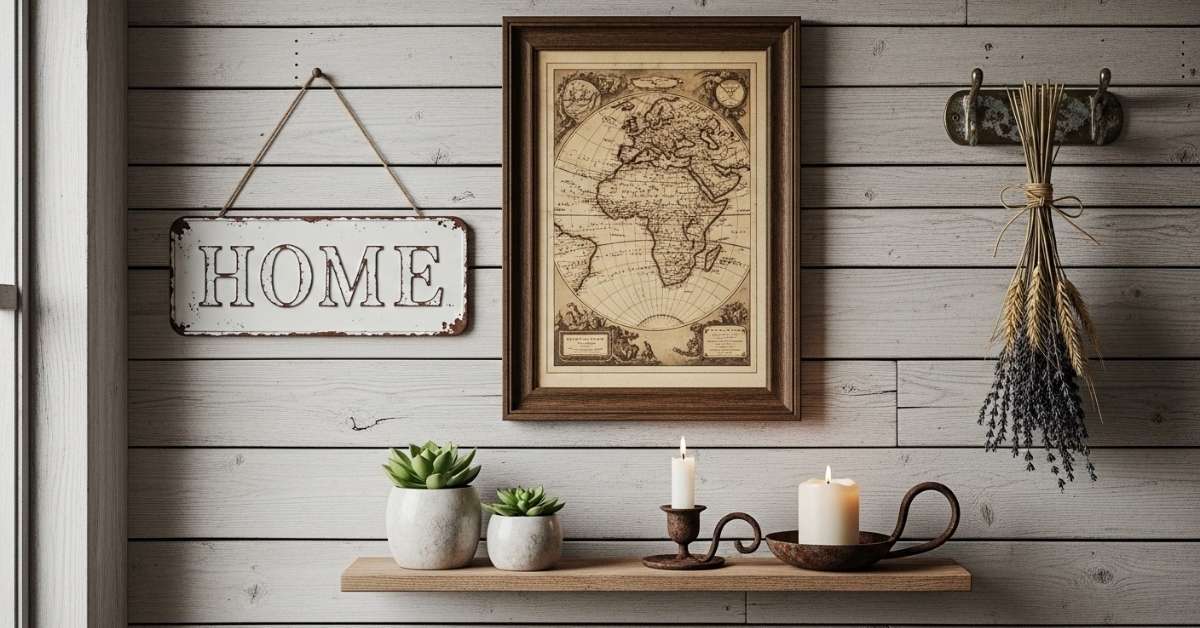
Rustic wall decor has a way of solving that without demanding a full renovation or a massive budget. The textures of raw wood, aged metal, woven fibers add depth that paint alone can’t achieve. And because the aesthetic is inherently relaxed, it’s forgiving nothing needs to be perfectly matched or precisely styled.
If your space leans toward neutral, warm, or natural tones, or if you’re working with a living room or bedroom that needs more personality without feeling cluttered, these ideas are worth bookmarking. A few of them are genuinely rental-friendly too.
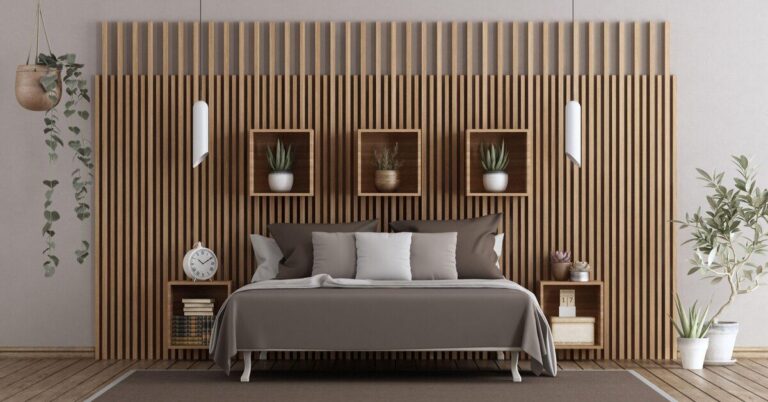
A Reclaimed Wood Plank Gallery Wall That Replaces the Headboard
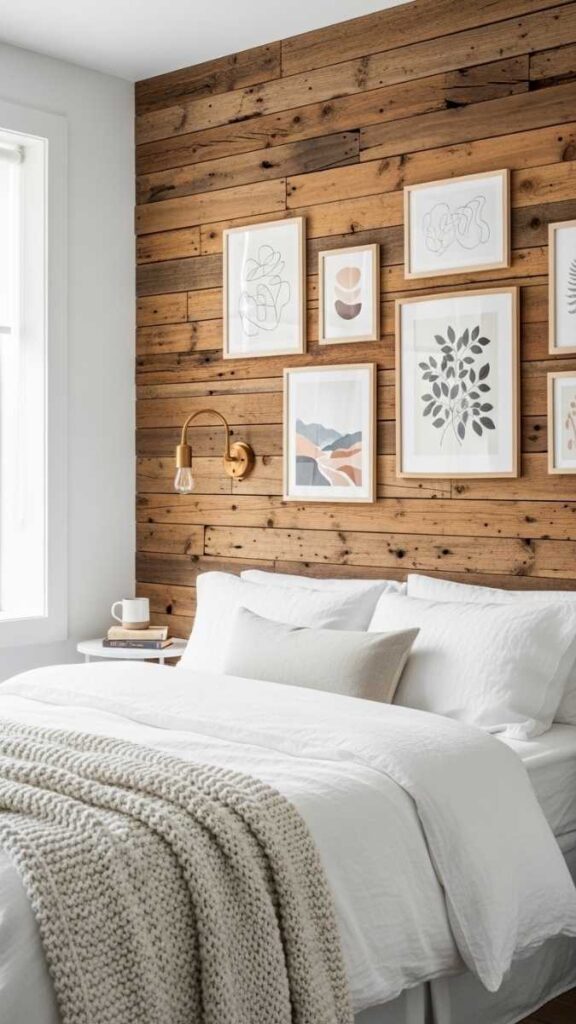
When a headboard feels too bulky or too expensive, a horizontal arrangement of reclaimed wood planks does the visual work instead.
Mount three to five planks of varying widths directly on the wall behind the bed, leaving slight gaps between them so the variation in grain and color reads clearly.
The result is a focal point with real texture, not just visual interest, but something that photographs well and feels tangible in person.
This works especially well in bedrooms where the ceiling height is lower, since horizontal lines widen the perception of the space rather than drawing the eye upward.
It’s also a strong option for renters who want something that feels permanent but can come down cleanly.
An Antler or Branch Arrangement With Woven Baskets
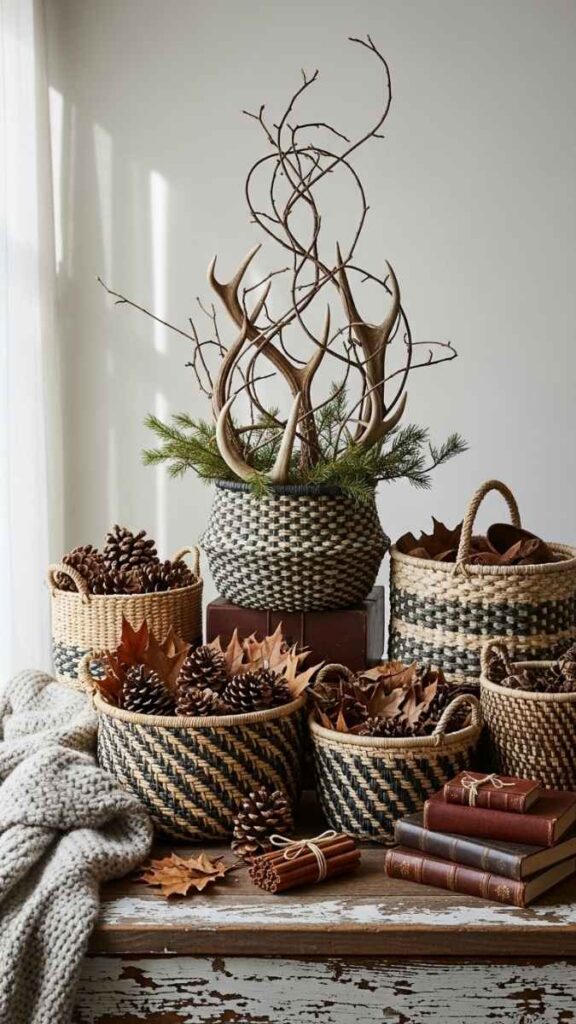
Wall-mounted baskets have become genuinely useful as decor, not just filler. Arrange three to five baskets of different sizes and weave patterns in an irregular cluster, then anchor the group with one or two antler pieces or a curved branch mount.
The key is keeping the overall shape of the arrangement roughly circular or oval, so it reads as intentional rather than scattered.
This setup works well over a console table or sofa because the baskets add dimension without extending far from the wall, which keeps the walking space open. In smaller living rooms, it’s a practical alternative to large framed art since it fills vertical space without overwhelming the proportions.
A Shiplap Accent Wall Behind Open Shelving
Shiplap behind open shelving is one of those combinations that does double duty: the planks create a backdrop that makes the shelving look intentional rather than utilitarian, and the shelves themselves keep the wall from feeling flat.
Paint the shiplap in a soft white or warm greige if you want contrast against natural wood shelves, or leave it raw and sealed if the room already has enough light.
In a dining room or kitchen, this setup adds storage-meets-decor value in a single wall section. The shiplap’s horizontal lines also help anchor the shelves visually; without it, open shelving on a plain wall can feel like it’s floating without context.
A Large Rope Mirror Flanked by Dried Botanicals
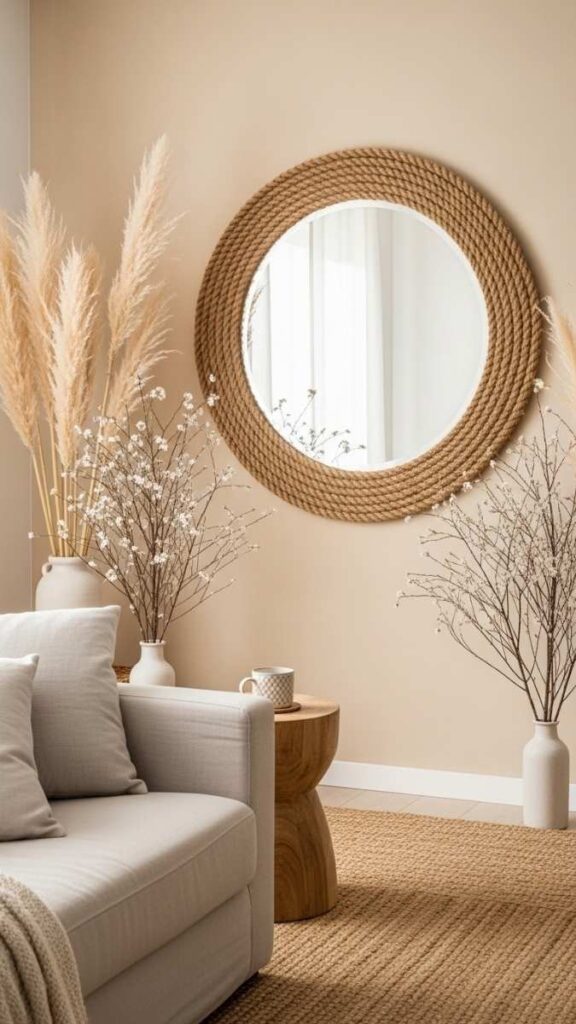
A rope-trimmed mirror in the 24–30 inch range has enough presence to stand alone, but flanking it with two tall dried botanical arrangements of pampas grass, dried eucalyptus, or bleached branches in simple floor vases turns it into a real installation.
The mirror bounces light back into the space, which is especially useful in entry halls or living room corners that don’t get much natural light.
Dried botanicals require zero maintenance and keep their texture for a long time, making this a setup worth the initial effort. This is one I’d actually recommend trying first if you’re not sure where to start with rustic decor; it’s low-commitment and easy to reconfigure if the proportions feel off.
Read More About: 50+ Cabin Decorating Ideas That Make Any Space Feel Warm Cozy and Intentionally Designed
A Horizontal Barnwood Shelf With Iron Pipe Brackets
The combination of raw barnwood and black iron pipe reads as industrial-rustic rather than purely farmhouse, which makes it easier to blend into more modern interiors. Mount the shelf at eye level or slightly above roughly 60 to 65 inches from the floor so the objects on it sit in the natural field of view.
The thickness of the wood matters, anything under an inch and a half tends to look decorative rather than structural, which works against the whole point of the aesthetic. Use the shelf for live plants, ceramic pitchers, or a curated mix of books and objects.
Honestly, even three well-chosen items on a thick barnwood shelf look considered in a way that a standard white shelf rarely does.
A Vintage Window Frame Mounted as Wall Art
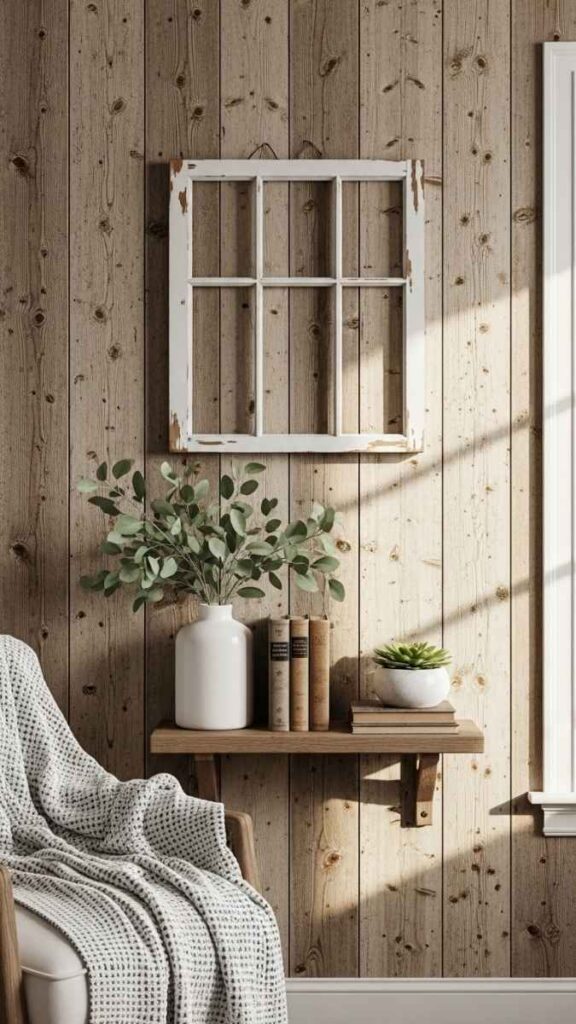
Old window frames of the kind with multiple divided panes work surprisingly well as wall art because they add architectural detail without competing with anything else in the room.
A single large frame (36 inches or wider) mounted at eye level on a plain wall creates the illusion of a pass-through, which tricks the eye into perceiving a bit more depth. If the frame still has its glass, it will also reflect light, which helps in dim spaces.
This works best in rooms where the walls are already a warm neutral; the frame doesn’t need contrast to make an impact, but it disappears on a wall that’s too dark. For renters, it’s worth noting that most vintage window frames are light enough to hang with standard picture hooks.
A Macramé Wall Hanging Over the Sofa
A macramé piece in the 36–48 inch width range fills the space above a sofa the way a large piece of art would, but with significantly more texture.
The key is to scale a piece that’s too small and reads as an accessory rather than an anchor.
Hang it centered above the sofa with the top of the piece starting roughly 8 to 10 inches above the sofa’s back, which creates visual connection without cramping the furniture arrangement. In small living rooms, the negative space within the macramé weave keeps the wall from feeling heavy unlike a solid framed canvas, light passes through it, which maintains a sense of openness. This setup is also fully rental-friendly and easy to take down without damage.
A Grid of Black and White Nature Prints in Thin Wood Frames
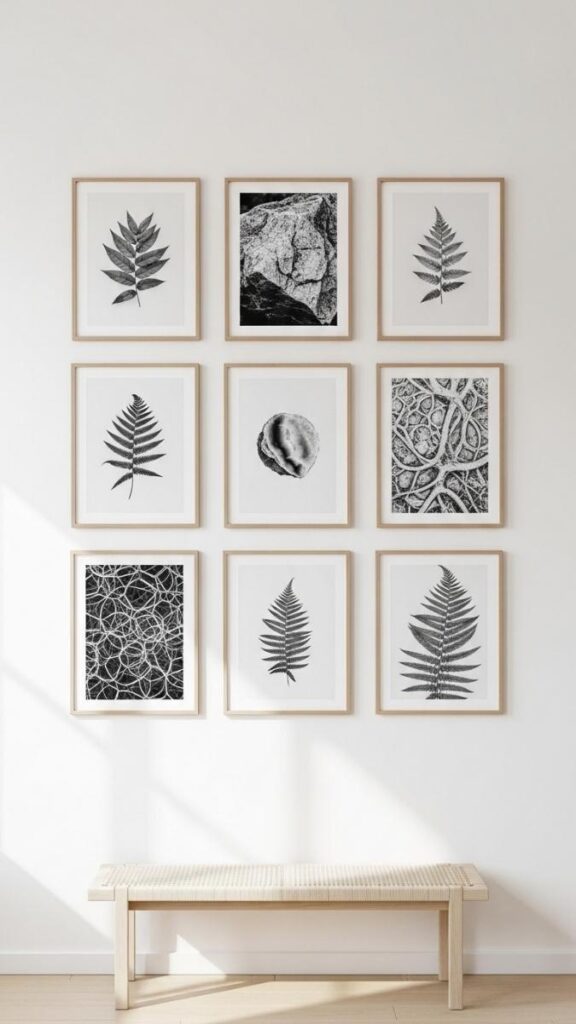
A grid gallery wall works when every element is consistent, same frame style, same mat width, same spacing between frames. Use thin natural wood frames rather than chunky ones; the lightness keeps the arrangement from visually dominating the room.
Black-and-white botanical prints, topographic maps, or simple landscape photography all work well here because they’re visually quiet and let the arrangement itself be the statement.
In a home office or bedroom, this approach brings in the rustic material (the wood frame) without leaning too heavily into any single decor style. The uniform spacing typically 2 to 3 inches between frames is worth measuring carefully; even a half-inch inconsistency makes the whole grid read as off.
Read More About: 49+ Rustic Kitchen Ideas That Make Your Space Feel Warm, Lived In, and Actually Functional
A Woven Textile Wall Hanging as a Bedroom Focal Point
A handwoven textile one with real variation in color and texture rather than a printed pattern changes the acoustic quality of a room slightly in addition to its visual impact.
In a bedroom with hard floors, that added softness matters more than people expect. Mount it using a simple wooden dowel and leather cord rather than a commercial curtain rod; the hardware itself becomes part of the piece.
Go for a textile that’s at least two-thirds the width of the bed so it anchors the sleeping area properly.
In 2026, the trend is moving away from the very shaggy, maximalist hangings of a few years ago toward flatter-woven pieces with more graphic structure, something worth considering if you want the look to feel current rather than dated.
A Mounted Wooden World Map or State Map
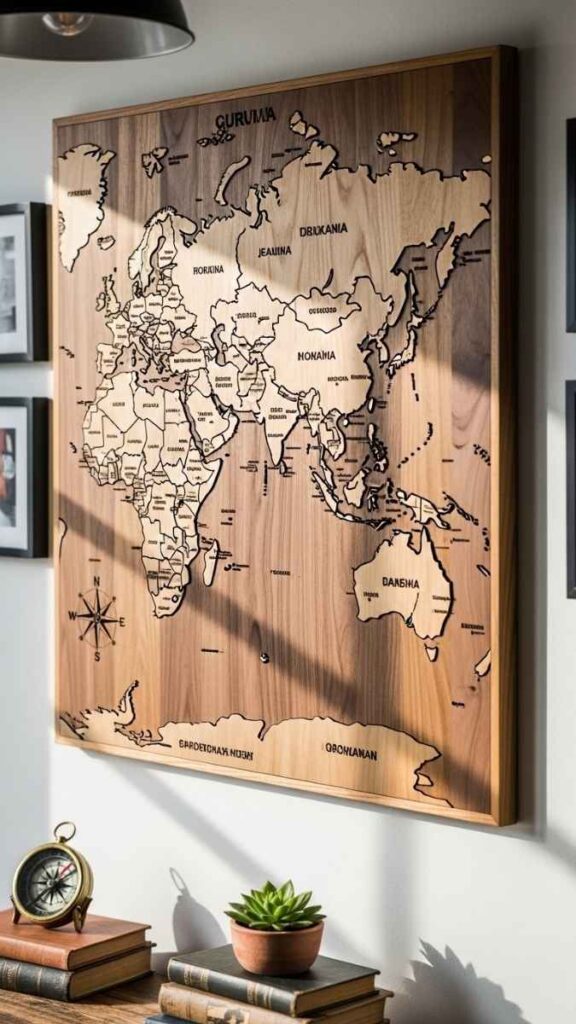
A layered wood map where each country or state is cut from a slightly different wood tone and assembled into a full map is one of the more specific rustic wall pieces available, but it’s effective because it’s genuinely dimensional.
The variation in wood grain and color across different sections creates movement even in a static piece.
These tend to work best in home offices or living rooms where the wall has room to accommodate the scale most are 36 inches wide at minimum. The practical advantage over a framed print is that it reads well from across the room, which means it doesn’t require close inspection to make an impression.
A Raw Edge Wood Slice Display
Wood slices cross-sections of a tree that keep the natural bark edge can be grouped into an arrangement that reads as both sculptural and organic.
Mount three to five of varying diameters in a loose cluster formation rather than a perfect grid; the asymmetry is part of the visual appeal.
These are light enough to hang with standard picture hooks, and the bark edge means no two pieces are identical. In an entryway or narrow hallway, a vertical arrangement of three slices takes up minimal visual space while adding significant texture.
The setup works on dark walls too; the natural wood tones read well against charcoal or navy, which is a less obvious use case that’s worth considering.
An Antique Metal Sign or Repurposed Farm Tool as Wall Art
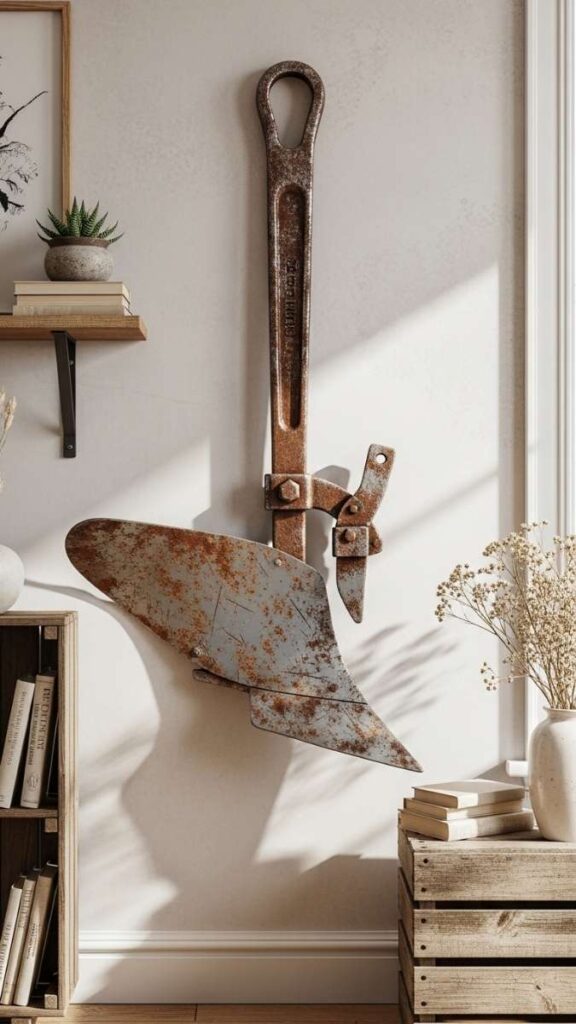
Repurposed metal pieces, old milk can lids, vintage farm signs, worn tin advertising pieces bring history into a room without requiring any styling around them.
A single oversized piece mounted at eye level works better than a cluster of smaller ones, which can read as cluttered. In a kitchen or mudroom, this type of piece fits the utilitarian quality of the space without trying too hard to be decorative.
The aged metal adds warmth in a way that’s different from wood, cooler in tone, harder in texture which provides contrast if the surrounding palette is mostly soft neutrals. Look for pieces with original typography or numbering; that surface detail does a lot of the visual work on its own.
A Floating Shelf With Amber Glass Bottle Collection
A collection of vintage or vintage-style glass bottles, amber, green, or clear grouped on a narrow floating shelf creates a display that reads as curated without requiring any framing or hardware.
The variation in bottle height naturally creates visual rhythm, and the translucency of the glass interacts with light in a way that solid objects don’t. Position the shelf where natural light can reach it, or add a small picture light above it to get the same effect artificially.
This works well in kitchens and dining rooms where the display is at eye level when standing. It’s also low-cost to build out gradually; you can start with a few bottles and add to the collection over time.
A Carved or Printed Mandala Wood Panel
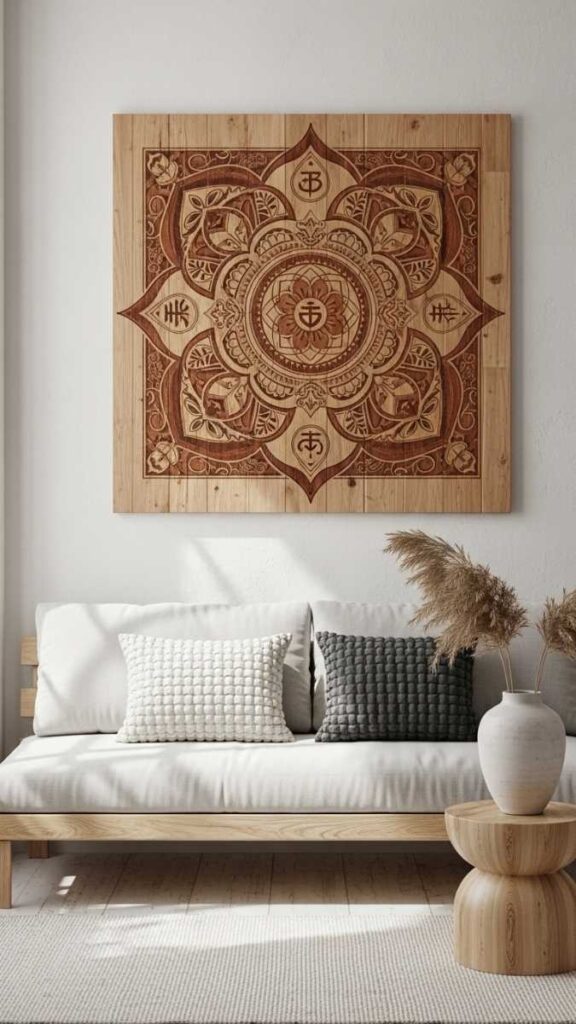
A laser-cut or hand-carved mandala panel in natural wood adds architectural detail that reads as artisanal rather than mass-produced.
The circular form works well as a standalone piece in the center of a wall, particularly above a low piece of furniture like a console or bench.
The cut-through sections of the design cast shadows on the wall behind it when lit from the side, which adds a layer of visual interest that changes depending on the time of day and the light source.
In a bedroom or meditation space, this type of piece contributes to a calm, grounded atmosphere. Go for raw or lightly oiled wood over a stained finish. The natural grain reads better than a uniform dark tone from a distance.
Read More About: 48+ Rustic Bedroom Ideas That Make Any Space Feel Warm, Grounded, and Effortlessly Lived In
A Pegboard With Leather Hooks and Hanging Plants
A pegboard wall system stops being purely utilitarian the moment you swap the metal hooks for leather ones and add a plant or two.
Mount it on a wall where it can handle some functional load coats and bags in a mudroom, tools and supplies in a home office and the visual payoff is a wall that’s organized without looking corporate.
Use a pegboard that’s at least 24 inches wide; anything smaller and the proportions feel decorative rather than purposeful. The leather hooks bring in the rustic element, and trailing plants like pothos or string of pearls add life without requiring much from the surrounding layout.
In my experience, this works best when the pegboard is painted the same color as the wall; it disappears into the background and the objects on it take visual priority.
A Set of Vintage Framed Botanical or Bird lustrations
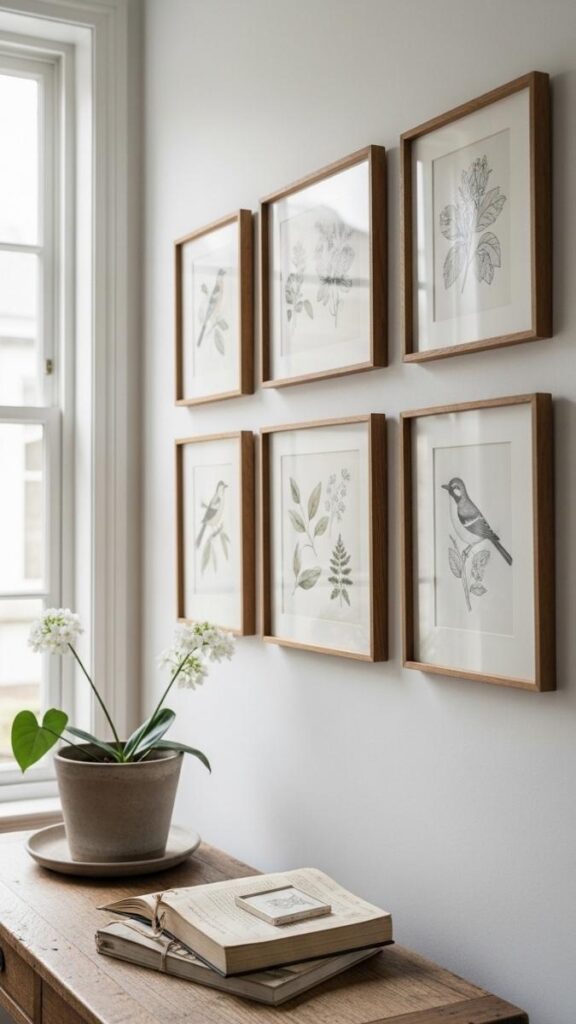
Antique-style botanical or ornithological prints of the kind with detailed illustrations and aged paper tones add a layer of quiet elegance that’s distinct from more casual rustic pieces.
Arrange them in a vertical column on a narrow wall section or beside a doorway where a horizontal arrangement wouldn’t fit.
The illustration style works particularly well with dark accent walls in forest green, deep rust, or warm taupe; the aged paper tones create contrast without clashing. These prints are widely available as reproductions, so the cost is manageable, but the visual effect reads as collected-over-time rather than purchased-all-at-once, which is hard to fake with most other decor choices.
A Live Edge Wood Shelf as a Dedicated Plant Wall
A live edge shelf where the natural curve of the tree’s outer edge is preserved functions as both storage and sculpture. Mount it at roughly 5 feet from the floor on a wall that gets indirect natural light, then line it with a mix of trailing and upright plants in unmatched terracotta pots.
The visual combination of the irregular wood edge, the varying plant forms, and the warm terracotta against a white or neutral wall creates significant depth. This setup works well in living rooms and kitchens because the plants bring life into the space while the wood anchors them materially.
It’s especially useful in apartments where bringing in large furniture-scale plants isn’t practical. The shelf takes the plants to eye level, which has more visual impact than pots grouped on the floor.
A Salvaged Barn Door Panel as Vertical Wall Art
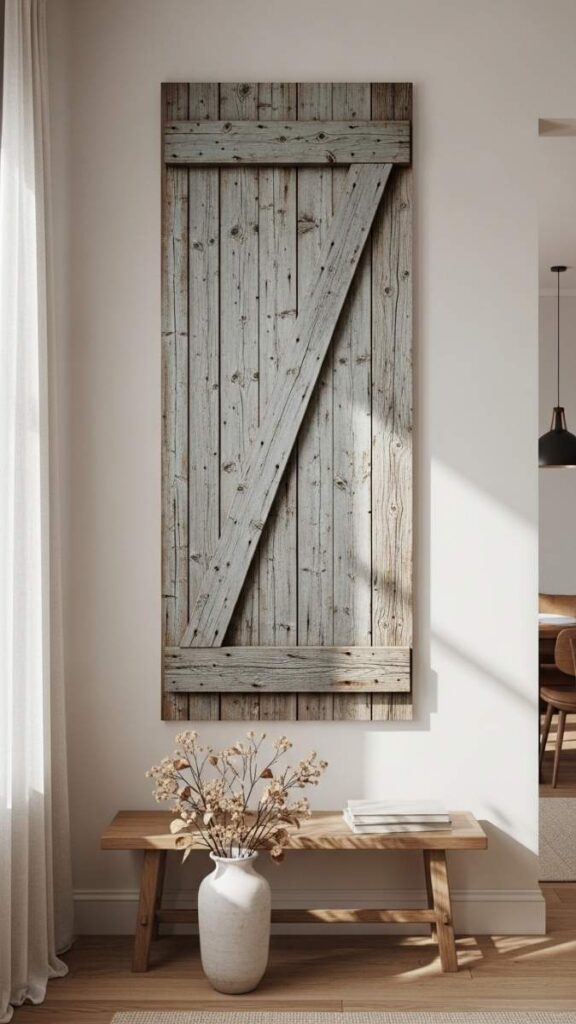
A single salvaged barn door panel, mounted flat and vertical on the wall rather than used as a functional sliding door, becomes a large-scale textural art piece.
The aged wood, faded hardware, and worn finish carry enough visual interest on their own without any additional styling around them. This works best on a wall that needs a statement piece rather than a gallery arrangement; the panel is already complex enough that adding objects around it competes with its texture.
At 32 to 36 inches wide, a standard door panel fills a medium wall section comfortably. The hardware (hinges, handles) can be left on or removed depending on how much industrial detail you want to keep in the composition.
A Rope or Jute Wrapped Wall Letter or Number
Rope or jute-wrapped letters in large format 18 inches or taller add texture in a way that’s more dimensional than a flat print or painted letter would be.
They work well in children’s rooms, entryways, or bedroom walls as a single focal object rather than part of a cluster. The winding pattern of the rope catches light differently at different angles, which gives the piece subtle movement without any actual motion.
In a nursery or kids’ room, the natural material is visually calming compared to brightly colored plastic alternatives. For adults, a single initial or a house number makes for a clean, personalized piece that doesn’t read as juvenile. Pair it with a simple wood shelf below it and the combination gains context.
A Wall Mounted Lantern Cluster for Ambient Lighting
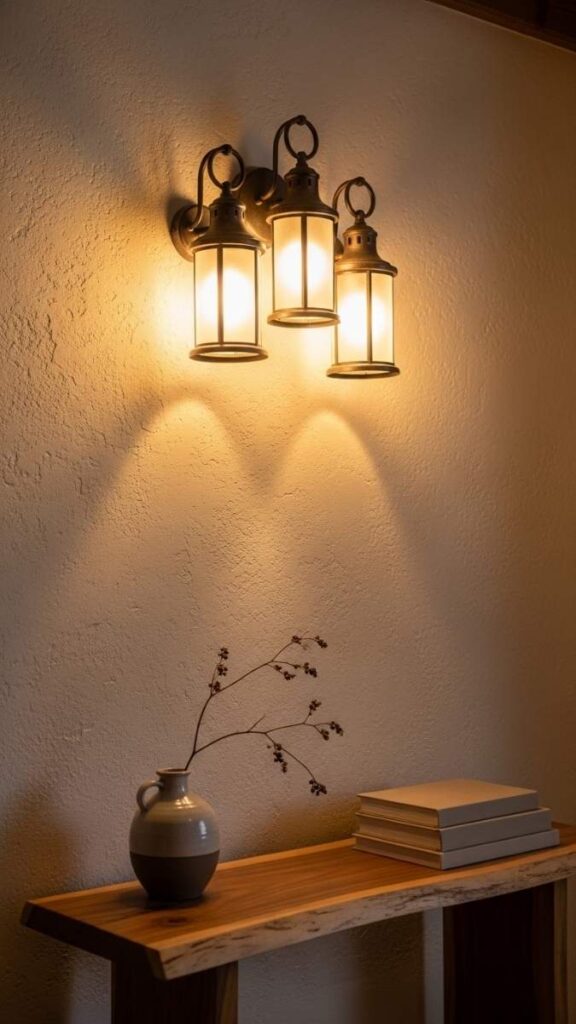
Three or four wall-mounted lanterns arranged in a loose vertical or diagonal cluster function as both decor and practical lighting. Use black or oil-rubbed bronze metal for the frame and fill them with Edison-style bulbs or battery-operated candle inserts.
The warm glow they produce at night changes the entire atmosphere of the room far more so than overhead lighting would.
In a dining room adjacent to an outdoor space, this type of cluster bridges the indoor-outdoor aesthetic in a way that feels intentional. I’ve noticed this style tends to work best when the lanterns vary slightly in size rather than being identical; the variation makes the grouping look gathered rather than installed.
A Chalkboard Panel in a Rustic Wood Frame
A chalkboard panel framed in reclaimed wood serves a dual function: it’s visually textural thanks to the wood frame, and it’s actively useful as a writable surface. In a kitchen, it functions as a weekly menu board or grocery list. In a home office, it becomes a visual planning tool.
The key is the frame: a thick, rough-hewn border in natural wood elevates the chalkboard from classroom prop to intentional decor piece. Size matters here too a 24×36 inch panel reads as a design feature; anything smaller reads as an afterthought.
Leave part of the board blank rather than filling it completely; negative space is part of the visual balance.
A Pressed Wildflower or Herb Frame Series
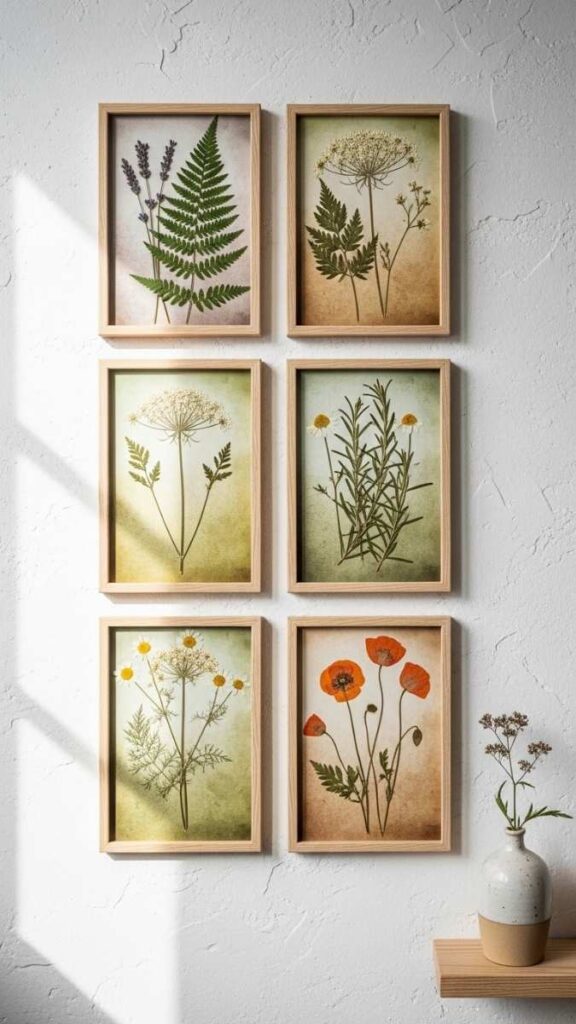
Pressed botanicals, wildflowers, ferns, herbs mounted under glass in simple wood frames bring in the organic quality of rustic decor with a delicacy that heavier wood or metal pieces don’t have.
Arrange them in a tight horizontal row above a kitchen shelf or along a dining room wall at eye level.
The natural color variation in dried botanicals, dusty greens, pale yellows, washed pinks works well against both white and warm-toned walls. This is a genuinely low-cost setup; the frames are inexpensive, and the botanicals can be collected rather than purchased.
For renters or anyone frequently rearranging, the light weight makes swapping the pieces out entirely practical.
A Woven Rattan Headboard Wall Installation
A large rattan or cane-woven panel 48 inches or wider mounted on the wall behind the bed functions as a headboard without the bulk or cost of traditional upholstered versions. The woven surface adds texture that photographs well and feels warm in person, and the natural material complements both light and dark bedding tones.
Because it’s mounted on the wall rather than attached to the bed frame, it’s also easier to reposition if the room layout changes.
This approach works particularly well in smaller bedrooms where a traditional headboard creates a visual obstacle: the rattan panel stays flat against the wall and doesn’t interrupt the floor space.
An Arrowhead or Native American Pottery Print Collection
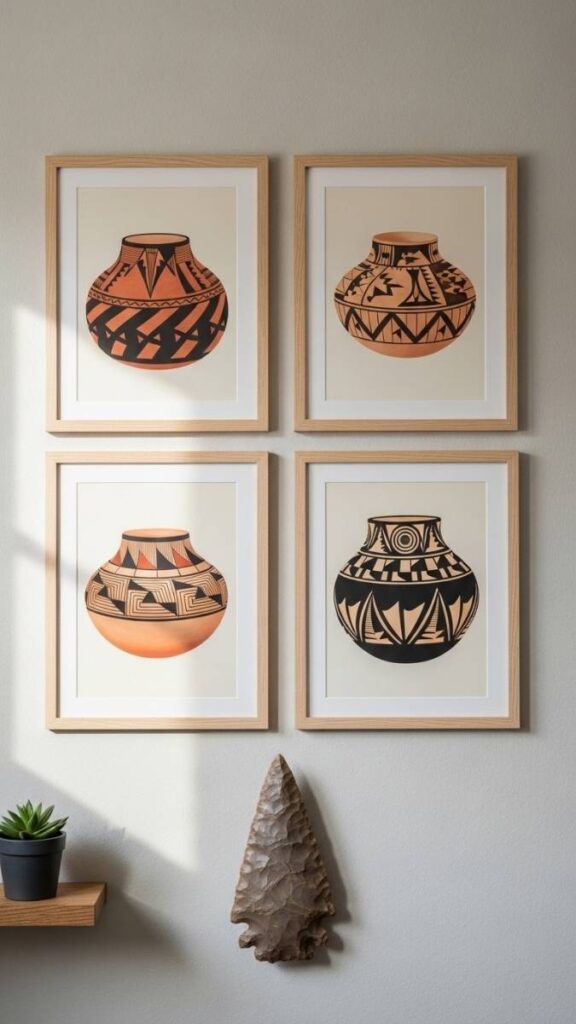
A thoughtfully assembled collection of geometric prints inspired by Native American pottery and textile motifs combined with one or two small ceramic or terracotta pieces mounted on small wall shelves creates a wall arrangement with cultural depth.
The earthy palette of these patterns (rust, cream, ochre, black) slots naturally into rustic-toned interiors. A mix of framed flat prints and dimensional mounted objects keeps the arrangement from feeling like wallpaper.
In a study or living room, this type of wall builds a sense of intentional collecting over time, which is one of the harder things to achieve in spaces that are otherwise furnished all at once.
A Wood Slice Clock as Both Art and Function
A wood slice clock especially one where the face is left as natural wood grain with minimal numbering doubles as wall art without trying to be. The bark edge and organic shape of the slice mean no two are identical.
Mount it on a plain wall without surrounding objects; the scale (most run 18 to 24 inches across) and the natural patterning of the grain do enough work on their own. This is a strong option for walls adjacent to a kitchen or dining area where functional wall pieces make practical sense.
The time-telling function is secondary to the visual impact, but it justifies the piece to anyone who might question a “decorative clock.”
A Hanging Driftwood and Stone Mobile Installation
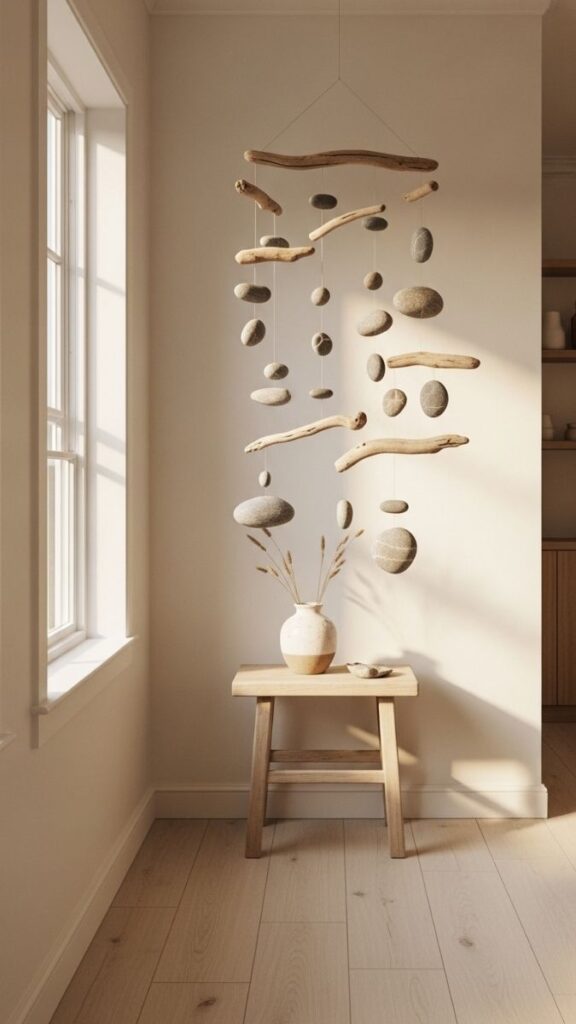
A wall-adjacent mobile made from a long piece of smooth driftwood with river stones or small natural pendants tied at varying lengths on natural twine creates movement without taking up floor space. Hang it from a simple hook or beam bracket near the wall rather than in the center of the ceiling.
The wall proximity gives it context and keeps it from feeling like a standalone art installation in the middle of the room. In an entryway or bedroom, the subtle movement when a door opens or air shifts adds life to a space without any powered fixture.
This is one of the few rustic decor options that works well in very minimal or even Japanese-inspired interior styles because it relies on shape and natural material rather than warmth or mass.
A Leather-Strap and Wood Hanging Plant System
A hanging plant system built from thick leather straps and wooden dowels, essentially a ladder-style plant display mounted against the wall, creates a vertical green installation that’s more architectural than a single hanging planter.
The leather develops patina over time, and the natural wood dowels tie it to the rustic palette. Space three to five dowels at varying intervals so trailing plants from upper pots can cascade without blocking the ones below.
This works well in rooms that lack natural shelving space since it takes advantage of vertical wall area instead. The materials are also durable enough that this isn’t a temporary setup; it’s something worth investing a small amount of care into initially.
What Actually Makes Rustic Wall Decor Work in Real Homes
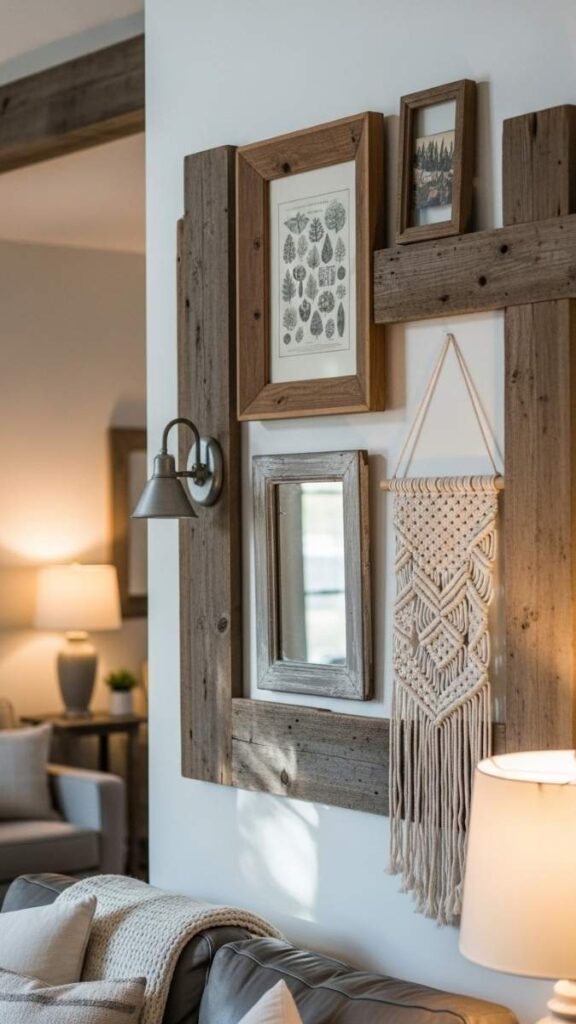
There’s a gap between rustic wall decor that feels layered and considered versus the kind that just looks like a collection of farmhouse-adjacent objects thrown at a wall. The difference usually comes down to three things: material contrast, scale, and restraint.
Material contrast is about pairing textures that push against each other without clashing. Raw wood next to smooth ceramic. Aged metal beside linen. Rope against glass. When all the textures in a room read as similarly rough or similarly smooth, the eye has nowhere interesting to land. One material contrast per wall section is usually enough.
Scale is where most setups go wrong pieces that are too small for the wall they’re on. A 12-inch basket on a 10-foot wall reads as an afterthought. A rule of thumb the main piece or arrangement on any given wall should cover at least one-third of that wall’s width. For a sofa wall that’s 10 feet wide, that means your main arrangement needs to be at least 40 inches across.
Restraint is about knowing when to stop. Rustic decor tends toward layering and layering is good but there’s a threshold beyond which a wall stops feeling curated and starts feeling overwhelmed. In most rooms, one or two walls should carry the bulk of the decor, and the remaining walls should contribute very little. That contrast between a detailed feature wall and a quieter adjacent wall is what makes the decorated wall feel intentional.
Rustic Wall Decor Setup Comparison Guide
| Setup | Best For | Space Type | Problem It Solves | Difficulty |
| Reclaimed wood plank wall | Bedrooms | Small to medium | Bare wall, no headboard | Moderate |
| Basket + antler cluster | Living rooms | Small to large | Unfinished wall above sofa | Easy |
| Shiplap + open shelving | Dining, living room | Medium to large | Needs storage + character | Moderate |
| Rope mirror + botanicals | Entryway, living room | Any | Poor lighting, empty focal wall | Easy |
| Barnwood shelf + iron brackets | Kitchen, living room | Any | No storage, plain wall | Easy |
| Vintage window frame | Living room, bedroom | Small to medium | Wall depth, spatial illusion | Easy |
| Macramé hanging | Living room, bedroom | Small to medium | Sofa wall lacks anchor | Easy |
| Pegboard + leather hooks | Office, mudroom | Small to medium | Clutter, no organization | Moderate |
| Live edge plant shelf | Kitchen, living room | Any | Dead wall space, no greenery | Easy–Moderate |
| Salvaged barn door panel | Hallway, living room | Medium to large | Needs statement piece | Easy |
Common Rustic Wall Decor Mistakes That Make Spaces Feel Off
Hanging everything at the same height.
A gallery wall where every piece is centered at exactly the same level reads as flat and corporate rather than layered and organic. Vary the center heights of pieces by at least 4 to 6 inches across the arrangement to create visual movement.
Choosing pieces that are too small for the wall.
This is the most common issue, and it’s one that’s hard to unsee once you notice it. A piece that’s the right scale for a side table or shelf will look lost on an 8-foot wall. Always measure your wall section before purchasing.
Mixing too many different material types.
Rustic decor is broad; it encompasses wood, metal, fiber, stone, ceramic, and more. Using all of them in the same room (or worse, on the same wall) creates visual noise rather than richness. Limit the number of materials per arrangement to two or three.
Ignoring the furniture below the wall.
Wall decor doesn’t exist in isolation; it relates to whatever is beneath it. A wall arrangement that’s beautifully composed but has nothing anchoring it to the room below (no shelf, no console, no furniture piece) can feel disconnected. Even a simple narrow table or bench beneath a gallery arrangement grounds it.
Treating all walls equally.
In rooms where every wall has something on it, none of them stand out. Choose one or two feature walls and let the others stay relatively bare. The restraint on the quiet walls makes the decorated ones feel more deliberate.
FAQ’s
What is rustic wall decor?
Rustic wall decor refers to wall-mounted pieces made from or styled around natural, raw, or reclaimed materials wood, metal, fiber, stone, or aged finishes. It prioritizes texture and organic form over polish or precision. Common elements include reclaimed wood shelves, woven baskets, vintage metal signs, botanical prints, and natural fiber hangings.
How do I make rustic wall decor work in a modern home?
The key is mixing the rustic material (raw wood, aged metal, natural fiber) with cleaner, more minimal surroundings. Keep the furniture lines simple and the color palette neutral. One or two rustic wall pieces in an otherwise contemporary room tend to feel curated; too many pieces shift the room toward a full farmhouse aesthetic, which may not be the goal.
What size should wall decor be relative to the wall?
As a general guide, the main piece or arrangement on a wall should span at least one-third to one-half of that wall’s width. Above a sofa, aim for art or arrangements that are roughly two-thirds the width of the sofa itself. Anything smaller tends to look out of proportion.
Can rustic wall decor work in small rooms or apartments?
Yes and in some ways it works better in smaller spaces because the texture adds depth that paint alone can’t. Stick to one or two substantial pieces rather than multiple small ones, and opt for flat-profile pieces (woven baskets, framed prints, thin wood panels) rather than bulky three-dimensional objects that project far from the wall.
Is rustic wall decor renter-friendly?
Most of it is. Baskets, macramé hangings, lightweight wood frames, rope mirrors, and textile wall hangings all hang on standard picture hooks with minimal wall impact. Heavier pieces like barnwood shelves or shiplap panels require more hardware, but command strips and removable mounting systems have improved significantly and can handle moderate weight.
Rustic vs. farmhouse wall decor what’s the difference?
Farmhouse decor is a specific subset of rustic that leans heavily on white shiplap, vintage signage, distressed finishes, and a warm, domestic aesthetic. Rustic decor is broader; it includes more global influences (Japanese wabi-sabi, Scandinavian naturalism, Southwestern textile patterns) and doesn’t necessarily involve white-painted everything. A farmhouse is rustic, but not all rustic is a farmhouse.
How do I avoid rustic wall decor looking overdone?
Limit the number of feature walls in any given room to one or two. Within those walls, choose a clear material palette (no more than two or three texture types) and make sure at least one piece is scaled generously to the wall.
Leaving some wall space completely empty is just as important as what you put up; the contrast is what makes the decorated sections read as intentional.
Conclusion
Rustic wall decor isn’t about achieving a specific look, it’s about making your walls feel like they belong to the room rather than just existing behind it.
The right combination of natural textures, intentional scale, and material contrast can shift a space from feeling unfinished to feeling genuinely lived-in.
And the good news is that even a single well-chosen piece, a thick barnwood shelf, a large rope mirror, a woven textile above the bed can do more for a room than an entire gallery wall of undersized prints.
Not every idea here will suit your space, your budget, or your existing furniture and that’s fine. The key is finding one or two setups that solve a real problem in your room, whether that’s a bare sofa wall, a dim entryway, or a bedroom that lacks a focal point. Start there, get the scale right, and build from it slowly. Rustic decor rewards patience more than most styles do.